
一种基于细胞的多重检测方法,用于鉴定作为抗登革病毒靶点的膜前加工调节剂。
A Multiplexed Cell-Based Assay for the Identification of Modulators of Pre-Membrane Processing as a Target against Dengue Virus.
作者信息
Stolp Zachary D, Smurthwaite Cameron A, Reed Connor, Williams Wesley, Dharmawan Andre, Djaballah Hakim, Wolkowicz Roland
机构信息
Department of Biology, San Diego State University, San Diego, CA, USA.
Institut Pasteur Korea, Seoul, South Korea.
出版信息
J Biomol Screen. 2015 Jun;20(5):616-26. doi: 10.1177/1087057115571247. Epub 2015 Feb 27.
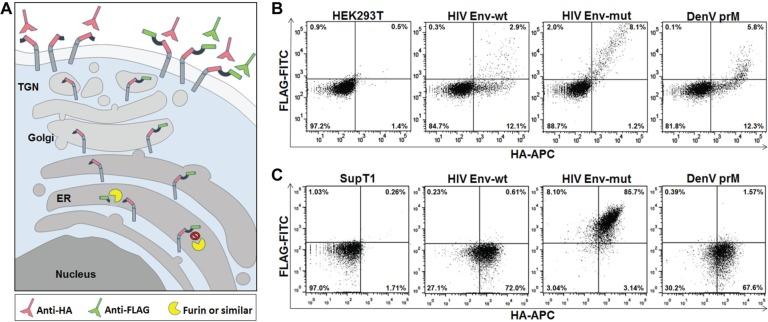
The DenV pre-membrane protein (prM) is a crucial chaperone for the viral envelope protein, preventing premature fusion with vesicles during viral export. prM molecules in immature particles are cleaved by host proteases, leading to mature fusogenic virions. Blockade of prM cleavage would restrict fusion and represents a novel druggable opportunity against DenV. We have thus established a cell-based platform to monitor prM processing that relies on an engineered two-tag scaffold that travels to the cell surface through the secretory pathway. The assay discriminates between a single cell-surface tag when prM is cleaved and two tags when it is not, as detected through fluorescent-coupled antibodies by flow cytometry. The assay, miniaturized into a 96-well plate format, was multiplexed with the HIV-1 envelope boundary, also cleaved in the same pathway. A pilot screen against 1280 compounds was executed, leading to the identification of a potential active and corroborating the robustness of our assay for large-scale screening. We describe for the first time a cell-based assay that monitors DenV prM processing within the classical secretory pathway, which was exploited to identify a potential novel drug against DenV.
登革病毒(DenV)的前膜蛋白(prM)是病毒包膜蛋白的关键伴侣蛋白,可防止病毒输出过程中与囊泡过早融合。未成熟颗粒中的prM分子被宿主蛋白酶切割,从而产生成熟的具有融合能力的病毒粒子。阻断prM的切割会限制融合,这为抗登革病毒提供了一个新的可成药靶点。因此,我们建立了一个基于细胞的平台来监测prM的加工过程,该平台依赖于一种经过工程改造的双标签支架,该支架通过分泌途径转运到细胞表面。该检测方法通过流式细胞术检测荧光偶联抗体,区分prM被切割时的单个细胞表面标签和未被切割时的两个标签。该检测方法被小型化到96孔板形式,并与HIV-1包膜边界进行多重检测,HIV-1包膜边界也在相同途径中被切割。对1280种化合物进行了初步筛选,从而鉴定出一种潜在的活性化合物,并证实了我们的检测方法用于大规模筛选的稳健性。我们首次描述了一种基于细胞的检测方法,该方法可监测经典分泌途径中的登革病毒prM加工过程,并利用该方法鉴定出一种潜在的抗登革病毒新药。



 Zotero 插件