
微小RNA-186和326可预测胰腺导管腺癌的预后,并影响癌细胞的增殖和迁移。
miR-186 and 326 predict the prognosis of pancreatic ductal adenocarcinoma and affect the proliferation and migration of cancer cells.
作者信息
Zhang Zheng-liang, Bai Zheng-hai, Wang Xiao-bo, Bai Ling, Miao Fei, Pei Hong-hong
机构信息
Emergency Department, The Second Affiliated Hospital of Xi'an Jiaotong University, 710004, Xi'an, Shaan Xi, Peoples' Republic of China.
出版信息
PLoS One. 2015 Mar 5;10(3):e0118814. doi: 10.1371/journal.pone.0118814. eCollection 2015.
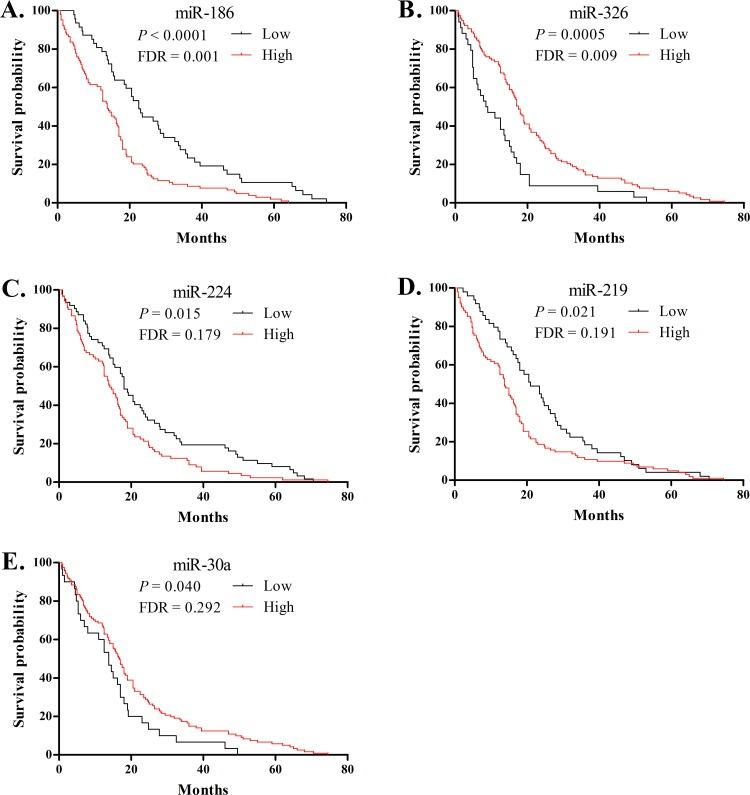
MicroRNAs can function as key tumor suppressors or oncogenes and act as biomarkers for cancer diagnosis or prognosis. Although high-throughput assays have revealed many miRNA biomarkers for pancreatic ductal adenocarcinoma (PDAC), only a few have been validated in independent populations or investigated for functional significance in PDAC pathogenesis. In this study, we correlated the expression of 36 potentially prognostic miRNAs within PDAC tissue with clinico-pathological features and survival in 151 Chinese patients. We then analyzed the functional roles and target genes of two miRNAs in PDAC development. We found that high expression of miR-186 and miR-326 predict poor and improved survival, respectively. miR-186 was over-expressed in PDAC patients compared with controls, especially in patients with large tumors (>2 cm), lymph node metastasis, or short-term survival (< 24 months). In contrast, miR-326 was down-regulated in patients compared with controls and displayed relatively increased expression in the patients with long-term survival or without venous invasion. Functional experiments revealed that PDAC cell proliferation and migration was decreased following inhibition and enhanced following over-expression of miR-186. In contrast, it was enhanced following inhibition and decreased after over-expression of miR-326. A luciferase assay indicated that miR-186 can bind directly to the 3'-UTR of NR5A2 to repress gene expression. These findings suggest that miR-186 over-expression contributes to the invasive potential of PDAC, likely via suppression of NR5A2, thereby leading to a poor prognosis; high miR-326 expression prolongs survival likely via the decreasing invasive potential of PDAC cells. These two miRNAs can be used as markers for clinical diagnosis and prognosis, and they represent therapeutic targets for PDAC.
微小RNA可作为关键的肿瘤抑制因子或癌基因,并充当癌症诊断或预后的生物标志物。尽管高通量检测已揭示了许多胰腺导管腺癌(PDAC)的微小RNA生物标志物,但只有少数在独立人群中得到验证,或在PDAC发病机制中进行了功能意义研究。在本研究中,我们将151例中国患者的PDAC组织中36种潜在预后微小RNA的表达与临床病理特征及生存情况进行了关联分析。然后,我们分析了两种微小RNA在PDAC发生发展中的功能作用及靶基因。我们发现,miR-186高表达分别预示着较差的生存情况,而miR-326高表达则预示着较好的生存情况。与对照组相比,miR-186在PDAC患者中过度表达,尤其是在肿瘤较大(>2 cm)、有淋巴结转移或短期生存(<24个月)的患者中。相反,与对照组相比,miR-326在患者中表达下调,在长期生存或无静脉侵犯的患者中表达相对增加。功能实验表明,抑制miR-186后PDAC细胞增殖和迁移减少,而过表达miR-186后则增强。相反,抑制miR-326后其增殖和迁移增强,过表达后则减少。荧光素酶报告基因检测表明,miR-186可直接与NR5A2的3'-UTR结合以抑制基因表达。这些发现表明,miR-186过表达可能通过抑制NR5A2促进PDAC的侵袭潜能,从而导致预后不良;高miR-326表达可能通过降低PDAC细胞的侵袭潜能延长生存期。这两种微小RNA可作为临床诊断和预后的标志物,并且它们代表了PDAC的治疗靶点。



 Zotero 插件