Lei Jieping, Rudolph Anja, Moysich Kirsten B, Rafiq Sajjad, Behrens Sabine, Goode Ellen L, Pharoah Paul P D, Seibold Petra, Fasching Peter A, Andrulis Irene L, Kristensen Vessela N, Couch Fergus J, Hamann Ute, Hooning Maartje J, Nevanlinna Heli, Eilber Ursula, Bolla Manjeet K, Dennis Joe, Wang Qin, Lindblom Annika, Mannermaa Arto, Lambrechts Diether, García-Closas Montserrat, Hall Per, Chenevix-Trench Georgia, Shah Mitul, Luben Robert, Haeberle Lothar, Ekici Arif B, Beckmann Matthias W, Knight Julia A, Glendon Gord, Tchatchou Sandrine, Alnæs Grethe I Grenaker, Borresen-Dale Anne-Lise, Nord Silje, Olson Janet E, Hallberg Emily, Vachon Celine, Torres Diana, Ulmer Hans-Ulrich, Rüdiger Thomas, Jager Agnes, van Deurzen Carolien H M, Tilanus-Linthorst Madeleine M A, Muranen Taru A, Aittomäki Kristiina, Blomqvist Carl, Margolin Sara, Kosma Veli-Matti, Hartikainen Jaana M, Kataja Vesa, Hatse Sigrid, Wildiers Hans, Smeets Ann, Figueroa Jonine, Chanock Stephen J, Lissowska Jolanta, Li Jingmei, Humphreys Keith, Phillips Kelly-Anne, Linn Sabine, Cornelissen Sten, van den Broek Sandra Alexandra J, Kang Daehee, Choi Ji-Yeob, Park Sue K, Yoo Keun-Young, Hsiung Chia-Ni, Wu Pei-Ei, Hou Ming-Feng, Shen Chen-Yang, Teo Soo Hwang, Taib Nur Aishah Mohd, Yip Cheng Har, Ho Gwo Fuang, Matsuo Keitaro, Ito Hidemi, Iwata Hiroji, Tajima Kazuo, Dunning Alison M, Benitez Javier, Czene Kamila, Sucheston Lara E, Maishman Tom, Tapper William J, Eccles Diana, Easton Douglas F, Schmidt Marjanka K, Chang-Claude Jenny
Breast Cancer Res. 2015 Feb 10;17(1):18. doi: 10.1186/s13058-015-0522-2.
Tumor lymphocyte infiltration is associated with clinical response to chemotherapy in estrogen receptor (ER) negative breast cancer. To identify variants in immunosuppressive pathway genes associated with prognosis after adjuvant chemotherapy for ER-negative patients, we studied stage I-III invasive breast cancer patients of European ancestry, including 9,334 ER-positive (3,151 treated with chemotherapy) and 2,334 ER-negative patients (1,499 treated with chemotherapy).
We pooled data from sixteen studies from the Breast Cancer Association Consortium (BCAC), and employed two independent studies for replications. Overall 3,610 single nucleotide polymorphisms (SNPs) in 133 genes were genotyped as part of the Collaborative Oncological Gene-environment Study, in which phenotype and clinical data were collected and harmonized. Multivariable Cox proportional hazard regression was used to assess genetic associations with overall survival (OS) and breast cancer-specific survival (BCSS). Heterogeneity according to chemotherapy or ER status was evaluated with the log-likelihood ratio test.
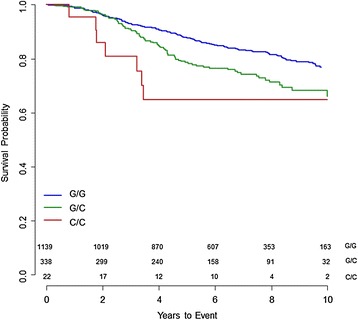
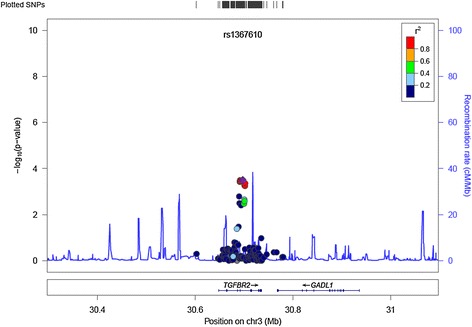
Three independent SNPs in TGFBR2 and IL12B were associated with OS (P <10⁻³) solely in ER-negative patients after chemotherapy (267 events). Poorer OS associated with TGFBR2 rs1367610 (G > C) (per allele hazard ratio (HR) 1.54 (95% confidence interval (CI) 1.22 to 1.95), P = 3.08 × 10⁻⁴) was not found in ER-negative patients without chemotherapy or ER-positive patients with chemotherapy (P for interaction <10-3). Two SNPs in IL12B (r² = 0.20) showed different associations with ER-negative disease after chemotherapy: rs2546892 (G > A) with poorer OS (HR 1.50 (95% CI 1.21 to 1.86), P = 1.81 × 10⁻⁴), and rs2853694 (A > C) with improved OS (HR 0.73 (95% CI 0.61 to 0.87), P = 3.67 × 10⁻⁴). Similar associations were observed with BCSS. Association with TGFBR2 rs1367610 but not IL12B variants replicated using BCAC Asian samples and the independent Prospective Study of Outcomes in Sporadic versus Hereditary Breast Cancer Study and yielded a combined HR of 1.57 ((95% CI 1.28 to 1.94), P = 2.05 × 10⁻⁵) without study heterogeneity.
TGFBR2 variants may have prognostic and predictive value in ER-negative breast cancer patients treated with adjuvant chemotherapy. Our findings provide further insights into the development of immunotherapeutic targets for ER-negative breast cancer.
肿瘤淋巴细胞浸润与雌激素受体(ER)阴性乳腺癌患者对化疗的临床反应相关。为了确定与ER阴性患者辅助化疗后预后相关的免疫抑制途径基因变异,我们研究了欧洲血统的I - III期浸润性乳腺癌患者,包括9334例ER阳性患者(3151例接受化疗)和2334例ER阴性患者(1499例接受化疗)。
我们汇总了来自乳腺癌协会联盟(BCAC)的16项研究的数据,并采用两项独立研究进行重复验证。作为协作肿瘤基因 - 环境研究的一部分,对133个基因中的3610个单核苷酸多态性(SNP)进行了基因分型,在该研究中收集并统一了表型和临床数据。使用多变量Cox比例风险回归来评估与总生存期(OS)和乳腺癌特异性生存期(BCSS)的遗传关联。根据化疗或ER状态的异质性通过对数似然比检验进行评估。
化疗后,仅在ER阴性患者(267例事件)中,转化生长因子β受体2(TGFBR2)和白细胞介素12B(IL12B)中的三个独立SNP与OS相关(P < 10⁻³)。在未接受化疗的ER阴性患者或接受化疗的ER阳性患者中未发现与TGFBR2 rs1367610(G > C)相关的较差OS(每个等位基因风险比(HR)1.54(95%置信区间(CI)1.22至1.95),P = 3.08×10⁻⁴)(交互作用P < 10⁻³)。IL12B中的两个SNP(r² = 0.20)在化疗后与ER阴性疾病显示出不同的关联:rs2546892(G > A)与较差的OS相关(HR 1.50(95% CI 1.21至1.86),P = 1.81×10⁻⁴),而rs2853694(A > C)与改善的OS相关(HR 0.73(95% CI 0.61至0.87),P = 3.67×10⁻⁴)。与BCSS也观察到类似的关联。使用BCAC亚洲样本以及散发性与遗传性乳腺癌结局的独立前瞻性研究对与TGFBR2 rs1367610的关联进行了重复验证,但未对IL12B变异进行重复验证,并且在无研究异质性的情况下得出合并HR为1.5(95% CI 1.28至1.94),P = 2.05×10⁻⁵。
TGFBR2变异可能在接受辅助化疗的ER阴性乳腺癌患者中具有预后和预测价值。我们的发现为ER阴性乳腺癌免疫治疗靶点的开发提供了进一步的见解。