Yu Wei, Zhao Junchang, Wang Mingzhu, Hu Yiheng, Chen Lifei, Xie Huaqing
College of Engineering, Shanghai Second Polytechnic University, 2360 Jin Hai Road, Pudong District,, Shanghai, 201209 China.
Shanghai Yueda New Materials Science and Technology Ltd., 2588 Jin Hai Road, Pudong District, Shanghai, 201209 China.
Nanoscale Res Lett. 2015 Mar 8;10:113. doi: 10.1186/s11671-015-0822-6. eCollection 2015.
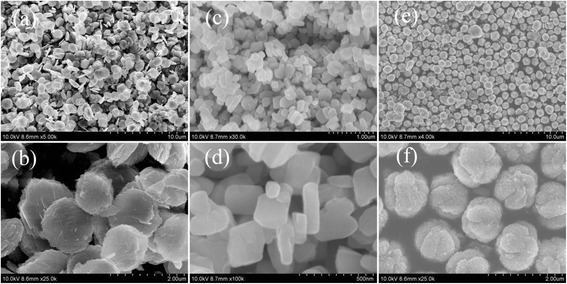
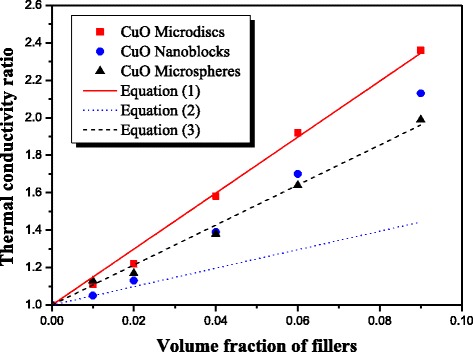
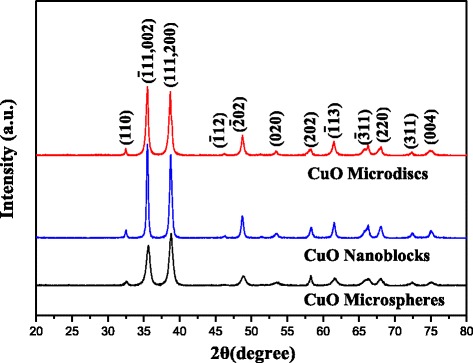
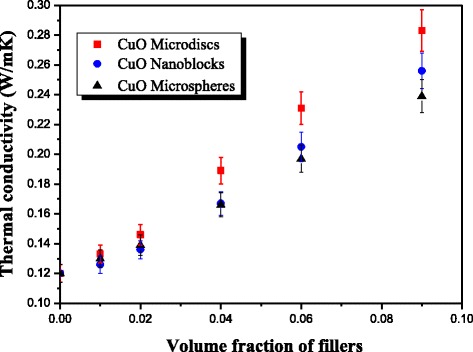
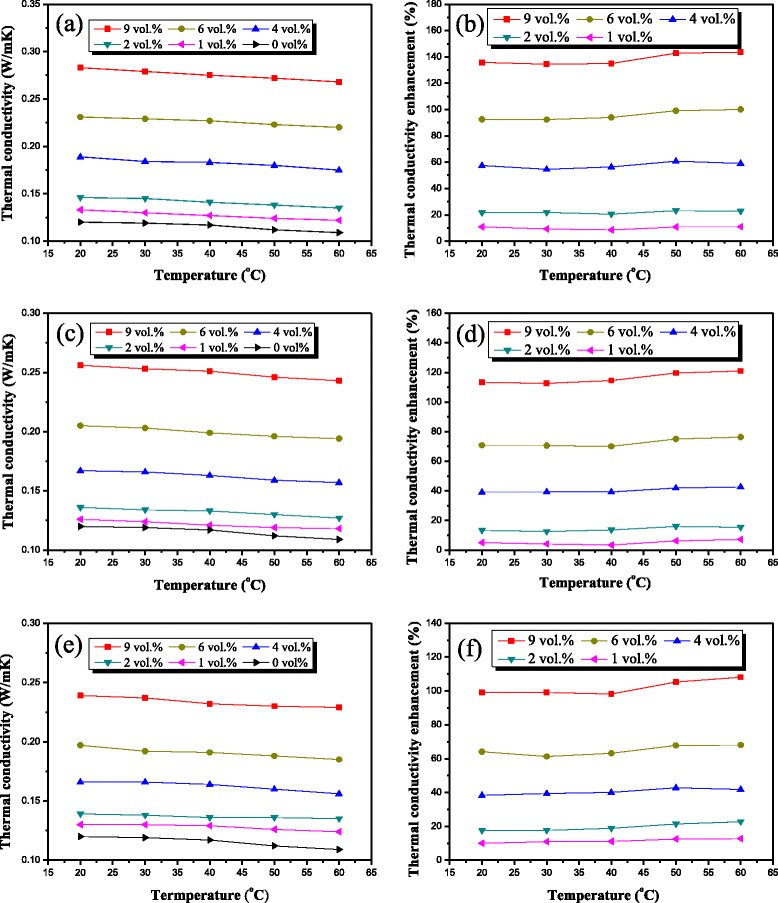
Different cupric oxide (CuO) structures have attracted intensive interest because of their promising applications in various fields. In this study, three kinds of CuO structures, namely, CuO microdisks, CuO nanoblocks, and CuO microspheres, are synthesized by solution-based synthetic methods. The morphologies and crystal structures of these CuO structures are characterized by field-emission scanning electron microscope and X-ray diffractometer, respectively. They are used as thermal conductive fillers to prepare silicone-based thermal greases, giving rise to great enhancement in thermal conductivity. Compared with pure silicone base, the thermal conductivities of thermal greases with CuO microdisks, CuO nanoblocks, and CuO microspheres are 0.283, 0256, and 0.239 W/mK, respectively, at filler loading of 9 vol.%, which increases 139%, 116%, and 99%, respectively. These thermal greases present a slight descendent tendency in thermal conductivity at elevated temperatures. These experimental data are compared with Nan's model prediction, indicating that the shape factor has a great influence on thermal conductivity improvement of thermal greases with different CuO structures. Meanwhile, due to large aspect ratio of CuO microdisks, they can form thermal networks more effectively than the other two structures, resulting in higher thermal conductivity enhancement.
不同的氧化铜(CuO)结构因其在各个领域的潜在应用而引起了广泛关注。在本研究中,通过基于溶液的合成方法合成了三种CuO结构,即CuO微盘、CuO纳米块和CuO微球。这些CuO结构的形貌和晶体结构分别用场发射扫描电子显微镜和X射线衍射仪进行表征。它们被用作导热填料来制备硅基导热脂,从而使导热率得到极大提高。与纯硅基相比,在填料含量为9体积%时,含有CuO微盘、CuO纳米块和CuO微球的导热脂的导热率分别为0.283、0.256和0.239W/mK,分别提高了139%、116%和99%。这些导热脂在高温下导热率呈现轻微下降趋势。将这些实验数据与Nan模型预测结果进行比较,表明形状因子对不同CuO结构的导热脂的导热率提高有很大影响。同时,由于CuO微盘的长径比大,它们比其他两种结构能更有效地形成热网络,从而导致更高的导热率提高。