Kremer Joel M, Kivitz Alan J, Simon-Campos Jesus A, Nasonov Evgeny L, Tony Hans-Peter, Lee Soo-Kon, Vlahos Bonnie, Hammond Constance, Bukowski Jack, Li Huihua, Schulman Seth L, Raber Susan, Zuckerman Andrea, Isaacs John D
Albany Medical College and The Center for Rheumatology, Albany, NY, USA.
Altoona Center for Clinical Research, Duncansville, PA, USA.
Arthritis Res Ther. 2015 Apr 6;17(1):95. doi: 10.1186/s13075-015-0612-7.
Tofacitinib is an oral Janus kinase inhibitor for the treatment of rheumatoid arthritis (RA). During the clinical development programme, increases in mean serum creatinine (SCr) of approximately 0.07 mg/dL and 0.08 mg/dL were observed which plateaued early. This study assessed changes in measured glomerular filtration rate (mGFR) with tofacitinib relative to placebo in patients with active RA.
This was a randomised, placebo-controlled, Phase 1 study (NCT01484561). Patients were aged ≥18 years with active RA. Patients were randomised 2:1 to oral tofacitinib 10 mg twice daily (BID) in Period 1 then placebo BID in Period 2 (tofacitinib → placebo); or oral placebo BID in both Periods (placebo → placebo). Change in mGFR was evaluated by iohexol serum clearance at four time points (run-in, pre-dose in Period 1, Period 1 end, and Period 2 end). The primary endpoint was the change in mGFR from baseline to Period 1 end. Secondary endpoints included: change in mGFR at other time points; change in estimated GFR (eGFR; Cockcroft-Gault equation) and SCr; efficacy; and safety.
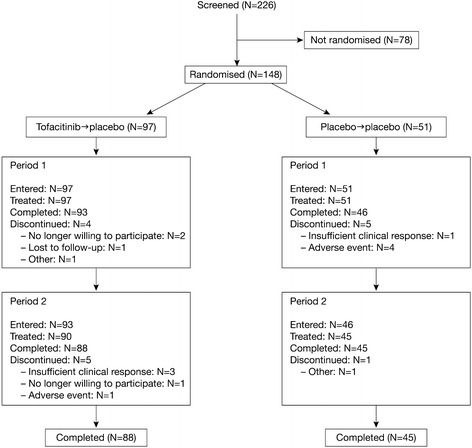
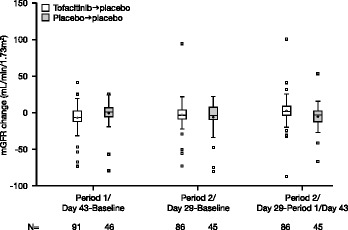
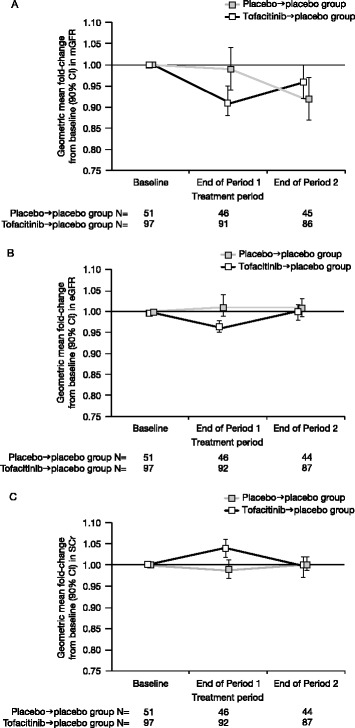
148 patients were randomised to tofacitinib → placebo (N = 97) or placebo → placebo (N = 51). Baseline characteristics were similar between groups. A reduction of 8% (90% confidence interval [CI]: 2%, 14%) from baseline in adjusted geometric mean mGFR was observed during tofacitinib treatment in Period 1 vs placebo. During Period 2, mean mGFR returned towards baseline during placebo treatment, and there was no difference between the two treatment groups at the end of the study--ratio (tofacitinib → placebo/placebo → placebo) of adjusted geometric mean fold change of mGFR was 1.04 (90% CI: 0.97, 1.11). Post-hoc analyses, focussed on mGFR variability in placebo → placebo patients, were consistent with this conclusion. At study end, similar results were observed for eGFR and SCr. Clinical efficacy and safety were consistent with prior studies.
Increases in mean SCr and decreases in eGFR in tofacitinib-treated patients with RA may occur in parallel with decreases in mean mGFR; mGFR returned towards baseline after tofacitinib discontinuation, with no significant difference vs placebo, even after post-hoc analyses. Safety monitoring will continue in ongoing and future clinical studies and routine pharmacovigilance.
Clinicaltrials.gov NCT01484561. Registered 30 November 2011.
托法替布是一种用于治疗类风湿性关节炎(RA)的口服 Janus 激酶抑制剂。在临床研发项目中,观察到平均血清肌酐(SCr)分别升高约 0.07 mg/dL 和 0.08 mg/dL,且早期趋于平稳。本研究评估了活动性 RA 患者中托法替布相对于安慰剂的实测肾小球滤过率(mGFR)变化。
这是一项随机、安慰剂对照的 1 期研究(NCT01484561)。患者年龄≥18 岁,患有活动性 RA。患者按 2:1 随机分组,在第 1 阶段每日两次口服 10 mg 托法替布(bid),然后在第 2 阶段每日两次口服安慰剂(托法替布→安慰剂);或在两个阶段均每日两次口服安慰剂(安慰剂→安慰剂)。在四个时间点(导入期、第 1 阶段给药前、第 1 阶段结束和第 2 阶段结束)通过碘海醇血清清除率评估 mGFR 的变化。主要终点是从基线到第 1 阶段结束时 mGFR 的变化。次要终点包括:其他时间点 mGFR 的变化;估算肾小球滤过率(eGFR;Cockcroft-Gault 方程)和 SCr 的变化;疗效;以及安全性。
148 例患者被随机分配至托法替布→安慰剂组(N = 97)或安慰剂→安慰剂组(N = 51)。两组的基线特征相似。与安慰剂相比,在第 1 阶段托法替布治疗期间,调整后的几何平均 mGFR 较基线降低了 8%(90%置信区间[CI]:2%,14%)。在第 2 阶段,安慰剂治疗期间平均 mGFR 恢复至基线水平,且在研究结束时两个治疗组之间无差异——mGFR 调整后的几何平均变化倍数的比值(托法替布→安慰剂/安慰剂→安慰剂)为 1.04(90%CI:0.97,1.11)。针对安慰剂→安慰剂组患者 mGFR 变异性的事后分析与该结论一致。在研究结束时,eGFR 和 SCr 也观察到了类似结果。临床疗效和安全性与先前研究一致。
托法替布治疗的 RA 患者中,平均 SCr 升高和 eGFR 降低可能与平均 mGFR 降低同时发生;托法替布停药后 mGFR 恢复至基线水平,即使经过事后分析,与安慰剂相比也无显著差异。在正在进行的和未来的临床研究以及常规药物警戒中,将继续进行安全性监测。
Clinicaltrials.gov NCT01484561。2011 年 11 月 30 日注册。