
脑出血患者血肿周围脑组织中的核因子-κB激活与预后相关。
Nuclear factor-κB activation in perihematomal brain tissue correlates with outcome in patients with intracerebral hemorrhage.
作者信息
Zhang Ze-Li, Liu Yu-Guang, Huang Qi-Bing, Wang Hong-Wei, Song Yan, Xu Zhen-Kuan, Li Feng
机构信息
Department of Emergency Surgery, Qilu Hospital of Shandong University, No. 107 Wenhuaxi Road, 250012, Jinan, Shandong Province, People's Republic of China.
Department of Neurosurgery, Qilu Hospital of Shandong University and Brain Science Research Institute of Shandong University, No. 107 Wenhuaxi Road, 250012, Jinan, Shandong Province, People's Republic of China.
出版信息
J Neuroinflammation. 2015 Mar 15;12:53. doi: 10.1186/s12974-015-0277-9.
BACKGROUND
Nuclear factor-κB (NF-κB) plays an important role in the inflammatory response after intracerebral hemorrhage (ICH). We therefore proposed that NF-κB activation in perihematomal brain tissue might correlate with clinical outcome in patients with ICH. To confirm this, we studied clinical data of 45 patients with ICH and NF-κB activation in perihematomal brain tissue and analyzed predictors of clinical outcome as well as the predictive value of NF-κB activation.
METHODS
Forty-five patients with spontaneous basal ganglia hemorrhage were prospectively investigated. The clinical data were collected, which include demographics, alcohol and tobacco abuse, stroke risk factors, neuroimaging variables at presentation, Glasgow Coma Scale (GCS) at admission, number of days in hospital, mechanical ventilation, pneumonia, and outcome. Clinical outcome was assessed by the modified Rankin Scale at 6 months after ICH. Perihematomal brain tissue was collected, and NF-κB activation was detected using immunohistochemistry. Univariate analysis and multivariate logistic regression analysis were performed to determine predictors of the poor outcome.
RESULTS
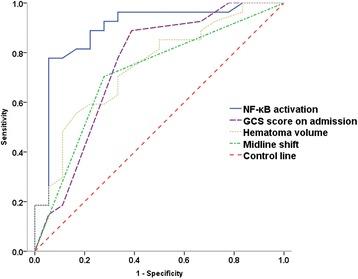
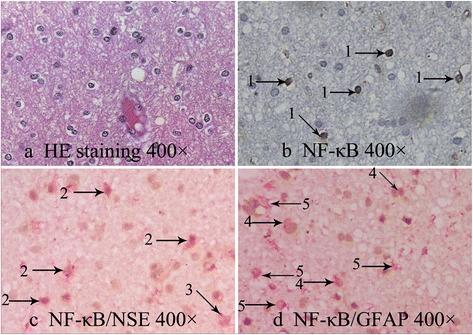
Immunohistochemical detection showed that NF-κB p65 was expressed in the nuclei of neurons and glial cells in all patients. The number of nuclear NF-κB p65-positive cells was 54 ± 21. Six months after ICH, 18 (40%) patients achieved a favorable functional outcome (mRS ≤ 3) while 27 (60%) had a poor functional outcome (mRS 4 to 6). In univariate analysis, predictors of poor functional outcome were lower GCS score on admission (P = 0.004), larger hematoma volume (P = 0.004), intraventricular extension (P = 0.047), midline shift (P = 0.005), NF-κB activation (P < 0.0001), mechanical ventilation (P = 0.018), and co-morbidity with pneumonia (P = 0.002). In multivariate logistic regression analysis, NF-κB activation was the only independent predictor of poor outcome at 6 months after ICH.
CONCLUSIONS
NF-κB activation is closely related to clinical outcome 6 months after ICH in humans. Therefore, it could be useful to predict prognosis of ICH accurately and should be further evaluated as a target for therapeutic strategies of ICH in the future.
背景
核因子-κB(NF-κB)在脑出血(ICH)后的炎症反应中起重要作用。因此,我们推测血肿周围脑组织中NF-κB的激活可能与ICH患者的临床结局相关。为证实这一点,我们研究了45例ICH患者的临床资料以及血肿周围脑组织中NF-κB的激活情况,并分析了临床结局的预测因素以及NF-κB激活的预测价值。
方法
对45例自发性基底节区脑出血患者进行前瞻性研究。收集临床资料,包括人口统计学资料、烟酒滥用情况、卒中危险因素、就诊时的神经影像学变量、入院时的格拉斯哥昏迷量表(GCS)评分、住院天数、机械通气、肺炎及结局。ICH后6个月采用改良Rankin量表评估临床结局。收集血肿周围脑组织,采用免疫组织化学法检测NF-κB的激活情况。进行单因素分析和多因素logistic回归分析以确定不良结局的预测因素。
结果
免疫组织化学检测显示,所有患者的神经元和胶质细胞核中均有NF-κB p65表达。细胞核NF-κB p65阳性细胞数为54±21。ICH后6个月,18例(40%)患者获得良好功能结局(改良Rankin量表评分≤3分),27例(60%)患者功能结局不良(改良Rankin量表评分4至6分)。单因素分析中,功能结局不良的预测因素为入院时GCS评分较低(P=0.004)、血肿体积较大(P=0.004)、脑室扩展(P=0.047)、中线移位(P=0.005)、NF-κB激活(P<0.0001)、机械通气(P=0.018)及合并肺炎(P=0.002)。多因素logistic回归分析显示,NF-κB激活是ICH后6个月不良结局的唯一独立预测因素。
结论
NF-κB激活与人类ICH后6个月的临床结局密切相关。因此,准确预测ICH的预后可能有用,未来应进一步评估其作为ICH治疗策略靶点的价值。
 Zotero 插件