Sahana Goutam, Höglund Johanna K, Guldbrandtsen Bernt, Lund Mogens S
Center for Quantitative Genetics and Genomics, Aarhus University, P.O. Box 50, DK-8830, Tjele, Denmark.
Present address: Department of Animal Science, Aarhus University, P.O. Box 50, DK-8830, Tjele, Denmark.
BMC Genet. 2015 May 3;16:47. doi: 10.1186/s12863-015-0202-3.
Understanding the underlying pleiotropic relationships among quantitative traits is necessary in order to predict correlated responses to artificial selection. The availability of large-scale next-generation sequence data in cattle has provided an opportunity to examine whether pleiotropy is responsible for overlapping QTL in multiple economic traits. In the present study, we examined QTL affecting cattle stillbirth, calf size, and adult stature located in the same genomic region.
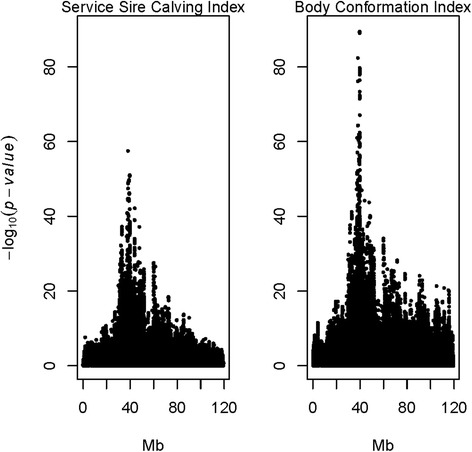
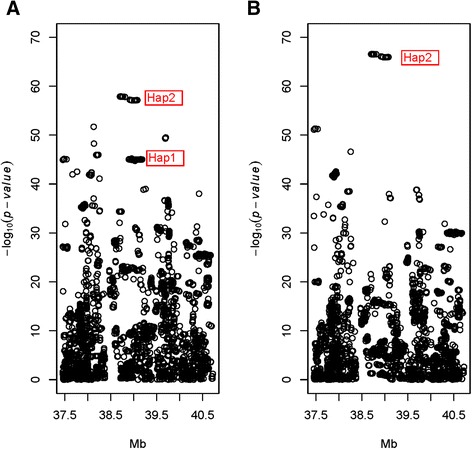
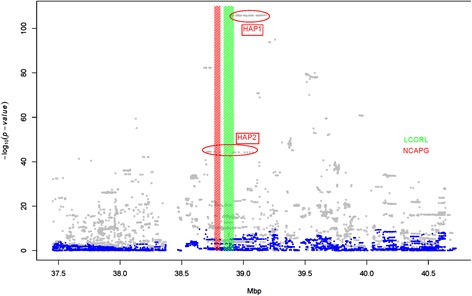
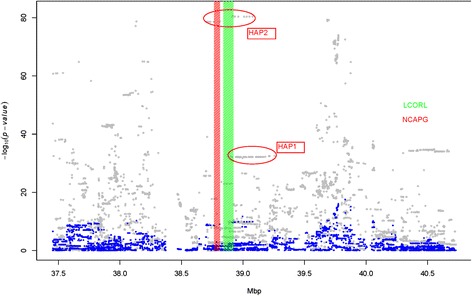
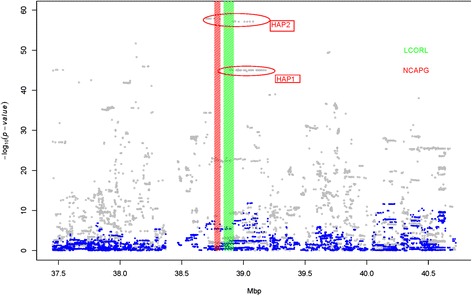
A genome scan using imputed whole genome sequence variants revealed one QTL with large effects on the service sire calving index (SCI), and body conformation index (BCI) at the same location (~39 Mb) on chromosome 6 in Nordic Red cattle. The targeted region was analyzed for SCI and BCI component traits. The QTL peak included LCORL and NCAPG genes, which had been reported to influence fetal growth and adult stature in several species. The QTL exhibited large effects on calf size and stature in Nordic Red cattle. Two deviant haplotypes (HAP1 and HAP2) were resolved which increased calf size at birth, and affected adult body conformation. However, the haplotypes also resulted in increased calving difficulties and calf mortality due to increased calf size at birth. Haplotype locations overlapped, however linkage disequilibrium (LD) between the sites was low, suggesting that two independent mutations were responsible for similar effects. The difference in prevalence between the two haplotypes in Nordic Red subpopulations suggested independent origins in different populations.
Results of our study identified QTL with large effects on body conformation and service sire calving traits on chromosome 6 in cattle. We present robust evidence that variation at the LCORL and NCAPG locus affects calf size at birth and adult stature. We suggest the two deviant haplotypes within the QTL were due to two independent mutations.
为了预测对人工选择的相关反应,了解数量性状之间潜在的多效性关系是必要的。牛大规模下一代测序数据的可用性提供了一个机会,来检验多效性是否导致多个经济性状中重叠的数量性状基因座(QTL)。在本研究中,我们检测了位于同一基因组区域影响牛死产、犊牛大小和成年身高的QTL。
使用估算的全基因组序列变异进行的全基因组扫描揭示,在北欧红牛的6号染色体上同一位置(约39 Mb)有一个对种公牛产犊指数(SCI)和体型指数(BCI)有重大影响的QTL。对该目标区域进行了SCI和BCI组成性状分析。QTL峰值包含LCORL和NCAPG基因,据报道这两个基因在几个物种中影响胎儿生长和成年身高。该QTL对北欧红牛的犊牛大小和身高有重大影响。解析出两种异常单倍型(HAP1和HAP2),它们增加了出生时的犊牛大小,并影响成年体型。然而,由于出生时犊牛大小增加,这些单倍型也导致产犊困难增加和犊牛死亡率上升。单倍型位置重叠,但位点之间的连锁不平衡(LD)较低,表明两个独立的突变导致了相似的效应。北欧红牛亚群中两种单倍型的频率差异表明它们在不同群体中有独立的起源。
我们的研究结果确定了对牛6号染色体上体型和种公牛产犊性状有重大影响的QTL。我们提供了有力证据,证明LCORL和NCAPG基因座的变异影响出生时的犊牛大小和成年身高。我们认为QTL内的两种异常单倍型是由两个独立的突变引起的。