
利用超声成像评估溶栓作用:一项体外研究。
Evaluation of thrombolysis by using ultrasonic imaging: an in vitro study.
作者信息
Fang Jui, Tsui Po-Hsiang
机构信息
Ph.D. Program in Biomedical Engineering, College of Engineering, Chang Gung University, Taoyuan, Taiwan.
1] Department of Medical Imaging and Radiological Sciences, College of Medicine, Chang Gung University, Taoyuan, Taiwan [2] Medical Imaging Research Center, Institute for Radiological Research, Chang Gung University and Chang Gung Memorial Hospital, Taoyuan, Taiwan [3] Department of Electrical Engineering, Chang Gung University, Taoyuan, Taiwan.
出版信息
Sci Rep. 2015 Jul 1;5:11669. doi: 10.1038/srep11669.
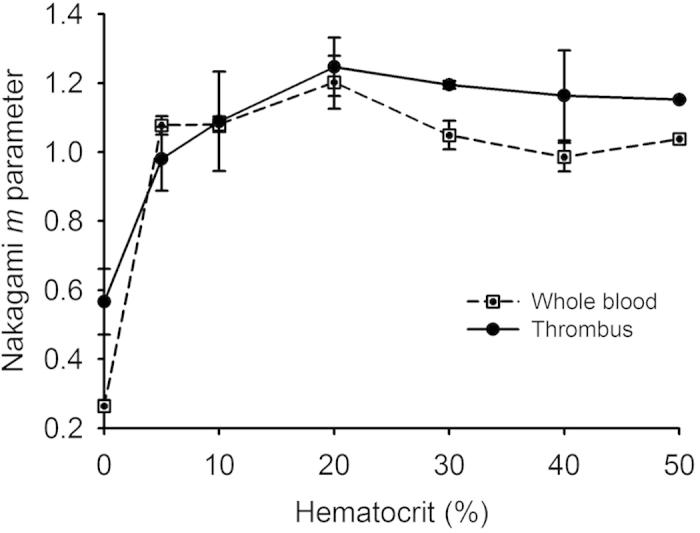
The hematocrit of a thrombus is a key factor associated with the susceptibility to thrombolysis. Ultrasonic imaging is currently the first-line screening tool for thrombus examinations. Different hematocrits result in different acoustical structures of thrombi, which alter the behavior of ultrasonic backscattering. This study explored the relationships among thrombolytic efficiencies, hematocrits, and ultrasonic parameters (the echo intensity and backscattered statistics). Porcine thrombi with different hematocrits, ranging from 0% to 50%, were induced in vitro. An ultrasonic scanner was used to scan thrombi and acquire raw image data for B-mode (echo intensity measurements) and Nakagami imaging (backscattered statistics analysis). Experiments on thrombolysis were performed using urokinase to explore the effect of the hematocrit on thrombolytic efficiency. Results showed that the weight loss ratio of thrombi exponentially decreased as the hematocrit increased from 0% to 50%. Compared with the echo intensity obtained from the conventional B-scan, the Nakagami parameter predicts the weight loss ratio, increasing from 0.6 to 1.2 as the weight loss ratio decreased from 0.67 to 0.26. The current findings suggest that using Nakagami imaging characterizing thrombi provides information of backscattered statistics, which may be associated with the thrombolytic efficiency.
血栓的血细胞比容是与溶栓易感性相关的关键因素。超声成像目前是血栓检查的一线筛查工具。不同的血细胞比容会导致血栓产生不同的声学结构,从而改变超声背向散射的特性。本研究探讨了溶栓效率、血细胞比容和超声参数(回声强度和背向散射统计量)之间的关系。在体外诱导产生血细胞比容范围为0%至50%的猪血栓。使用超声扫描仪对血栓进行扫描,并获取用于B模式(回声强度测量)和 Nakagami成像(背向散射统计分析)的原始图像数据。使用尿激酶进行溶栓实验,以探讨血细胞比容对溶栓效率的影响。结果表明,随着血细胞比容从0%增加到50%,血栓的失重率呈指数下降。与传统B扫描获得的回声强度相比,Nakagami参数可预测失重率,随着失重率从0.67降至0.26,该参数从0.6增加到1.2。当前研究结果表明,使用表征血栓的Nakagami成像可提供与背向散射统计量有关的信息,这可能与溶栓效率相关。




 Zotero 插件