Nguyễn Phong Vũ, Bellafiore Stéphane, Petitot Anne-Sophie, Haidar Rana, Bak Aurélie, Abed Amina, Gantet Pascal, Mezzalira Itamara, de Almeida Engler Janice, Fernandez Diana
Institut de Recherche pour le Développement, UMR 186 IRD-Cirad-UM2 Résistance des Plantes aux Bioagresseurs, 911 avenue Agropolis, BP 64501, Montpellier, Cedex 5, 34394, France,
Rice (N Y). 2014 Dec;7(1):23. doi: 10.1186/s12284-014-0023-4. Epub 2014 Sep 22.
Plant-parasitic nematodes developed strategies to invade and colonize their host plants, including expression of immune suppressors to overcome host defenses. Meloidogyne graminicola and M. incognita are root-knot nematode (RKN) species reported to damage rice (Oryza sativa L.) cultivated in upland and irrigated systems. Despite M. incognita wide host range, study of the molecular plant - RKN interaction has been so far limited to a few dicotyledonous model plants. The aim of this study was to investigate if the rice cv. Nipponbare widely used in rice genomic studies could be used as a suitable monocotyledon host plant for studying M. incognita pathogenicity mechanisms. Here we compared the ability of M. graminicola and M. incognita to develop and reproduce in Nipponbare roots. Next, we tested if RKNs modulates rice immunity-related genes expression in galls during infection and express the Mi-crt gene encoding an immune suppressor.
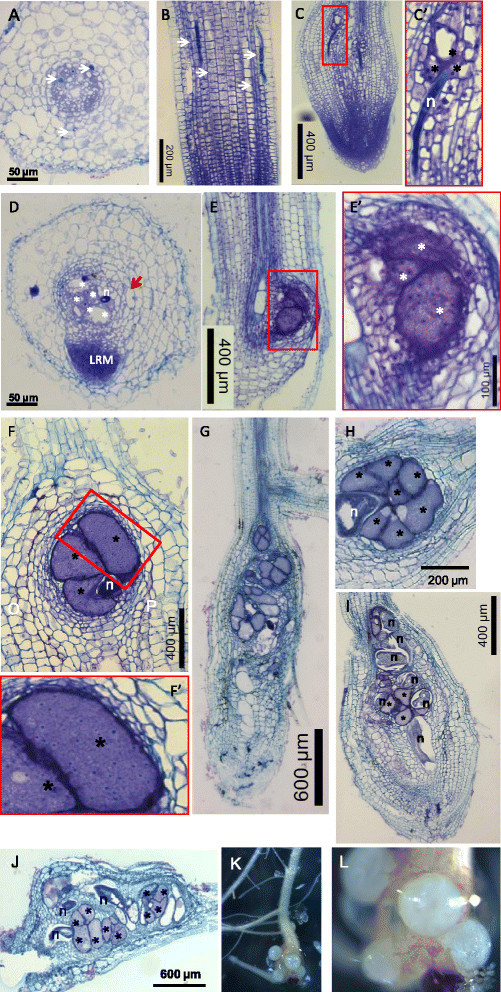
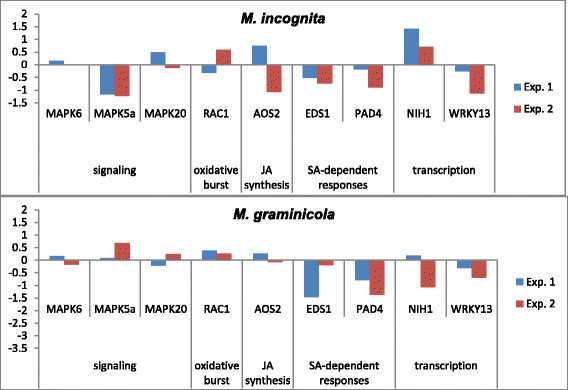
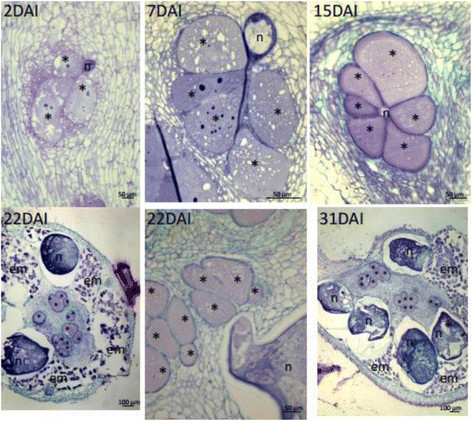
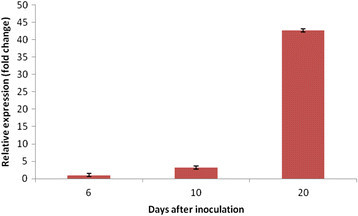
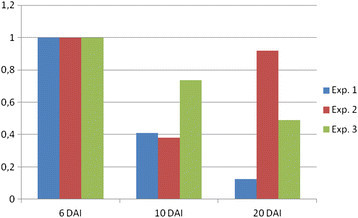
Root galling, mature females, eggs and newly formed J2s nematodes were obtained for both species in rice cultivated in hydroponic culture system after 4-5 weeks. Meloidogyne graminicola reproduced at higher rates than M. incognita on Nipponbare and the timing of infection was shorter. In contrast, the infection characteristics compared by histological analysis were similar for both nematode species. Giant cells formed from 2 days after infection (DAI) with M. graminicola and from 6 DAI with M. incognita. Real-time PCR (qRT-PCR) data indicated that RKNs are able to suppress transcription of immune regulators genes, such as OsEDS1, OsPAD4 and OsWRKY13 in young galls. Four M. incognita reference genes (Mi-eif-3, Mi-GDP-2, Mi-Y45F10D.4, and Mi-actin) were selected for normalizing nematode gene expression studies in planta and in pre-parasitic J2s. Meloidogyne incognita expressed the immune suppressor calreticulin gene (Mi-crt) in rice roots all along its infection cycle.
RKNs repress the transcription of key immune regulators in rice, likely in order to lower basal defence in newly-formed galls. The calreticulin Mi-CRT can be one of the immune-modulator effectors secreted by M. incognita in rice root tissues. Together, these data show that rice is a well suited model system to study host- M. incognita molecular interactions in monocotyledons.
植物寄生线虫进化出了侵入并定殖于寄主植物的策略,包括表达免疫抑制因子以克服寄主防御。禾谷根结线虫和南方根结线虫是报道中会对旱作和灌溉系统种植的水稻(Oryza sativa L.)造成损害的根结线虫种类。尽管南方根结线虫寄主范围广泛,但迄今为止,植物与根结线虫相互作用的分子研究仅限于少数双子叶模式植物。本研究的目的是调查在水稻基因组研究中广泛使用的日本晴水稻品种是否可作为研究南方根结线虫致病机制的合适单子叶寄主植物。在此,我们比较了禾谷根结线虫和南方根结线虫在日本晴根中发育和繁殖的能力。接下来,我们测试了根结线虫在感染过程中是否会调节虫瘿中水稻免疫相关基因的表达,以及是否会表达编码免疫抑制因子的Mi-crt基因。
在水培系统中种植的水稻中,4-5周后两种线虫均获得了根瘿、成熟雌虫、卵和新形成的J2期线虫。禾谷根结线虫在日本晴上的繁殖率高于南方根结线虫,且感染时间更短。相比之下,通过组织学分析比较的两种线虫的感染特征相似。禾谷根结线虫感染后2天(DAI)开始形成巨型细胞,南方根结线虫感染后6天开始形成。实时定量PCR(qRT-PCR)数据表明,根结线虫能够抑制年轻虫瘿中免疫调节基因如OsEDS1、OsPAD4和OsWRKY13的转录。选择了四个南方根结线虫内参基因(Mi-eif-3、Mi-GDP-2、Mi-Y45F10D.4和Mi-肌动蛋白)来标准化植物中和寄生前J2期线虫基因表达研究。南方根结线虫在其整个感染周期内在水稻根中均表达免疫抑制因子钙网蛋白基因(Mi-crt)。
根结线虫抑制水稻中关键免疫调节因子的转录,可能是为了降低新形成虫瘿中的基础防御。钙网蛋白Mi-CRT可能是南方根结线虫在水稻根组织中分泌的免疫调节效应因子之一。总之,这些数据表明水稻是研究单子叶植物中寄主与南方根结线虫分子相互作用的合适模式系统。