Adusumalli Swarnaseetha, Lee HueyTyng, Hoi Qiangze, Koo Si-Lin, Tan Iain Beehuat, Ng Pauline Crystal
Genome Institute of Singapore, Singapore, Singapore.
J Med Internet Res. 2015 Aug 28;17(8):e211. doi: 10.2196/jmir.4396.
Some health websites provide a public forum for consumers to post ratings and reviews on drugs. Drug reviews are easily accessible and comprehensible, unlike clinical trials and published literature. Because the public increasingly uses the Internet as a source of medical information, it is important to know whether such information is reliable.
We aim to examine whether Web-based consumer drug ratings and reviews can be used as a resource to compare drug performance.
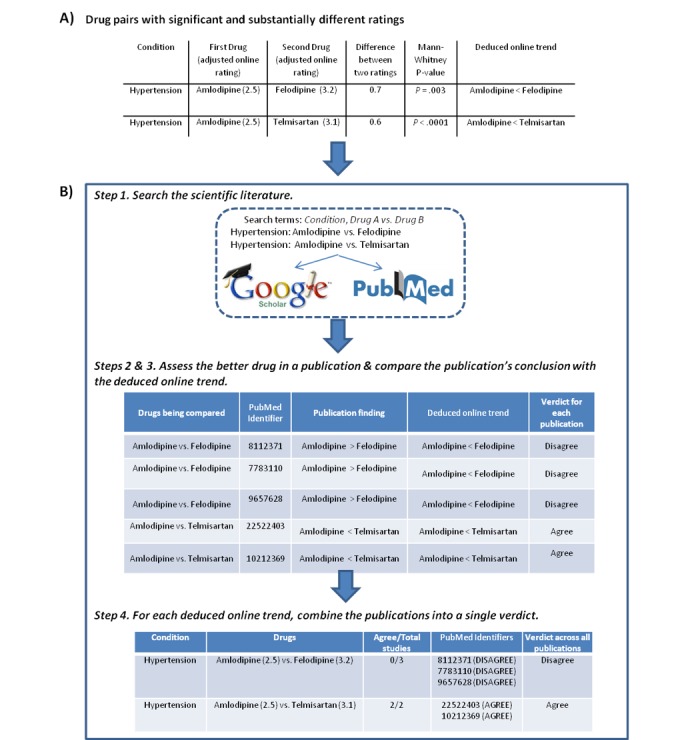
We analyzed 103,411 consumer-generated reviews on 615 drugs used to treat 249 disease conditions from the health website WebMD. Statistical analysis identified 427 drug pairs from 24 conditions for which two drugs treating the same condition had significantly and substantially different satisfaction ratings (with at least a half-point difference between Web-based ratings and P<.01). PubMed and Google Scholar were searched for publications that were assessed for concordance with findings online.
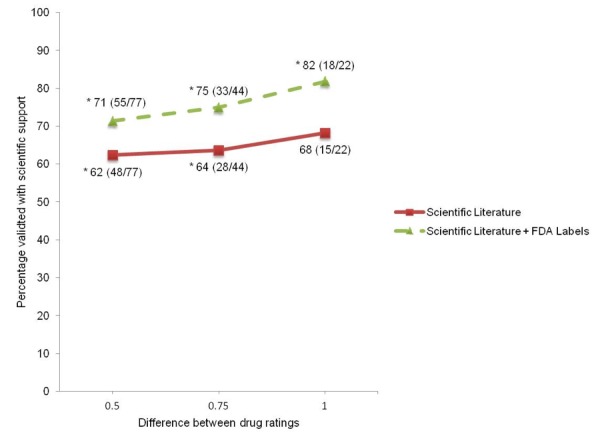
Scientific literature was found for 77 out of the 427 drug pairs and compared to findings online. Nearly two-thirds (48/77, 62%) of the online drug trends with at least a half-point difference in online ratings were supported by published literature (P=.02). For a 1-point online rating difference, the concordance rate increased to 68% (15/22) (P=.07). The discrepancies between scientific literature and findings online were further examined to obtain more insights into the usability of Web-based consumer-generated reviews. We discovered that (1) drugs with FDA black box warnings or used off-label were rated poorly in Web-based reviews, (2) drugs with addictive properties were rated higher than their counterparts in Web-based reviews, and (3) second-line or alternative drugs were rated higher. In addition, Web-based ratings indicated drug delivery problems. If FDA black box warning labels are used to resolve disagreements between publications and online trends, the concordance rate increases to 71% (55/77) (P<.001) for a half-point rating difference and 82% (18/22) for a 1-point rating difference (P=.002). Our results suggest that Web-based reviews can be used to inform patients' drug choices, with certain caveats.
Web-based reviews can be viewed as an orthogonal source of information for consumers, physicians, and drug manufacturers to assess the performance of a drug. However, one should be cautious to rely solely on consumer reviews as ratings can be strongly influenced by the consumer experience.
一些健康网站为消费者提供了一个公共论坛,用于发布对药物的评级和评论。与临床试验和已发表的文献不同,药物评论易于获取且易于理解。由于公众越来越多地将互联网作为医疗信息的来源,了解此类信息是否可靠非常重要。
我们旨在研究基于网络的消费者药物评级和评论是否可以用作比较药物性能的资源。
我们分析了来自健康网站WebMD的103411条消费者生成的评论,这些评论涉及用于治疗249种疾病的615种药物。统计分析从24种疾病中确定了427对药物,其中治疗相同疾病的两种药物的满意度评级存在显著且实质性的差异(基于网络的评级之间至少相差0.5分且P<0.01)。在PubMed和谷歌学术搜索了评估与在线结果一致性的出版物。
在427对药物中的77对中发现了科学文献,并与在线结果进行了比较。在线评级至少相差0.5分的近三分之二(48/77,62%)的在线药物趋势得到了已发表文献的支持(P=0.02)。对于在线评级相差1分的情况,一致性率提高到68%(15/22)(P=0.07)。进一步检查了科学文献与在线结果之间的差异,以更深入了解基于网络的消费者生成的评论的可用性。我们发现:(1)有FDA黑框警告或用于非标签用途的药物在基于网络的评论中评级较差;(2)具有成瘾性的药物在基于网络的评论中的评级高于其同类药物;(3)二线或替代药物的评级更高。此外,基于网络的评级表明了药物递送问题。如果使用FDA黑框警告标签来解决出版物与在线趋势之间的分歧,对于相差0.5分的评级差异,一致性率提高到71%(55/77)(P<0.001),对于相差1分的评级差异,一致性率提高到82%(18/22)(P=0.002)。我们的结果表明,基于网络的评论可用于为患者的药物选择提供信息,但有一定的注意事项。
基于网络的评论可以被视为消费者、医生和药物制造商评估药物性能的一个正交信息来源。然而,仅依赖消费者评论时应谨慎,因为评级可能会受到消费者体验的强烈影响。