Marno Hanna, Farroni Teresa, Vidal Dos Santos Yamil, Ekramnia Milad, Nespor Marina, Mehler Jacques
Language, Cognition and Development Lab, SISSA, Via Bonomea 265, Trieste, 34136, Italy.
Psychology Department, University of Padova, Via 8 Febbraio 1848, 2, 35122 Padova, Italy.
Sci Rep. 2015 Sep 1;5:13594. doi: 10.1038/srep13594.
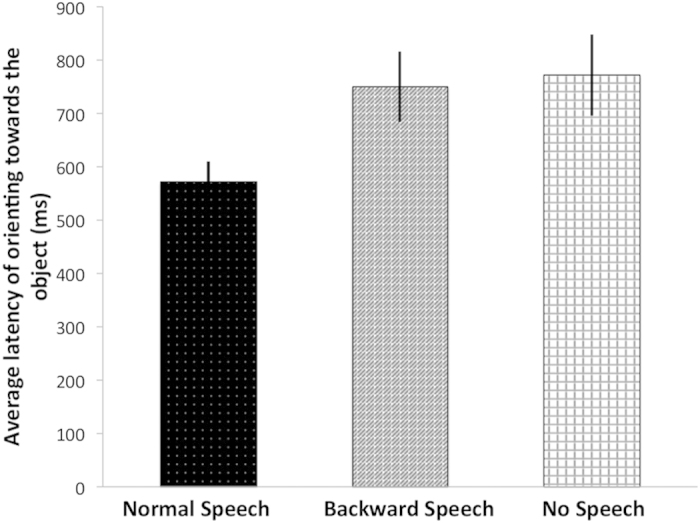
Infants' sensitivity to selectively attend to human speech and to process it in a unique way has been widely reported in the past. However, in order to successfully acquire language, one should also understand that speech is a referential, and that words can stand for other entities in the world. While there has been some evidence showing that young infants can make inferences about the communicative intentions of a speaker, whether they would also appreciate the direct relationship between a specific word and its referent, is still unknown. In the present study we tested four-month-old infants to see whether they would expect to find a referent when they hear human speech. Our results showed that compared to other auditory stimuli or to silence, when infants were listening to speech they were more prepared to find some visual referents of the words, as signalled by their faster orienting towards the visual objects. Hence, our study is the first to report evidence that infants at a very young age already understand the referential relationship between auditory words and physical objects, thus show a precursor in appreciating the symbolic nature of language, even if they do not understand yet the meanings of words.
过去已有广泛报道称,婴儿能够有选择地关注人类言语并以独特方式对其进行处理。然而,为了成功习得语言,人们还应明白言语具有指称性,即词语能够代表世界上的其他实体。虽然有一些证据表明,年幼的婴儿能够对说话者的交际意图进行推断,但他们是否也能理解特定词语与其所指对象之间的直接关系,仍是未知的。在本研究中,我们测试了四个月大的婴儿,看他们在听到人类言语时是否会期望找到所指对象。我们的结果表明,与其他听觉刺激或安静状态相比,当婴儿听言语时,他们更准备好去寻找词语的一些视觉所指对象,这表现为他们更快地转向视觉物体。因此,我们的研究首次报告了证据,表明非常年幼的婴儿已经理解听觉词语与实物之间的指称关系,从而在理解语言的符号性质方面表现出一种先兆,即便他们还不理解词语的含义。