Koning Ludi, Charlton Michael R, Pas Suzan D, Heimbach Julie K, Osterhaus Albert D M E, Watt Kymberly D, Janssen Harry L A, de Knegt Robert J, van der Eijk Annemiek A
Department of Gastroenterology and Hepatology, Erasmus University Medical Center, Rotterdam, The Netherlands.
Mayo Clinic Transplant Center, Rochester, MN, USA.
BMC Infect Dis. 2015 Sep 2;15:371. doi: 10.1186/s12879-015-1103-9.
Infection with hepatitis E virus (HEV) in immunocompromised patients can lead to severe liver disease. Treatment options for HEV include peginterferon or ribavirin, routinely also used for the treatment of hepatitis C virus (HCV) infection. We determined the prevalence and clinical consequences of HEV in United States (US) based patients who underwent liver transplantation (LT) for chronic HCV.
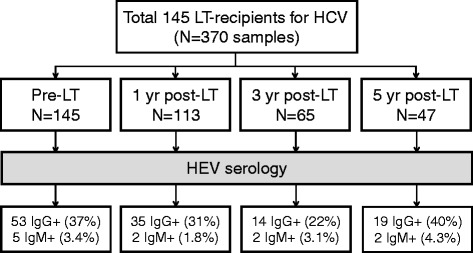
Seroprevalence of HEV in 145 US LT recipients with a history of chronic HCV was determined pre-LT, 1, 3 and 5 years post-LT. All last available samples and all samples in IgM positive patients and post-LT IgG seroconverters were tested for HEV RNA.
Overall anti-HEV seroprevalence was 42 %. Five patients were HEV IgM positive pre-LT, one patient had IgM seroconversion post-LT and eight patients had IgG seroconversion post-LT. None of the tested samples were positive for HEV RNA. Eight out of nine of the post-LT seroconverters had been treated for HCV recurrence before or at the moment of seroconversion.
LT recipients in the US are at risk of acquiring HEV. Post-LT HCV treatment with interferons and/or ribavirin may have protected patients against chronic HEV. With the arrival of new direct antiviral agents for the treatment of HCV and the elimination of peginterferon and ribavirin from HCV treatment regimens, the prevalence of chronic HEV in this population may rise again.
免疫功能低下患者感染戊型肝炎病毒(HEV)可导致严重肝病。HEV的治疗选择包括聚乙二醇干扰素或利巴韦林,这两种药物通常也用于治疗丙型肝炎病毒(HCV)感染。我们确定了在美国因慢性HCV接受肝移植(LT)的患者中HEV的患病率及其临床后果。
对145例有慢性HCV病史的美国LT受者在LT前、LT后1年、3年和5年测定HEV血清阳性率。对所有最后一次可用样本以及IgM阳性患者和LT后IgG血清学转换者的所有样本进行HEV RNA检测。
总体抗HEV血清阳性率为42%。5例患者在LT前HEV IgM阳性,1例患者在LT后出现IgM血清学转换,8例患者在LT后出现IgG血清学转换。所有检测样本的HEV RNA均为阴性。9例LT后血清学转换者中有8例在血清学转换前或转换时曾接受过HCV复发治疗。
美国的LT受者有感染HEV的风险。LT后使用干扰素和/或利巴韦林治疗HCV可能使患者免受慢性HEV感染。随着用于治疗HCV的新型直接抗病毒药物的出现以及聚乙二醇干扰素和利巴韦林从HCV治疗方案中被淘汰,该人群中慢性HEV的患病率可能会再次上升。