
肩部恐惧的神经关联:一项功能磁共振成像研究
The Neural Correlates of Shoulder Apprehension: A Functional MRI Study.
作者信息
Shitara Hitoshi, Shimoyama Daisuke, Sasaki Tsuyoshi, Hamano Noritaka, Ichinose Tsuyoshi, Yamamoto Atsushi, Kobayashi Tsutomu, Osawa Toshihisa, Iizuka Haku, Hanakawa Takashi, Tsushima Yoshito, Takagishi Kenji
机构信息
Department of Orthopaedic Surgery, Gunma University Graduate School of Medicine, Maebashi, Gunma, Japan.
Department of Physical Therapy, Takasaki University of Health and Welfare, Takasaki, Gunma, Japan.
出版信息
PLoS One. 2015 Sep 9;10(9):e0137387. doi: 10.1371/journal.pone.0137387. eCollection 2015.
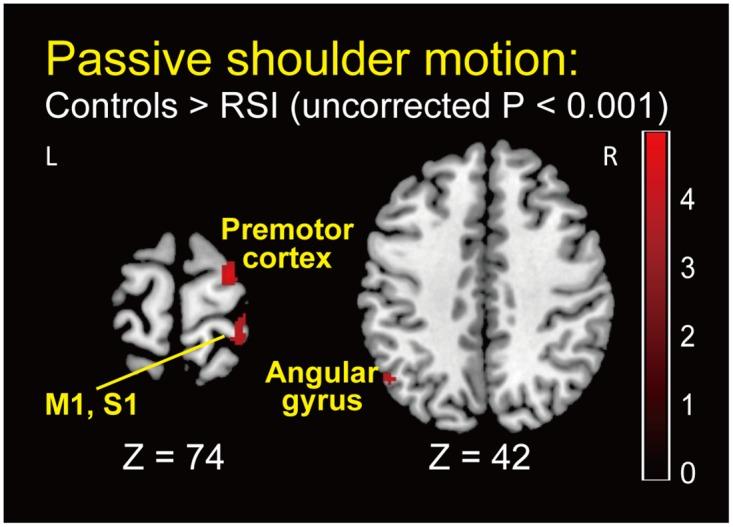
Although shoulder apprehension is an established clinical finding and is important for the prevention of shoulder dislocation, how this subjective perception is evoked remains unclear. We elucidated the functional neuroplasticity associated with apprehension in patients with recurrent anterior shoulder instability (RSI) using functional magnetic resonance imaging (fMRI). Twelve healthy volunteers and 14 patients with right-sided RSI performed a motor imagery task and a passive shoulder motion task. Brain activity was compared between healthy participants and those with RSI and was correlated with the apprehension intensity reported by participants after each task. Compared to healthy volunteers, participants with RSI exhibited decreased brain activity in the motor network, but increased activity in the hippocampus and amygdala. During the passive motion task, participants with RSI exhibited decreased activity in the left premotor and primary motor/somatosensory areas. Furthermore, brain activity was correlated with apprehension intensity in the left amygdala and left thalamus during the motor imagery task (memory-induced), while a correlation between apprehension intensity and brain activity was found in the left prefrontal cortex during the passive motion task (instability-induced). Our findings provide insight into the pathophysiology of RSI by identifying its associated neural alterations. We elucidated that shoulder apprehension was induced by two different factors, namely instability and memory.
尽管肩部恐惧是一种既定的临床发现,对预防肩关节脱位很重要,但这种主观感受是如何诱发的仍不清楚。我们使用功能磁共振成像(fMRI)阐明了复发性前肩关节不稳(RSI)患者中与恐惧相关的功能神经可塑性。12名健康志愿者和14名右侧RSI患者进行了运动想象任务和被动肩部运动任务。比较了健康参与者和RSI患者之间的大脑活动,并将其与每个任务后参与者报告的恐惧强度相关联。与健康志愿者相比,RSI患者在运动网络中的大脑活动减少,但海马体和杏仁核的活动增加。在被动运动任务期间,RSI患者在左前运动区和初级运动/体感区的活动减少。此外,在运动想象任务(记忆诱导)期间,大脑活动与左杏仁核和左丘脑的恐惧强度相关,而在被动运动任务(不稳诱导)期间,在左前额叶皮层发现了恐惧强度与大脑活动之间的相关性。我们的研究结果通过识别其相关的神经改变,为RSI的病理生理学提供了见解。我们阐明了肩部恐惧是由两种不同因素诱发的,即不稳和记忆。


 Zotero 插件