Kiweewa Flavia M, Bakaki Paul M, McConnell Michelle S, Musisi Maria, Namirembe Constance, Nakayiwa Frances, Kusasira Fiona, Nakintu Dorothy, Mubiru Michael C, Musoke Philippa, Fowler Mary Glenn
Makerere University-Johns Hopkins University (MU-JHU) Research Collaboration, Kampala, Uganda.
Department of Epidemiology and Biostatistics, Makerere University School of Public Health, Makerere University College of Health Sciences, Kampala, Uganda.
BMC Public Health. 2015 Sep 29;15:988. doi: 10.1186/s12889-015-2345-6.
HIV status disclosure is a difficult emotional task for HIV-infected persons and may create the opportunity for both social support and rejection. In this study, we evaluated the proportions, patterns, barriers and outcomes of HIV- 1 status disclosure among a group of women in Uganda.
An exit interview was conducted one year post-partum for 85 HIV-infected women who participated in a study of HIV-1 transmission rates among NVP-experienced compared with NVP-naïve women in "The Nevirapine Repeat Pregnancy (NVP-RP) Study" at the Makerere University-Johns Hopkins University Research Collaboration, Kampala-Uganda, between June 2004 and June 2006.
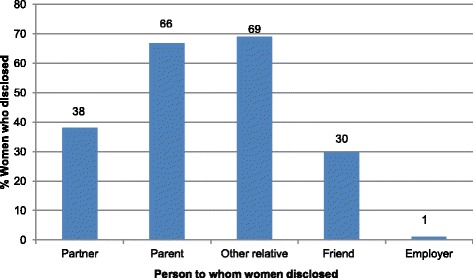
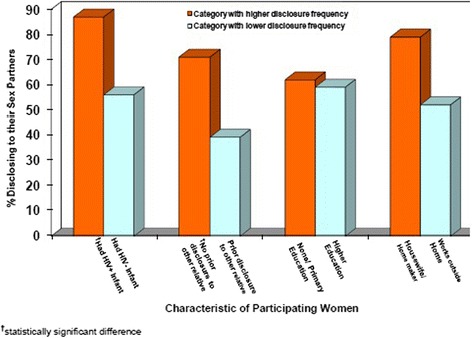
Of the 85 women interviewed, 99 % had disclosed their HIV status to at least one other person. Disclosure proportions ranged between 1 % to employer(s) and 69 % to a relative other than a parent. Only 38 % of the women had disclosed to their sex partners. Women with an HIV-infected baby were more likely than those with an uninfected baby to disclose to their sex partner, OR 4.9 (95 % CI, 2.0 -11.2), and women were less likely to disclose to a partner if they had previously disclosed to another relative than if they had not, OR 0.19 (95 % CI, 0.14-0.52). The most common reasons for non-disclosure included fear of separation from the partner and subsequent loss of financial support 34 %, and not living with the partner (not having opportunities to disclose) 26 %. While most women (67 %) reported getting social support following disclosure, 22 % reported negative outcomes (neglect, separation from their partners, and loss of financial support). Following disclosure of HIV status, 9 % of women reported that their partner (s) decided to have an HIV test.
Results from this study show high overall HIV disclosure proportions and how this disclosure of HIV status can foster social support. However, proportions of disclosure specifically to male sex partners were low, which suggests the need for interventions aimed at increasing male involvement in perinatal care, along with supportive counseling.
对于感染艾滋病毒的人来说,披露艾滋病毒感染状况是一项艰难的情感任务,可能会带来获得社会支持和遭到排斥的机会。在本研究中,我们评估了乌干达一组女性中披露艾滋病毒1型感染状况的比例、模式、障碍及结果。
对85名感染艾滋病毒的女性进行产后一年的随访访谈,这些女性参与了在乌干达坎帕拉的马凯雷雷大学 - 约翰·霍普金斯大学研究合作项目中开展的“奈韦拉平重复妊娠(NVP - RP)研究”,该研究比较了有奈韦拉平使用经历的女性与未使用过奈韦拉平的女性之间的艾滋病毒1型传播率,研究时间为2004年6月至2006年6月。
在接受访谈的85名女性中,99%已向至少一人披露了自己的艾滋病毒感染状况。披露比例在向雇主披露的为1%至向非父母的亲属披露的为69%之间。只有38%的女性向其性伴侣披露了感染状况。感染艾滋病毒的婴儿的母亲比未感染婴儿的母亲更有可能向其性伴侣披露感染状况,比值比为4.9(95%置信区间,2.0 - 11.2),并且如果女性之前已向其他亲属披露过,那么她们向伴侣披露的可能性低于未向其他亲属披露过的女性,比值比为0.19(95%置信区间,0.14 - 0.52)。不披露的最常见原因包括担心与伴侣分离及随后失去经济支持(34%),以及未与伴侣同住(没有披露机会)(26%)。虽然大多数女性(67%)报告在披露后获得了社会支持,但2个2%报告有负面结果(被忽视、与伴侣分离以及失去经济支持)。在披露艾滋病毒感染状况后,9%的女性报告其伴侣决定进行艾滋病毒检测。
本研究结果显示总体艾滋病毒披露比例较高,以及这种艾滋病毒感染状况的披露如何促进社会支持。然而,向男性性伴侣的披露比例较低,这表明需要采取干预措施,旨在提高男性在围产期护理中的参与度,并提供支持性咨询。