Ongen Halit, Dermitzakis Emmanouil T
Department of Genetic Medicine and Development, University of Geneva Medical School, 1211 Geneva, Switzerland; Institute for Genetics and Genomics in Geneva (iGE3), University of Geneva, 1211 Geneva, Switzerland; Swiss Institute of Bioinformatics, 1211 Geneva, Switzerland.
Department of Genetic Medicine and Development, University of Geneva Medical School, 1211 Geneva, Switzerland; Institute for Genetics and Genomics in Geneva (iGE3), University of Geneva, 1211 Geneva, Switzerland; Swiss Institute of Bioinformatics, 1211 Geneva, Switzerland; Center of Excellence for Genomic Medicine Research, King Abdulaziz University, Jeddah 21589, Saudi Arabia; Biomedical Research Foundation Academy of Athens, Athens 11527, Greece.
Am J Hum Genet. 2015 Oct 1;97(4):567-75. doi: 10.1016/j.ajhg.2015.09.004.
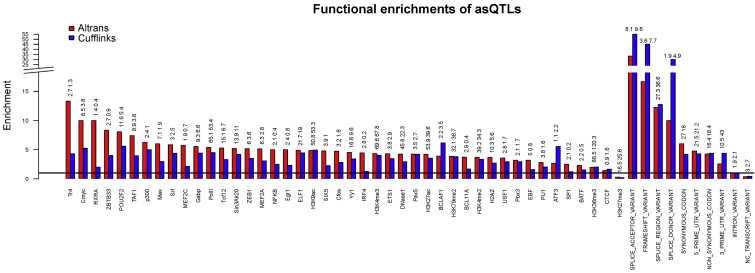
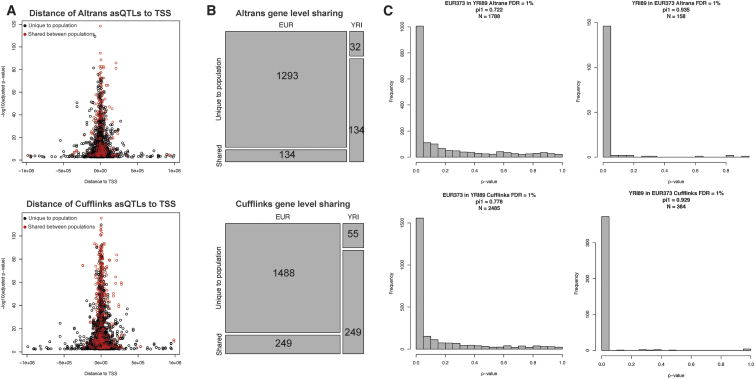
With the advent of RNA-sequencing technology, we can detect different types of alternative splicing and determine how DNA variation regulates splicing. However, given the short read lengths used in most population-based RNA-sequencing experiments, quantifying transcripts accurately remains a challenge. Here we present a method, Altrans, for discovery of alternative splicing quantitative trait loci (asQTLs). To assess the performance of Altrans, we compared it to Cufflinks and MISO in simulations and Cufflinks for asQTL discovery. Simulations show that in the presence of unannotated transcripts, Altrans performs better in quantifications than Cufflinks and MISO. We have applied Altrans and Cufflinks to the Geuvadis dataset, which comprises samples from European and African populations, and discovered (FDR = 1%) 1,427 and 166 asQTLs with Altrans and 1,737 and 304 asQTLs with Cufflinks for Europeans and Africans, respectively. We show that, by discovering a set of asQTLs in a smaller subset of European samples and replicating these in the remaining larger subset of Europeans, both methods achieve similar replication levels (95% for both methods). We find many Altrans-specific asQTLs, which replicate to a high degree (93%). This is mainly due to junctions absent from the annotations and hence not tested with Cufflinks. The asQTLs are significantly enriched for biochemically active regions of the genome, functional marks, and variants in splicing regions, highlighting their biological relevance. We present an approach for discovering asQTLs that is a more direct assessment of splicing compared to other methods and is complementary to other transcript quantification methods.
随着RNA测序技术的出现,我们能够检测不同类型的可变剪接,并确定DNA变异如何调控剪接。然而,鉴于大多数基于群体的RNA测序实验中使用的读长较短,准确量化转录本仍然是一项挑战。在此,我们提出一种名为Altrans的方法,用于发现可变剪接数量性状基因座(asQTL)。为了评估Altrans的性能,我们在模拟实验中将其与Cufflinks和MISO进行比较,并将其与用于asQTL发现的Cufflinks进行比较。模拟结果表明,在存在未注释转录本的情况下,Altrans在定量方面比Cufflinks和MISO表现更好。我们已将Altrans和Cufflinks应用于Geuvadis数据集,该数据集包含来自欧洲和非洲人群的样本,并分别为欧洲人和非洲人发现(FDR = 1%):使用Altrans发现1427个和166个asQTL;使用Cufflinks发现1737个和304个asQTL。我们表明,通过在较小的欧洲样本子集中发现一组asQTL,并在其余较大的欧洲样本子集中进行复制,两种方法都达到了相似的复制水平(两种方法均为95%)。我们发现了许多Altrans特有的asQTL,并具有高度的可重复性(93%)。这主要是由于注释中缺少这些连接,因此Cufflinks未对其进行测试。这些asQTL在基因组的生物化学活性区域、功能标记和剪接区域的变体中显著富集,突出了它们的生物学相关性。我们提出了一种发现asQTL的方法,与其他方法相比,该方法是对剪接的更直接评估,并且是对其他转录本定量方法的补充。