
群居斑胸草雀之间的鸣叫交流模式在繁殖周期中会发生变化。
Patterns of call communication between group-housed zebra finches change during the breeding cycle.
作者信息
Gill Lisa F, Goymann Wolfgang, Ter Maat Andries, Gahr Manfred
机构信息
Max Planck Institute for Ornithology, Seewiesen, Germany.
出版信息
Elife. 2015 Oct 6;4:e07770. doi: 10.7554/eLife.07770.
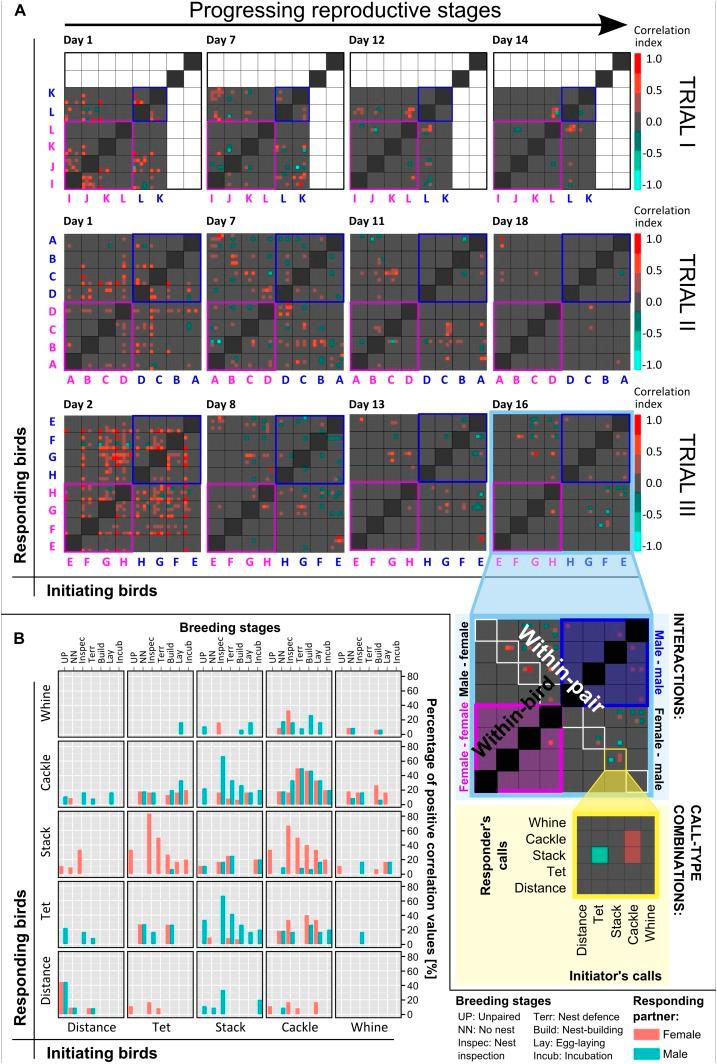
Vocal signals such as calls play a crucial role for survival and successful reproduction, especially in group-living animals. However, call interactions and call dynamics within groups remain largely unexplored because their relation to relevant contexts or life-history stages could not be studied with individual-level resolution. Using on-bird microphone transmitters, we recorded the vocalisations of individual zebra finches (Taeniopygia guttata) behaving freely in social groups, while females and males previously unknown to each other passed through different stages of the breeding cycle. As birds formed pairs and shifted their reproductive status, their call repertoire composition changed. The recordings revealed that calls occurred non-randomly in fine-tuned vocal interactions and decreased within groups while pair-specific patterns emerged. Call-type combinations of vocal interactions changed within pairs and were associated with successful egg-laying, highlighting a potential fitness relevance of calling dynamics in communication systems.
诸如鸣叫之类的声音信号对生存和成功繁殖起着至关重要的作用,尤其是在群居动物中。然而,群体内的鸣叫互动和鸣叫动态在很大程度上仍未得到探索,因为无法以个体水平的分辨率研究它们与相关环境或生活史阶段的关系。我们使用鸟类身上的麦克风发射器,记录了在社会群体中自由活动的单个斑胸草雀(Taeniopygia guttata)的发声,在此期间,此前互不相识的雌性和雄性经历了繁殖周期的不同阶段。随着鸟类配对并改变其繁殖状态,它们的鸣叫曲目组成发生了变化。录音显示,鸣叫在精细调节的声音互动中并非随机出现,且在群体中减少,同时出现了特定配对的模式。配对内声音互动的鸣叫类型组合发生了变化,并与成功产卵相关,这突出了鸣叫动态在通信系统中潜在的适应性相关性。




 Zotero 插件