
肝移植稳定受者每日一次他克莫司制剂的群体药代动力学和药物遗传学
Population pharmacokinetics and pharmacogenetics of once daily tacrolimus formulation in stable liver transplant recipients.
作者信息
Moes D J A R, van der Bent S A S, Swen J J, van der Straaten T, Inderson A, Olofsen E, Verspaget H W, Guchelaar H J, den Hartigh J, van Hoek B
机构信息
Department of Clinical Pharmacy and Toxicology, Leiden University Medical Center, Albinusdreef 2, 2333, ZA, Leiden, The Netherlands.
Department of Gastroenterology and Hepatology, Leiden University Medical Center, Leiden, The Netherlands.
出版信息
Eur J Clin Pharmacol. 2016 Feb;72(2):163-74. doi: 10.1007/s00228-015-1963-3. Epub 2015 Oct 31.
PURPOSE
The once daily formulation of tacrolimus is an important immunosuppressive drug. Interpatient variability in metabolism has been related to genetic variation in CYP3A4 and CYP3A5. However, in liver transplantation, both donor and recipient genotypes may affect pharmacokinetics. The primary objective of this study was to investigate the effect of CYP3A422 and CYP3A53 of both donor and recipient on once daily tacrolimus pharmacokinetics. The secondary objective was to develop a limited sampling model able to accurately predict exposure.
METHODS
Stable liver transplant patients receiving once daily tacrolimus (N = 66) were included. Population pharmacokinetic analysis was performed with patients of whom DNA was available (N = 49), and demographic factors, CYP3A422 and CYP3A53, were tested as covariates. Moreover, a limited sampling model was developed using data of 66 patients.
RESULTS
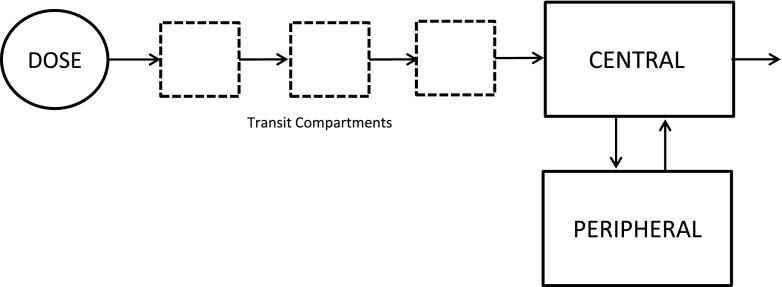
Pharmacokinetics was best described by a two-compartment model with delayed absorption. CYP3A51 carrying recipients engrafted with a CYP3A51 carrying liver had an average 1.7-fold higher clearance compared to non-carriers. CYP3A51 carrying recipients engrafted with a CYP3A51 non-carrying liver or vice versa showed an average 1.3-fold higher clearance compared with non-carriers. CYP3A4*22 was not significantly associated with once daily tacrolimus pharmacokinetics. Using 0, 2, and 3 h postdose as limited sampling model resulted in significantly improved prediction of tacrolimus exposure compared with trough concentration.
CONCLUSIONS
Both donor and recipient CYP3A5 genotype significantly influences tacrolimus once daily pharmacokinetics. In contrast, CYP3A4*22 appears not suitable as biomarker. The developed limited sampling model can be used to accurately estimate tacrolimus once daily exposure.
目的
他克莫司的每日一次剂型是一种重要的免疫抑制药物。患者间代谢的变异性与CYP3A4和CYP3A5的基因变异有关。然而,在肝移植中,供体和受体的基因型都可能影响药代动力学。本研究的主要目的是调查供体和受体的CYP3A422和CYP3A53对他克莫司每日一次药代动力学的影响。次要目的是建立一个能够准确预测暴露量的有限采样模型。
方法
纳入接受他克莫司每日一次治疗的稳定肝移植患者(N = 66)。对有DNA数据的患者(N = 49)进行群体药代动力学分析,并将人口统计学因素、CYP3A422和CYP3A53作为协变量进行测试。此外,利用66例患者的数据建立了有限采样模型。
结果
药代动力学最好用具有延迟吸收的二室模型来描述。携带CYP3A51的受体移植了携带CYP3A51的肝脏,其清除率比非携带者平均高1.7倍。携带CYP3A51的受体移植了不携带CYP3A51的肝脏,反之亦然,其清除率与非携带者相比平均高1.3倍。CYP3A4*22与他克莫司每日一次的药代动力学无显著相关性。与谷浓度相比,使用给药后0、2和3小时作为有限采样模型可显著改善他克莫司暴露量的预测。
结论
供体和受体的CYP3A5基因型均显著影响他克莫司的每日一次药代动力学。相比之下,CYP3A4*22似乎不适合作为生物标志物。所建立的有限采样模型可用于准确估计他克莫司的每日一次暴露量。



 Zotero 插件