
体外阿司匹林激发后,阿司匹林敏感型哮喘患者与阿司匹林耐受患者及健康供体外周血单个核细胞的全基因组表达分析。
The whole-genome expression analysis of peripheral blood mononuclear cells from aspirin sensitive asthmatics versus aspirin tolerant patients and healthy donors after in vitro aspirin challenge.
作者信息
Wieczfinska Joanna, Kacprzak Dorota, Pospiech Karolina, Sokolowska Milena, Nowakowska Magdalena, Pniewska Ewa, Bednarek Andrzej, Kuprys-Lipinska Izabela, Kuna Piotr, Pawliczak Rafal
机构信息
Department of Immunopathology, Medical University of Lodz, Chair of Allergology, Immunology and Dermatology, 7/9 Zeligowskiego, 90-752, Lodz, Poland.
Department of Molecular Carcinogenesis, Medical University of Lodz, Chair of Molecular Medicine and Biotechnology, Lodz, Poland.
出版信息
Respir Res. 2015 Dec 9;16:147. doi: 10.1186/s12931-015-0305-4.
BACKGROUND
Up to 30% of adults with severe asthma are hypersensitive to aspirin and no unambiguous theory exists which provides a satisfactory explanation for the occurrence of aspirin-induced asthma (AIA) in some asthmatic patients. Therefore, the aim of this study was to compare the AIA expression profile against aspirin tolerant asthma (ATA) and healthy volunteers (HV) profile in peripheral blood mononuclear cells (PBMCs) after in vitro aspirin challenge in Caucasian population.
METHODS
PBMCs were separated from blood of three groups of subjects--11 AIA, 7 ATA and 15 HV and then stimulated by either 2 μM lysine aspirin or 20 μM lysine as a control. Subsequently, RNA was isolated, transcribed into cDNA and subjected to microarray and qPCR studies. Simultaneously, protein was extracted from PBMCs and used in further immunoblotting analysis.
RESULTS
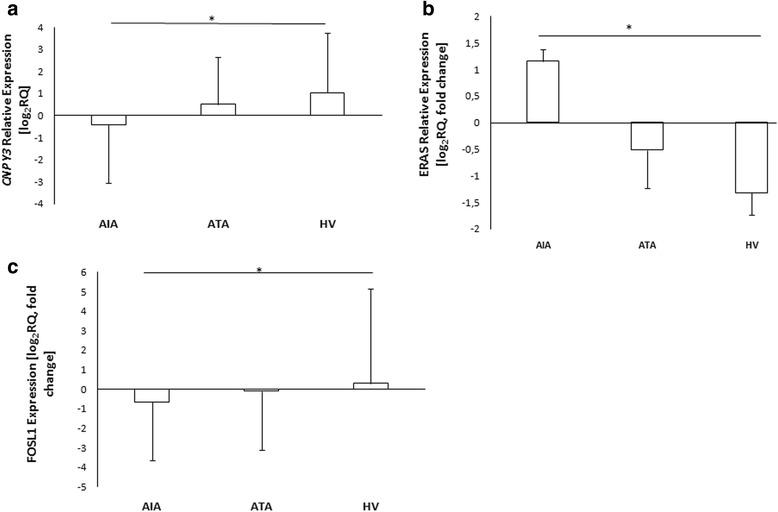
The validation of results at mRNA level has shown only three genes, whose expression was significantly altered between comprising groups. mRNA expression of CNPY3 in PBMCs in AIA was significantly lower (-0.41 ± 2.67) than in HV (1.04 ± 2.69), (p = 0.02); mRNA expression of FOSL1 in PBMCs in AIA was also significantly decreased (-0.66 ± 2.97) as opposed to HV (0.31 ± 4.83), (p = 0.02). While mRNA expression of ERAS in PBMCs was increased (1.15 ± 0.23) in AIA in comparison to HV (-1.32 ± 0.41), (p = 0.03). At protein level the changed expression of one protein was confirmed. Protein expression of FOSL1 in PBMCs in AIA was both significantly lower (-0.86 ± 0.08) than in ATA (0.39 ± 0.42), (p = 0.046) and in HV (0.9 ± 0.27), (p = 0.007).
CONCLUSIONS
This pilot study implies a positive association between CNPY3, ERAS, FOSL1 and aspirin-intolerant asthma, suggesting that these findings would be useful for further investigations of NSAIDs mechanism.
背景
高达30%的重度哮喘成年患者对阿司匹林过敏,目前尚无明确理论能圆满解释某些哮喘患者为何会发生阿司匹林诱发的哮喘(AIA)。因此,本研究旨在比较高加索人群体外阿司匹林激发后,外周血单个核细胞(PBMCs)中AIA的表达谱与阿司匹林耐受哮喘(ATA)及健康志愿者(HV)的表达谱。
方法
从三组受试者的血液中分离出PBMCs,即11例AIA患者、7例ATA患者和15名HV,然后用2 μM赖氨酸阿司匹林或20 μM赖氨酸作为对照进行刺激。随后,提取RNA,转录成cDNA,并进行微阵列和qPCR研究。同时,从PBMCs中提取蛋白质,用于进一步的免疫印迹分析。
结果
mRNA水平结果验证显示,只有三个基因在各组成组之间表达有显著变化。AIA患者PBMCs中CNPY3的mRNA表达(-0.41±2.67)显著低于HV(1.04±2.69),(p = 0.02);AIA患者PBMCs中FOSL1的mRNA表达(-0.66±2.97)也显著低于HV(0.31±4.83),(p = 0.02)。而AIA患者PBMCs中ERAS的mRNA表达(1.15±0.23)相较于HV(-1.32±0.41)有所增加,(p = 0.03)。在蛋白质水平上,证实了一种蛋白质的表达发生了变化。AIA患者PBMCs中FOSL1的蛋白质表达(-0.86±0.08)显著低于ATA患者(0.39±0.42),(p = 0.046)和HV(0.9±0.27),(p = 0.007)。
结论
这项初步研究表明CNPY3、ERAS、FOSL1与阿司匹林不耐受性哮喘之间存在正相关,提示这些发现将有助于进一步研究非甾体抗炎药的作用机制。






 Zotero 插件