
未用药的精神分裂症患者大规模功能网络的异常及利培酮的作用
Abnormalities in large scale functional networks in unmedicated patients with schizophrenia and effects of risperidone.
作者信息
Kraguljac Nina Vanessa, White David Matthew, Hadley Jennifer Ann, Visscher Kristina, Knight David, ver Hoef Lawrence, Falola Blessing, Lahti Adrienne Carol
机构信息
Department of Psychiatry and Behavioral Neurobiology, University of Alabama at Birmingham, Birmingham, AL, 35294, USA.
Department of Neurobiology, University of Alabama at Birmingham, Birmingham, AL 35294, USA.
出版信息
Neuroimage Clin. 2015 Nov 22;10:146-58. doi: 10.1016/j.nicl.2015.11.015. eCollection 2016.
OBJECTIVE
To describe abnormalities in large scale functional networks in unmedicated patients with schizophrenia and to examine effects of risperidone on networks.
MATERIAL AND METHODS
34 unmedicated patients with schizophrenia and 34 matched healthy controls were enrolled in this longitudinal study. We collected resting state functional MRI data with a 3T scanner at baseline and six weeks after they were started on risperidone. In addition, a group of 19 healthy controls were scanned twice six weeks apart. Four large scale networks, the dorsal attention network, executive control network, salience network, and default mode network were identified with seed based functional connectivity analyses. Group differences in connectivity, as well as changes in connectivity over time, were assessed on the group's participant level functional connectivity maps.
RESULTS
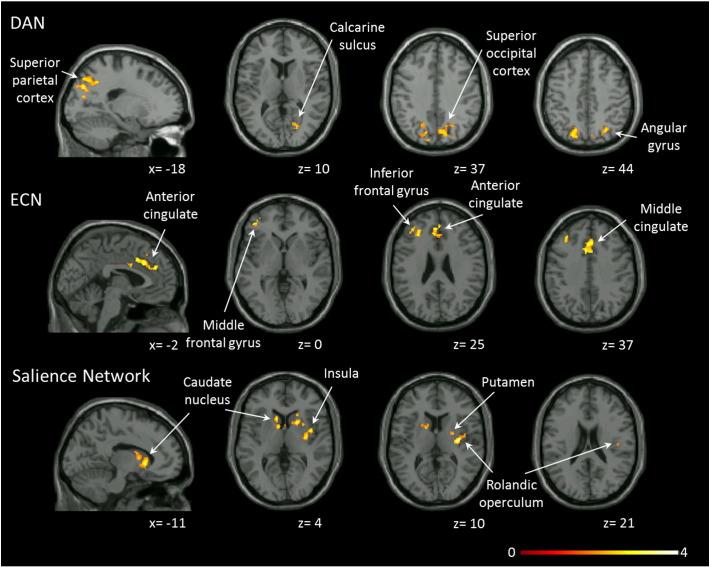
In unmedicated patients with schizophrenia we found resting state connectivity to be increased in the dorsal attention network, executive control network, and salience network relative to control participants, but not the default mode network. Dysconnectivity was attenuated after six weeks of treatment only in the dorsal attention network. Baseline connectivity in this network was also related to clinical response at six weeks of treatment with risperidone.
CONCLUSIONS
Our results demonstrate abnormalities in large scale functional networks in patients with schizophrenia that are modulated by risperidone only to a certain extent, underscoring the dire need for development of novel antipsychotic medications that have the ability to alleviate symptoms through attenuation of dysconnectivity.
目的
描述未用药的精神分裂症患者大规模功能网络的异常情况,并研究利培酮对这些网络的影响。
材料与方法
34名未用药的精神分裂症患者和34名匹配的健康对照者参与了这项纵向研究。我们在基线时以及他们开始服用利培酮六周后,用3T扫描仪收集静息态功能磁共振成像数据。此外,一组19名健康对照者在六周内接受了两次扫描。通过基于种子点的功能连接分析确定了四个大规模网络,即背侧注意网络、执行控制网络、突显网络和默认模式网络。在组内参与者水平的功能连接图上评估连接性的组间差异以及连接性随时间的变化。
结果
在未用药的精神分裂症患者中,我们发现相对于对照参与者,背侧注意网络、执行控制网络和突显网络的静息态连接性增加,但默认模式网络未增加。仅在背侧注意网络中,治疗六周后失连接情况有所减轻。该网络的基线连接性也与利培酮治疗六周后的临床反应相关。
结论
我们的结果表明精神分裂症患者的大规模功能网络存在异常,而利培酮仅在一定程度上对其进行调节,这突出了迫切需要开发新型抗精神病药物,这些药物能够通过减轻失连接来缓解症状。



 Zotero 插件