Karawani Hanin, Bitan Tali, Attias Joseph, Banai Karen
The Department of Communication Sciences and Disorders, Faculty of Social Welfare and Health Sciences, University of Haifa Haifa, Israel.
The Department of Psychology, Faculty of Social Sciences, University of Haifa Haifa, Israel.
Front Psychol. 2016 Feb 3;6:2066. doi: 10.3389/fpsyg.2015.02066. eCollection 2015.
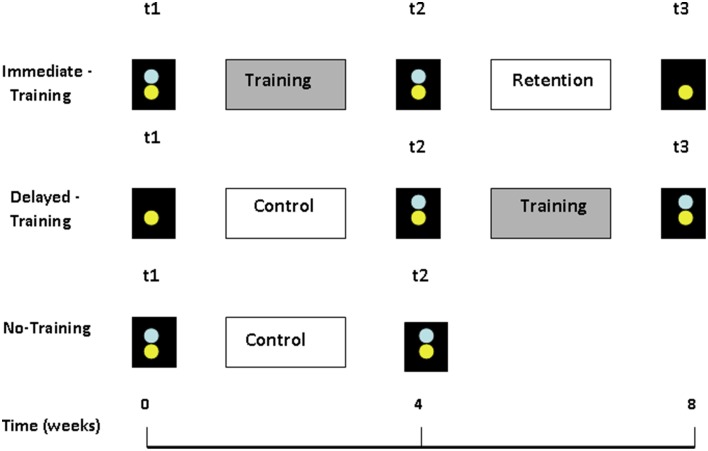
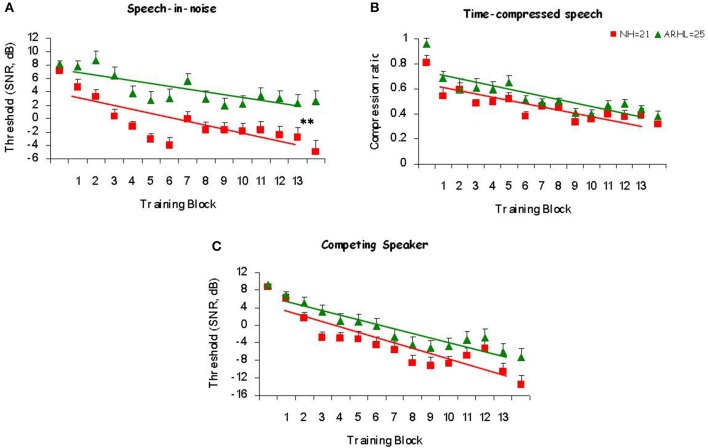
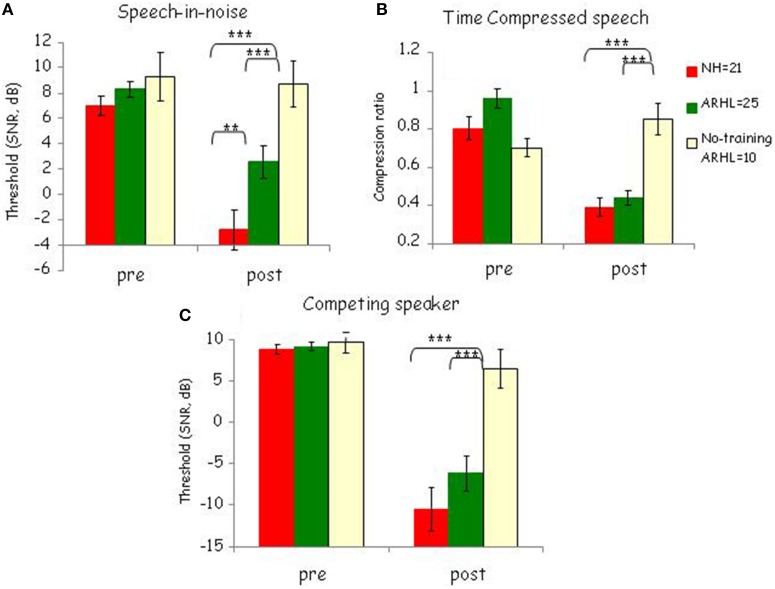
Introduction : Speech recognition in adverse listening conditions becomes more difficult as we age, particularly for individuals with age-related hearing loss (ARHL). Whether these difficulties can be eased with training remains debated, because it is not clear whether the outcomes are sufficiently general to be of use outside of the training context. The aim of the current study was to compare training-induced learning and generalization between normal-hearing older adults and those with ARHL. Methods : Fifty-six listeners (60-72 y/o), 35 participants with ARHL, and 21 normal hearing adults participated in the study. The study design was a cross over design with three groups (immediate-training, delayed-training, and no-training group). Trained participants received 13 sessions of home-based auditory training over the course of 4 weeks. Three adverse listening conditions were targeted: (1) Speech-in-noise, (2) time compressed speech, and (3) competing speakers, and the outcomes of training were compared between normal and ARHL groups. Pre- and post-test sessions were completed by all participants. Outcome measures included tests on all of the trained conditions as well as on a series of untrained conditions designed to assess the transfer of learning to other speech and non-speech conditions. Results : Significant improvements on all trained conditions were observed in both ARHL and normal-hearing groups over the course of training. Normal hearing participants learned more than participants with ARHL in the speech-in-noise condition, but showed similar patterns of learning in the other conditions. Greater pre- to post-test changes were observed in trained than in untrained listeners on all trained conditions. In addition, the ability of trained listeners from the ARHL group to discriminate minimally different pseudowords in noise also improved with training. Conclusions : ARHL did not preclude auditory perceptual learning but there was little generalization to untrained conditions. We suggest that most training-related changes occurred at higher level task-specific cognitive processes in both groups. However, these were enhanced by high quality perceptual representations in the normal-hearing group. In contrast, some training-related changes have also occurred at the level of phonemic representations in the ARHL group, consistent with an interaction between bottom-up and top-down processes.
随着年龄的增长,在不利听力条件下的语音识别变得更加困难,对于患有年龄相关性听力损失(ARHL)的个体尤其如此。这些困难能否通过训练得到缓解仍存在争议,因为尚不清楚训练结果是否具有足够的普遍性,能够在训练环境之外发挥作用。本研究的目的是比较正常听力的老年人与患有ARHL的老年人在训练诱导学习和泛化方面的差异。方法:56名年龄在60至72岁之间的听众参与了该研究,其中35名患有ARHL,21名听力正常的成年人。研究设计为交叉设计,分为三组(即时训练组、延迟训练组和无训练组)。接受训练的参与者在4周内进行了13次基于家庭的听觉训练。针对三种不利听力条件进行训练:(1)噪声中的语音,(2)时间压缩语音,(3)竞争说话者,并比较正常组和ARHL组的训练结果。所有参与者均完成了训练前和训练后的测试。结果测量包括对所有训练条件以及一系列未训练条件的测试,这些未训练条件旨在评估学习向其他语音和非语音条件的迁移情况。结果:在训练过程中,ARHL组和正常听力组在所有训练条件下均有显著改善。在噪声中的语音条件下,听力正常的参与者比患有ARHL的参与者学习得更多,但在其他条件下表现出相似的学习模式。在所有训练条件下,训练后的参与者比未训练的参与者在训练前到训练后的变化更大。此外,ARHL组经过训练的听众在噪声中辨别最小差异伪词的能力也随着训练而提高。结论:ARHL并不妨碍听觉感知学习,但对未训练条件的泛化能力较弱。我们认为,两组中与训练相关的大多数变化发生在更高层次的特定任务认知过程中。然而,正常听力组高质量的感知表征增强了这些变化。相比之下,ARHL组中一些与训练相关的变化也发生在音素表征层面,这与自下而上和自上而下过程之间的相互作用一致。