
交替氧化酶途径通过调节细胞活性氧、苹果酸阀和抗氧化系统在渗透胁迫和温度胁迫期间优化光合作用。
Alternative Oxidase Pathway Optimizes Photosynthesis During Osmotic and Temperature Stress by Regulating Cellular ROS, Malate Valve and Antioxidative Systems.
作者信息
Dinakar Challabathula, Vishwakarma Abhaypratap, Raghavendra Agepati S, Padmasree Kollipara
机构信息
Department of Plant Sciences, School of Life Sciences, University of HyderabadHyderabad, India; Department of Life Sciences, School of Basic and Applied Sciences, Central University of Tamil NaduThiruvarur, India.
Department of Plant Sciences, School of Life Sciences, University of Hyderabad Hyderabad, India.
出版信息
Front Plant Sci. 2016 Feb 9;7:68. doi: 10.3389/fpls.2016.00068. eCollection 2016.
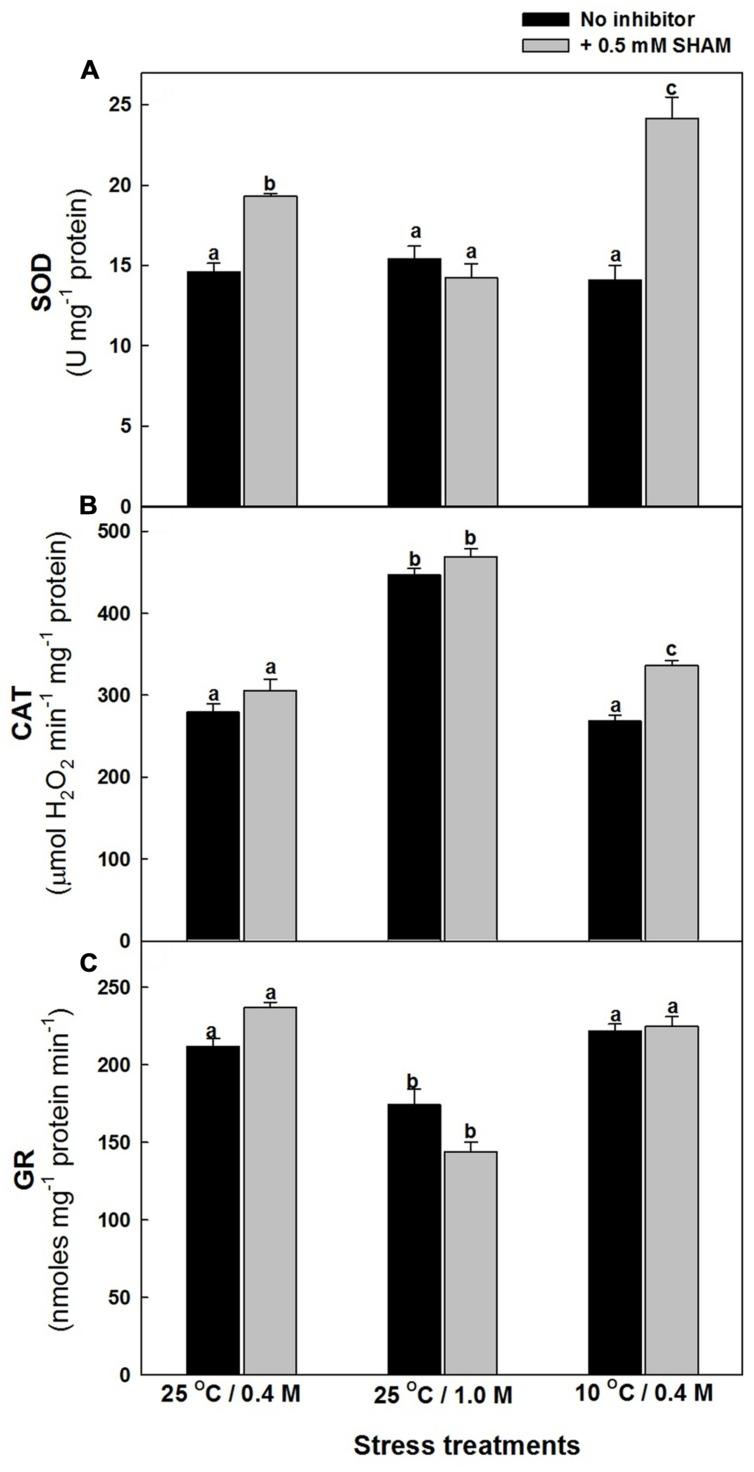
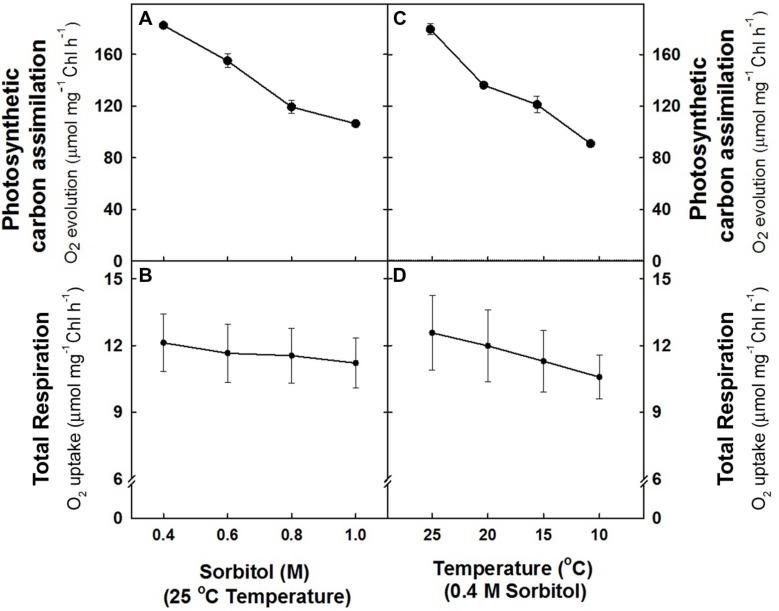
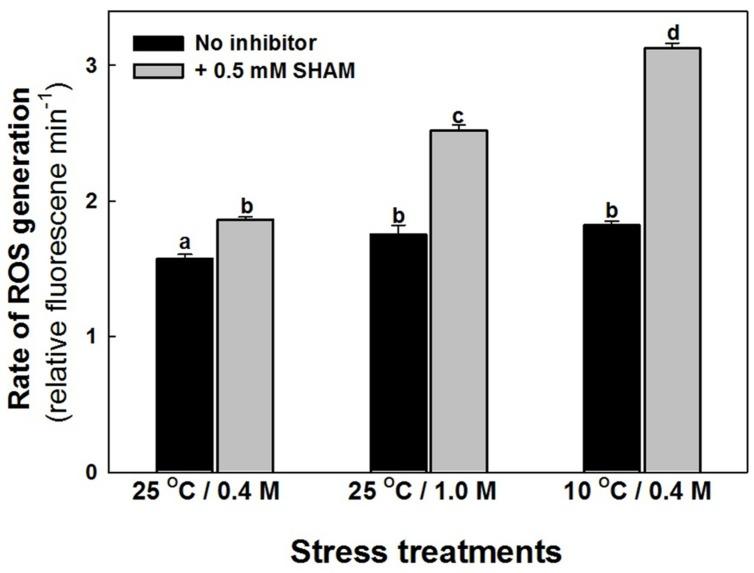
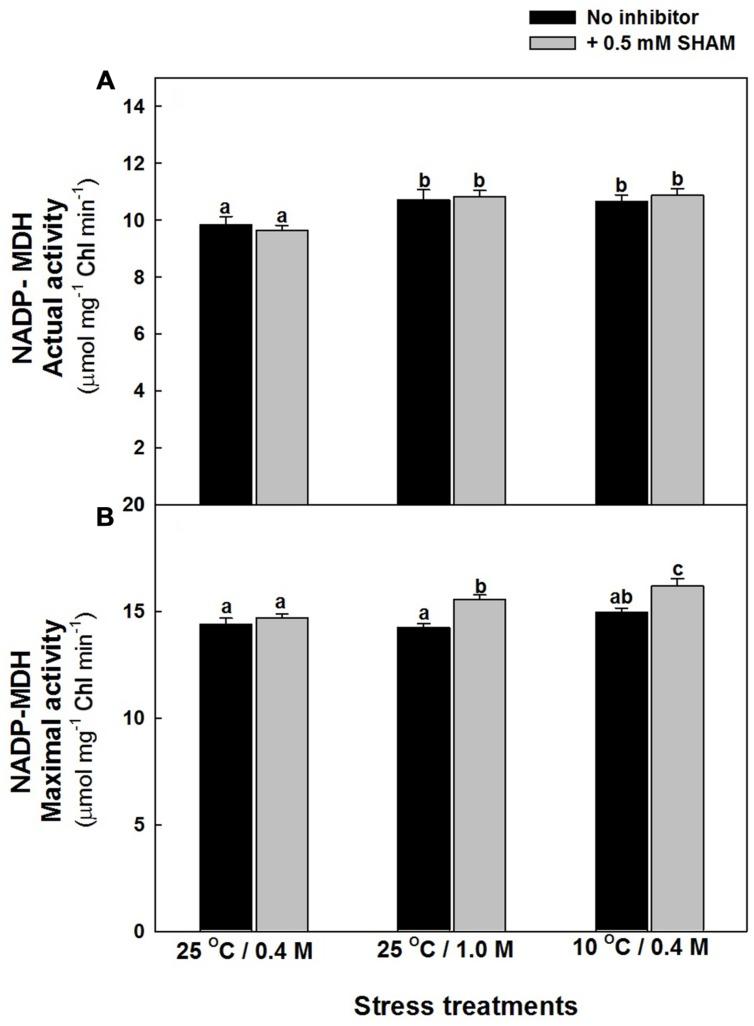
The present study reveals the importance of alternative oxidase (AOX) pathway in optimizing photosynthesis under osmotic and temperature stress conditions in the mesophyll protoplasts of Pisum sativum. The responses of photosynthesis and respiration were monitored at saturating light intensity of 1000 μmoles m(-2) s(-1) at 25°C under a range of sorbitol concentrations from 0.4 to 1.0 M to induce hyper-osmotic stress and by varying the temperature of the thermo-jacketed pre-incubation chamber from 25 to 10°C to impose sub-optimal temperature stress. Compared to controls (0.4 M sorbitol and 25°C), the mesophyll protoplasts showed remarkable decrease in NaHCO3-dependent O2 evolution (indicator of photosynthetic carbon assimilation), under both hyper-osmotic (1.0 M sorbitol) and sub-optimal temperature stress conditions (10°C), while the decrease in rates of respiratory O2 uptake were marginal. The capacity of AOX pathway increased significantly in parallel to increase in intracellular pyruvate and reactive oxygen species (ROS) levels under both hyper-osmotic stress and sub-optimal temperature stress under the background of saturating light. The ratio of redox couple (Malate/OAA) related to malate valve increased in contrast to the ratio of redox couple (GSH/GSSG) related to antioxidative system during hyper-osmotic stress. Further, the ratio of GSH/GSSG decreased in the presence of sub-optimal temperature, while the ratio of Malate/OAA showed no visible changes. Also, the redox ratios of pyridine nucleotides increased under hyper-osmotic (NADH/NAD) and sub-optimal temperature (NADPH/NADP) stresses, respectively. However, upon restriction of AOX pathway by using salicylhydroxamic acid (SHAM), the observed changes in NaHCO3-dependent O2 evolution, cellular ROS, redox ratios of Malate/OAA, NAD(P)H/NAD(P) and GSH/GSSG were further aggravated under stress conditions with concomitant modulations in NADP-MDH and antioxidant enzymes. Taken together, the results indicated the importance of AOX pathway in optimizing photosynthesis under both hyper-osmotic stress and sub-optimal temperatures. Regulation of ROS through redox couples related to malate valve and antioxidant system by AOX pathway to optimize photosynthesis under these stresses are discussed.
本研究揭示了交替氧化酶(AOX)途径在优化豌豆叶肉原生质体在渗透和温度胁迫条件下光合作用中的重要性。在25°C、1000 μmol m⁻² s⁻¹的饱和光强下,监测光合作用和呼吸作用的响应,通过在0.4至1.0 M的一系列山梨醇浓度下诱导高渗胁迫,并通过将热套式预孵育室的温度从25°C变化到10°C来施加次优温度胁迫。与对照(0.4 M山梨醇和25°C)相比,叶肉原生质体在高渗(1.0 M山梨醇)和次优温度胁迫条件(10°C)下,依赖NaHCO₃的O₂释放(光合碳同化指标)显著降低,而呼吸O₂摄取速率的降低幅度较小。在饱和光背景下,高渗胁迫和次优温度胁迫下,AOX途径的能力与细胞内丙酮酸和活性氧(ROS)水平的增加同时显著增加。在高渗胁迫期间,与苹果酸阀相关的氧化还原对(苹果酸/草酰乙酸)的比率增加,与抗氧化系统相关的氧化还原对(GSH/GSSG)的比率则相反。此外,在次优温度存在下,GSH/GSSG的比率降低,而苹果酸/草酰乙酸的比率没有明显变化。同样,吡啶核苷酸的氧化还原比率在高渗(NADH/NAD)和次优温度(NADPH/NADP)胁迫下分别增加。然而,通过使用水杨基羟肟酸(SHAM)限制AOX途径后,在胁迫条件下,观察到的依赖NaHCO₃的O₂释放、细胞ROS、苹果酸/草酰乙酸、NAD(P)H/NAD(P)和GSH/GSSG的氧化还原比率的变化进一步加剧,同时NADP - MDH和抗氧化酶也发生了调节。综上所述,结果表明AOX途径在高渗胁迫和次优温度下优化光合作用中的重要性。讨论了AOX途径通过与苹果酸阀和抗氧化系统相关的氧化还原对调节ROS以在这些胁迫下优化光合作用的情况。




 Zotero 插件