
Ran结合蛋白9(RanBP9)是肺癌细胞中细胞DNA损伤反应的一种新型介质。
Ran Binding Protein 9 (RanBP9) is a novel mediator of cellular DNA damage response in lung cancer cells.
作者信息
Palmieri Dario, Scarpa Mario, Tessari Anna, Uka Rexhep, Amari Foued, Lee Cindy, Richmond Timothy, Foray Claudia, Sheetz Tyler, Braddom Ashley, Burd Christin E, Parvin Jeffrey D, Ludwig Thomas, Croce Carlo M, Coppola Vincenzo
机构信息
Department of Molecular Virology, Immunology and Medical Genetics, College of Medicine, 43210 Columbus, OH, USA.
Solid Tumor Biology Program, Comprehensive Cancer Center, The Ohio State University, 43210 Columbus, OH, USA.
出版信息
Oncotarget. 2016 Apr 5;7(14):18371-83. doi: 10.18632/oncotarget.7813.
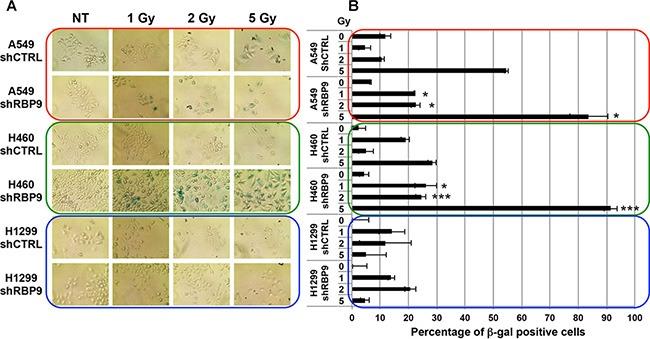
Ran Binding Protein 9 (RanBP9, also known as RanBPM) is an evolutionary conserved scaffold protein present both in the nucleus and the cytoplasm of cells whose biological functions remain elusive. We show that active ATM phosphorylates RanBP9 on at least two different residues (S181 and S603). In response to IR, RanBP9 rapidly accumulates into the nucleus of lung cancer cells, but this nuclear accumulation is prevented by ATM inhibition. RanBP9 stable silencing in three different lung cancer cell lines significantly affects the DNA Damage Response (DDR), resulting in delayed activation of key components of the cellular response to IR such as ATM itself, Chk2, γH2AX, and p53. Accordingly, abrogation of RanBP9 expression reduces homologous recombination-dependent DNA repair efficiency, causing an abnormal activation of IR-induced senescence and apoptosis. In summary, here we report that RanBP9 is a novel mediator of the cellular DDR, whose accumulation into the nucleus upon IR is dependent on ATM kinase activity. RanBP9 absence hampers the molecular mechanisms leading to efficient repair of damaged DNA, resulting in enhanced sensitivity to genotoxic stress. These findings suggest that targeting RanBP9 might enhance lung cancer cell sensitivity to genotoxic anti-neoplastic treatment.
Ran结合蛋白9(RanBP9,也称为RanBPM)是一种在细胞的细胞核和细胞质中均存在的进化保守支架蛋白,其生物学功能仍不清楚。我们发现,活性ATM可使RanBP9在至少两个不同的位点(S181和S603)发生磷酸化。响应电离辐射(IR)时,RanBP9迅速积累到肺癌细胞的细胞核中,但这种核内积累可被ATM抑制所阻止。在三种不同的肺癌细胞系中稳定沉默RanBP9会显著影响DNA损伤反应(DDR),导致细胞对IR反应的关键成分(如ATM自身、Chk2、γH2AX和p53)的激活延迟。因此,RanBP9表达的缺失会降低同源重组依赖性DNA修复效率,导致IR诱导的衰老和凋亡异常激活。总之,我们在此报告,RanBP9是细胞DDR的一种新型介质,其在IR作用下向细胞核的积累依赖于ATM激酶活性。RanBP9的缺失阻碍了导致受损DNA有效修复的分子机制,从而增强了对基因毒性应激的敏感性。这些发现表明,靶向RanBP9可能会增强肺癌细胞对基因毒性抗肿瘤治疗的敏感性。


 Zotero 插件