
一种用于合成碳酸钙分子薄片的化学模板。
A Chemical Template for Synthesis of Molecular Sheets of Calcium Carbonate.
机构信息
Engineering Division, New York University, Abu Dhabi, UAE.
Chemistry Program, New York University Abu Dhabi, Abu Dhabi, UAE.
出版信息
Sci Rep. 2016 May 5;6:25393. doi: 10.1038/srep25393.
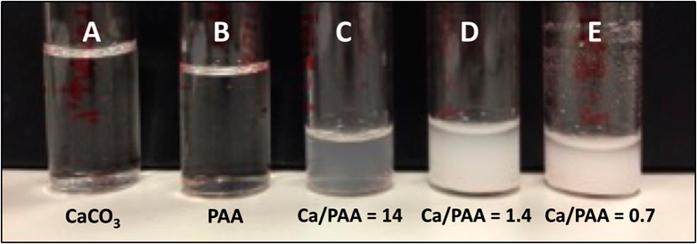
Inspired by the discovery of graphene and its unique properties, we focused our research to develop a scheme to create nacre like lamellar structures of molecular sheets of CaCO3 interleaved with an organic material, namely carbon. We developed a facile, chemical template technique, using a formulation of poly(acrylic) acid (PAA) and calcium acetate to create lamellar stacks of single crystal sheets of CaCO3, with a nominal thickness of 17 Å, the same as a unit-cell dimension for calcite (c-axis = 17.062 Å), interleaved with amorphous carbon with a nominal thickness of 8 Å. The strong binding affinity between carboxylate anions and calcium cations in the formulation was used as a molecular template to guide CaCO3 crystallization. Computational modeling of the FTIR spectra showed good agreement with experimental data and confirmed that calcium ions are bridged between polymer chains, resulting in a net-like polymer structure. The process readily lends itself to explore the feasibility of creating molecular sheets of other important inorganic materials and potentially find applications in many fields such as super capacitors and "low k di-electric" systems.
受石墨烯及其独特性质的启发,我们专注于研究开发一种方案,以创造出类似珍珠层的层状结构,其中分子层状的碳酸钙与一种有机材料(即碳)相互交错。我们开发了一种简便的化学模板技术,使用聚丙烯酸(PAA)和醋酸钙的配方来创建具有标称厚度为 17 Å 的单晶片状碳酸钙的层状堆叠,这与方解石的一个晶胞尺寸(c 轴= 17.062 Å)相同,与标称厚度为 8 Å 的无定形碳交错。配方中羧酸根阴离子和钙离子之间的强结合亲和力被用作分子模板来引导碳酸钙结晶。傅里叶变换红外光谱的计算模型与实验数据吻合较好,证实了钙离子在聚合物链之间形成桥接,从而形成网状聚合物结构。该过程易于探索其他重要无机材料的分子片的可行性,并有可能在超级电容器和“低 k 介电”系统等许多领域找到应用。




 Zotero 插件