
言语运动学习会改变对听觉和体感信号的神经反应。
Speech motor learning changes the neural response to both auditory and somatosensory signals.
作者信息
Ito Takayuki, Coppola Joshua H, Ostry David J
机构信息
Haskins Laboratories, 300 George Street, New Haven, CT, 06511, USA.
CNRS, GIPSA-LAB, 11 rue des Mathématiques, Grenoble Campus BP46, F-38402, Saint Martin D'heres Cedex, France.
出版信息
Sci Rep. 2016 May 16;6:25926. doi: 10.1038/srep25926.
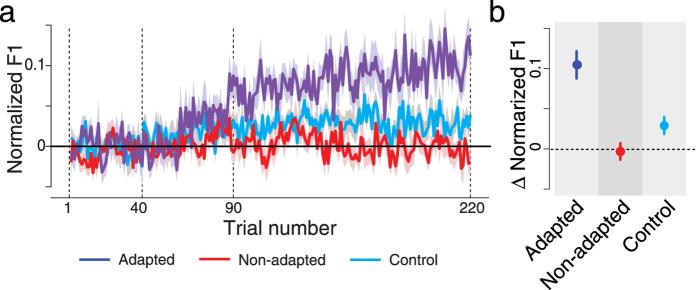
In the present paper, we present evidence for the idea that speech motor learning is accompanied by changes to the neural coding of both auditory and somatosensory stimuli. Participants in our experiments undergo adaptation to altered auditory feedback, an experimental model of speech motor learning which like visuo-motor adaptation in limb movement, requires that participants change their speech movements and associated somatosensory inputs to correct for systematic real-time changes to auditory feedback. We measure the sensory effects of adaptation by examining changes to auditory and somatosensory event-related responses. We find that adaptation results in progressive changes to speech acoustical outputs that serve to correct for the perturbation. We also observe changes in both auditory and somatosensory event-related responses that are correlated with the magnitude of adaptation. These results indicate that sensory change occurs in conjunction with the processes involved in speech motor adaptation.
在本论文中,我们提供证据支持这样一种观点,即言语运动学习伴随着听觉和体感刺激神经编码的变化。我们实验中的参与者经历对改变的听觉反馈的适应,这是一种言语运动学习的实验模型,类似于肢体运动中的视觉运动适应,要求参与者改变他们的言语运动和相关的体感输入,以校正听觉反馈的系统性实时变化。我们通过检查听觉和体感事件相关反应的变化来测量适应的感觉效应。我们发现适应导致言语声学输出的渐进变化,以校正扰动。我们还观察到听觉和体感事件相关反应的变化,这些变化与适应的程度相关。这些结果表明,感觉变化与言语运动适应所涉及的过程同时发生。




 Zotero 插件