
儿童桡骨远端畸形愈合:预期重塑的准确预测
Malunion of the distal radius in children: accurate prediction of the expected remodeling.
作者信息
van der Sluijs J A, Bron J L
机构信息
Department of Orthopaedic Surgery, VU University Medical Center, Amsterdam, The Netherlands.
出版信息
J Child Orthop. 2016 Jun;10(3):235-40. doi: 10.1007/s11832-016-0741-9. Epub 2016 May 20.
PURPOSE
Malunions of fractures in children have a natural tendency to remodel. However, quantitative data of this well-known process are scarce. The extent of the correction depends inter alia on the type of bone and the location of the deformity and growth remaining. The aim of this study was to quantify the remodeling process of distal radius malunions in children to allow better future prediction.
METHODS
Data were derived from two published patient series. Analysis included 63 malunions of distal radius fractures in 62 children (38 boys), with a mean age of 8.5 years (range 2-14.5 years).
RESULTS
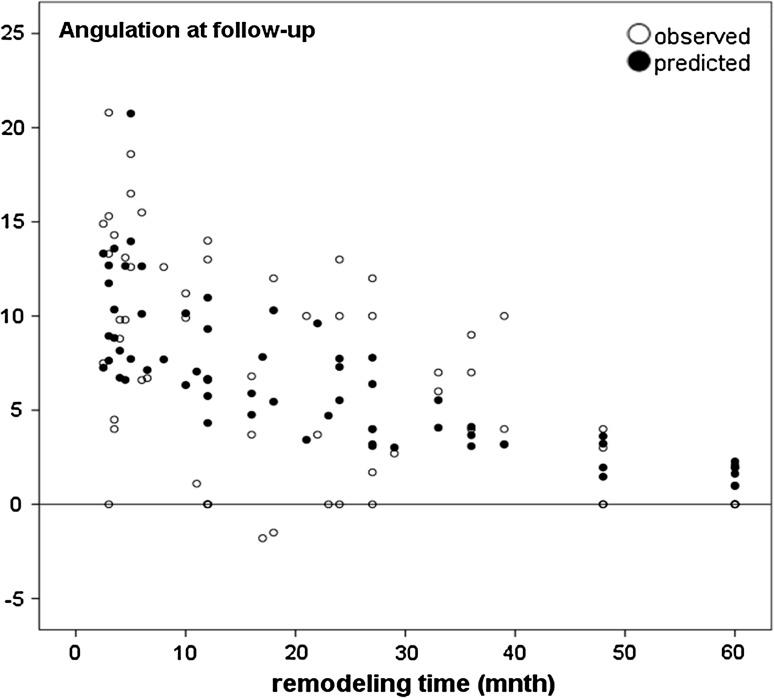
The mean initial dorsovolar angulation was 25º [standard deviation (SD) 7.8°], remodeling time 22 (SD 18) months, and angulation at follow-up 6.7° (SD 5.8°). Based on these findings, the remodeling process can be described as an exponential function with angulation (A 0) as a factor and the remodeling time (RT) as a negative exponent of e (R (2) = 0.47). The function allows accurate prediction of the expected correction in over 76 % of the malunions. From this model, a formula was derived for calculation of the time needed for complete remodeling, but this formula lacked precision when compared to findings in the literature and needs to be validated.
CONCLUSIONS
The remodeling of distal radius malunions can be described as an exponential function with starting speed dependent on the initial angulation. The current model proves to be more accurate than models described previously in the literature. These findings allow for better patient information and optimal planning of eventual surgical intervention. The postulated model could serve as a basis for the description of correction of other malunions by adaptation of the coefficients in this model.
目的
儿童骨折畸形愈合有自然重塑的趋势。然而,关于这一众所周知过程的定量数据却很匮乏。矫正程度尤其取决于骨骼类型、畸形位置以及剩余生长情况。本研究的目的是量化儿童桡骨远端畸形愈合的重塑过程,以便未来能更好地进行预测。
方法
数据来源于两个已发表的患者系列。分析包括62名儿童(38名男孩)的63例桡骨远端骨折畸形愈合,平均年龄8.5岁(范围2 - 14.5岁)。
结果
初始掌背侧成角平均为25°[标准差(SD)7.8°],重塑时间为22(SD 18)个月,随访时成角为6.7°(SD 5.8°)。基于这些发现,重塑过程可描述为以成角(A0)为因子、重塑时间(RT)为e的负指数的指数函数(R(2)=0.47)。该函数能准确预测超过76%的畸形愈合的预期矫正情况。从这个模型推导出了一个计算完全重塑所需时间的公式,但与文献中的结果相比,该公式缺乏精确性,需要进行验证。
结论
桡骨远端畸形愈合的重塑可描述为一种指数函数,起始速度取决于初始成角。当前模型比文献中先前描述的模型更准确。这些发现有助于为患者提供更好的信息,并对最终的手术干预进行优化规划。所提出的模型可作为通过调整该模型中的系数来描述其他畸形愈合矫正情况的基础。
 Zotero 插件