Goldman Orit, Valdes Victor Julian, Ezhkova Elena, Gouon-Evans Valerie
Department of Developmental and Regenerative Biology, Black Family Stem Cell Institute, Icahn School of Medicine at Mount Sinai, New York, NY 10029, USA.
Department of Developmental and Regenerative Biology, Black Family Stem Cell Institute, Icahn School of Medicine at Mount Sinai, New York, NY 10029, USA.
Stem Cell Res. 2016 Jul;17(1):62-8. doi: 10.1016/j.scr.2016.05.007. Epub 2016 May 21.
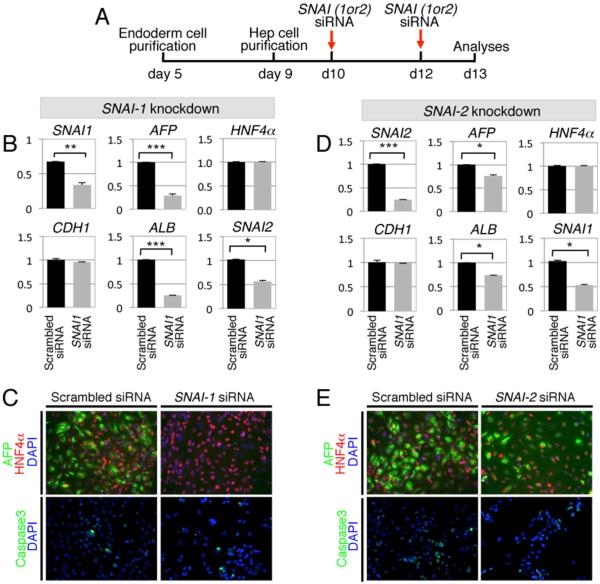
Epithelial-mesenchymal transition (EMT) and the mesenchymal-epithelial transition (MET) are processes required for embryo organogenesis. Liver develops from the epithelial foregut endoderm from which the liver progenitors, hepatoblasts, are specified. The migrating hepatoblasts acquire a mesenchymal phenotype to form the liver bud. In mid-gestation, hepatoblasts mature into epithelial structures: the hepatocyte cords and biliary ducts. While EMT has been associated with liver bud formation, nothing is known about its contribution to hepatic specification. We previously established an efficient protocol from human embryonic stem cells (hESC) to generate hepatic cells (Hep cells) resembling the hepatoblasts expressing alpha-fetoprotein (AFP) and albumin (ALB). Here we show that Hep cells express both epithelial (EpCAM and E-cadherin) and mesenchymal (vimentin and SNAI-1) markers. Similar epithelial and mesenchymal hepatoblasts were identified in human and mouse fetal livers, suggesting a conserved interspecies phenotype. Knock-down experiments demonstrated the importance of SNAI-1 in Hep cell hepatic specification. Moreover, ChIP assays revealed direct binding of SNAI-1 in the promoters of AFP and ALB genes consistent with its transcriptional activator function in hepatic specification. Altogether, our hESC-derived Hep cell cultures reveal the dual mesenchymal and epithelial phenotype of hepatoblast-like cells and support the unexpected transcriptional activator role of SNAI-1 in hepatic specification.
上皮-间质转化(EMT)和间质-上皮转化(MET)是胚胎器官发生所必需的过程。肝脏由上皮性前肠内胚层发育而来,肝脏祖细胞即成肝细胞由此分化产生。迁移的成肝细胞获得间充质表型以形成肝芽。在妊娠中期,成肝细胞成熟为上皮结构:肝细胞索和胆管。虽然EMT与肝芽形成有关,但其对肝脏分化的贡献尚不清楚。我们之前建立了一种从人胚胎干细胞(hESC)高效生成肝细胞(Hep细胞)的方法,这些肝细胞类似于表达甲胎蛋白(AFP)和白蛋白(ALB)的成肝细胞。在此我们表明,Hep细胞同时表达上皮标记物(EpCAM和E-钙黏蛋白)和间充质标记物(波形蛋白和SNAI-1)。在人和小鼠胎肝中也鉴定出了类似的上皮性和间充质性成肝细胞,这表明存在一种保守的种间表型。敲低实验证明了SNAI-1在Hep细胞肝脏分化中的重要性。此外,染色质免疫沉淀实验(ChIP)显示SNAI-1直接结合在AFP和ALB基因的启动子上,这与其在肝脏分化中的转录激活功能一致。总之,我们从hESC衍生的Hep细胞培养物揭示了成肝细胞样细胞的双间充质和上皮表型,并支持了SNAI-1在肝脏分化中意想不到的转录激活作用。