
肾上腺切除术对促肾上腺皮质激素释放因子尿皮质素I保护大鼠吲哚美辛诱导的肠病作用的影响。
Influence of Adrenalectomy on Protective Effects of Urocortin I, a Corticotropin-Releasing Factor, Against Indomethacin-Induced Enteropathy in Rats.
作者信息
Takeuchi Koji, Abe Naoko, Kumano Aiko
机构信息
General Incorporated Association, Kyoto Research Center for Gastrointestinal Diseases, Karasuma-Oike, Kyoto 604-8106, Japan.
出版信息
Curr Neuropharmacol. 2016;14(8):866-875. doi: 10.2174/1570159x14666160701020807.
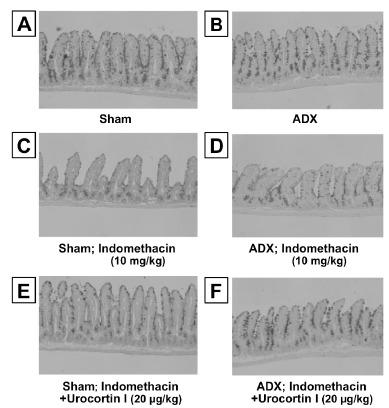
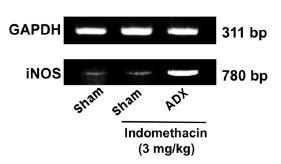
We examined the influence of adrenalectomy on NSAID-induced small intestinal damage in rats and investigated the possible involvement of adrenal glucocorticoids in the protective effects of urocortin I, a corticotropin-releasing factor (CRF) agonist. Male SD rats without fasting were administered indomethacin s.c. and killed 24 h later in order to examine the hemorrhagic lesions that developed in the small intestine. Urocortin I (20 μg/kg) was given i.v. 10 min before the administration of indomethacin. Bilateral adrenalectomy was performed a week before the experiment. Indomethacin (10 mg/kg) caused multiple hemorrhagic lesions in the small intestine, which were accompanied by a decrease in mucus secretion and increases in intestinal motility, enterobacterial invasion, and iNOS expression. Adrenalectomy markedly increased the ulcerogenic and motility responses caused by indomethacin, with further enhancements in bacterial invasion and iNOS expression; severe lesions occurred at 3 mg/kg, a dose that did not induce any damage in sham-operated rats. This worsening effect was also observed by the pretreatment with mifepristone (a glucocorticoid receptor antagonist). Urocortin I prevented indomethacin-induced enteropathy, and this effect was completely abrogated by the pretreatment with astressin 2B, a CRF2 receptor antagonist, but was not significantly affected by either adrenalectomy or the mifepristone pretreatment. These results suggested that adrenalectomy aggravated the intestinal ulcerogenic response to indomethacin, the intestinal hypermotility response may be a key element in the mechanism for this aggravation, and endogenous glucocorticoids played a role in intestinal mucosal defense against indomethacin-induced enteropathy, but did not account for the protective effects of urocortin I, which were mediated by the activation of peripheral CRF2 receptors.
我们研究了肾上腺切除术对非甾体抗炎药(NSAID)诱导的大鼠小肠损伤的影响,并探讨了肾上腺糖皮质激素是否可能参与了促肾上腺皮质激素释放因子(CRF)激动剂尿皮质素I的保护作用。对未禁食的雄性SD大鼠皮下注射吲哚美辛,并在24小时后处死,以检查小肠中出现的出血性病变。在注射吲哚美辛前10分钟静脉注射尿皮质素I(20μg/kg)。在实验前一周进行双侧肾上腺切除术。吲哚美辛(10mg/kg)在小肠中引起多处出血性病变,同时伴有黏液分泌减少、肠蠕动增加、肠道细菌侵袭增加和诱导型一氧化氮合酶(iNOS)表达增加。肾上腺切除术显著增加了吲哚美辛引起的致溃疡和蠕动反应,细菌侵袭和iNOS表达进一步增强;在3mg/kg剂量时出现严重病变,而该剂量在假手术大鼠中未诱导任何损伤。米非司酮(一种糖皮质激素受体拮抗剂)预处理也观察到了这种恶化作用。尿皮质素I可预防吲哚美辛诱导的肠病,而这种作用被CRF2受体拮抗剂astressin 2B预处理完全消除,但肾上腺切除术或米非司酮预处理对此无显著影响。这些结果表明,肾上腺切除术加重了对吲哚美辛的肠道致溃疡反应,肠道蠕动亢进反应可能是这种加重机制的关键因素,内源性糖皮质激素在肠道黏膜抵御吲哚美辛诱导的肠病中发挥作用,但不能解释尿皮质素I的保护作用,其保护作用是由外周CRF2受体的激活介导的。



 Zotero 插件