Meisch Richard A, Gomez Thomas H
The University of Texas Health Science Center at Houston.
J Exp Anal Behav. 2016 Jul;106(1):75-92. doi: 10.1002/jeab.215. Epub 2016 Jul 12.
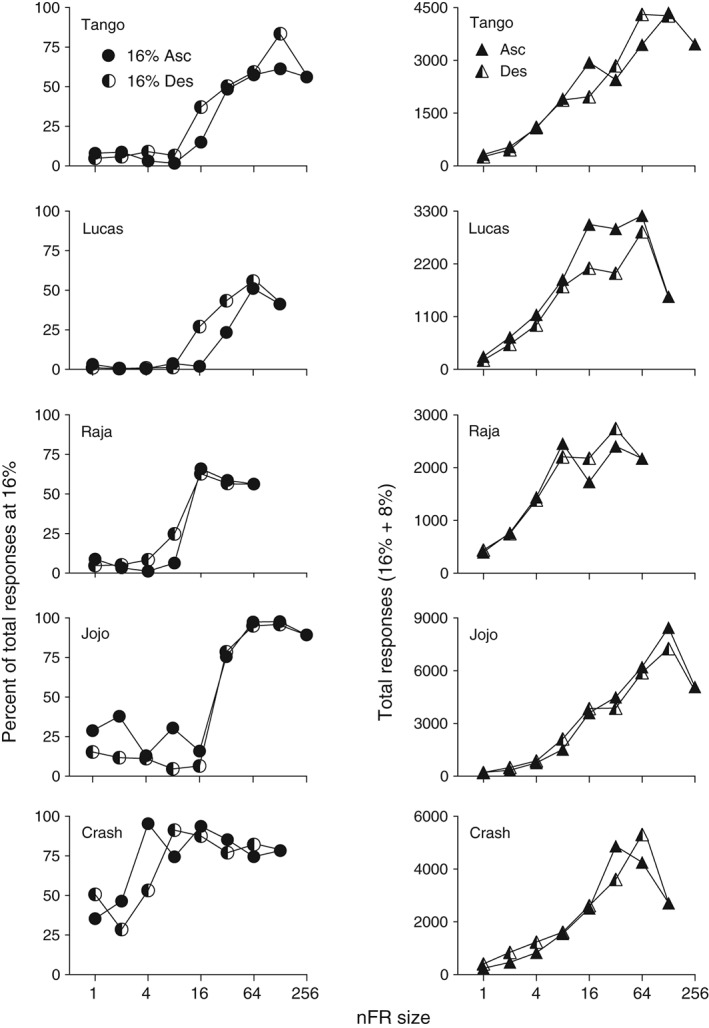
Choice behavior was studied under concurrent nonindependent fixed-ratio fixed-ratio (nFR) schedules of reinforcement, as these schedules result in frequent changeover responses. With these schedules, responses on either operandum count toward the completion of the ratio requirements of both schedules. Five monkeys were subjects, and two pairs of liquid reinforcers were concurrently available: 16% (w/v) and 0% ethanol or 16% and 8% ethanol. For each pair of reinforcers, the nFR sizes were systematically altered across sessions while keeping the schedule size equal for both liquids. Responding varied as a function of reinforcer pair and nFR size. With the 16% and 0% pair, higher response rates were maintained by 16% and were an inverted U-shape function of nFR size. With 16% and 8%, a greater number of responses initially occurred on the schedule that delivered 8% ethanol. However, as nFR size increased, preference reversed such that responses that delivered 16% ethanol were greater. When the nFR size was subsequently decreased, preference reverted back to 8%. Number of responses emitted per delivery was a dependent variable and, in behavioral economic terms, was the price paid for each liquid delivery. With 16% and 0%, changeover responses initially increased and then decreased as schedule size became larger. In contrast, with the 16% and 8% pair, changeover responses increased directly with schedule size. Responding under nFR schedules is sensitive to differences in reinforcer magnitude and demonstrates that relative reinforcing effects can change as a function of schedule size.
在并发非独立固定比率固定比率(nFR)强化程序下研究了选择行为,因为这些程序会导致频繁的转换反应。在这些程序中,对任一操作杆的反应都计入两个程序的比率要求的完成情况。以5只猴子为实验对象,同时提供两对液体强化物:16%(w/v)乙醇和0%乙醇或16%乙醇和8%乙醇。对于每对强化物,在各实验时段系统地改变nFR的大小,同时保持两种液体的程序大小相等。反应随强化物对和nFR大小而变化。对于16%和0%这一对,16%的强化物维持了较高的反应率,且反应率是nFR大小的倒U形函数。对于16%和8%这一对,最初在提供8%乙醇的程序上出现的反应更多。然而,随着nFR大小增加,偏好发生逆转,使得提供16%乙醇的反应更多。当nFR大小随后减小时,偏好又恢复到8%。每次投放发出的反应次数是一个因变量,从行为经济学角度来看,是为每次液体投放支付的代价。对于16%和0%这一对,随着程序大小变大,转换反应最初增加,然后减少。相比之下,对于16%和8%这一对,转换反应随程序大小直接增加。在nFR程序下的反应对强化物强度的差异敏感,并表明相对强化效果会随程序大小而变化。