Thaler B, Hohensinner P J, Krychtiuk K A, Matzneller P, Koller L, Brekalo M, Maurer G, Huber K, Zeitlinger M, Jilma B, Wojta J, Speidl W S
Department of Internal Medicine II, Medical University of Vienna, Vienna, Austria.
Ludwig Boltzmann Cluster for Cardiovascular Research, Vienna, Austria.
Sci Rep. 2016 Jul 22;6:30162. doi: 10.1038/srep30162.
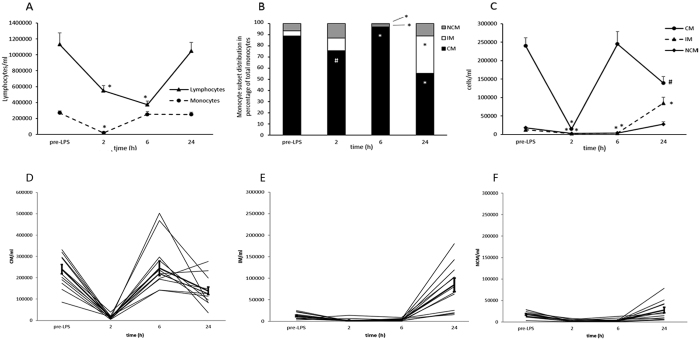
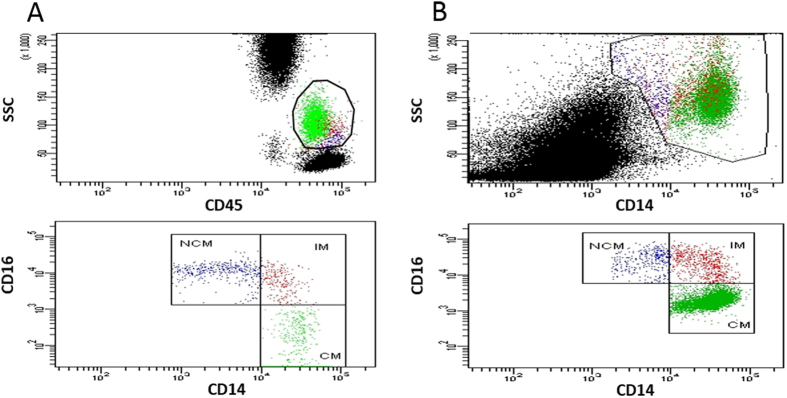
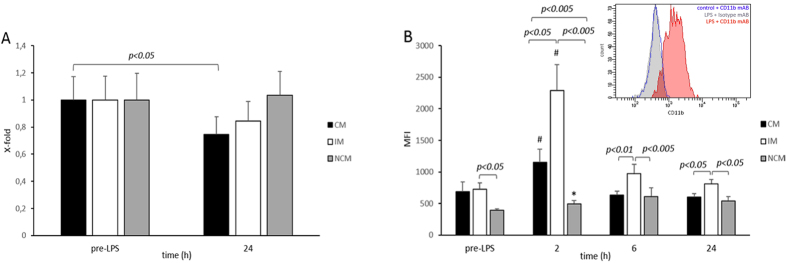
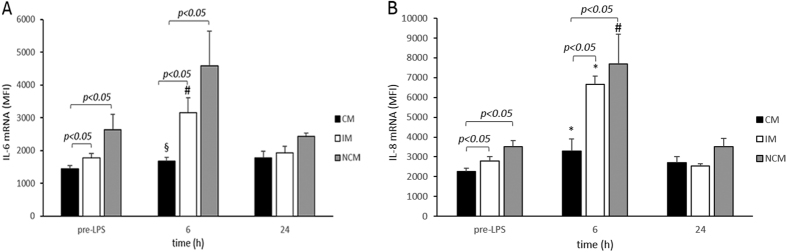
Human monocytes are a heterogeneous cell population, which can be divided into a classical (CD14++CD16-), a non-classical (CD14+CD16+), and an intermediate (CD14++CD16+) subset. We hypothesized that low-grade inflammation may differentially affect monocyte subsets. We used a human lipopolysaccharide (LPS) infusion model to mimic low-grade inflammation to identify, which monocyte subsets are preferentially activated under these conditions. Monocyte subsets were identified by staining for CD14 and CD16, activation status of monocytes was analyzed by staining for CD11b and a novel in situ mRNA hybridization approach to detect IL-6 and IL-8 specific mRNA at the single-cell level by flow cytometry. After LPS challenge, cell numbers of monocyte subsets dropped after 2 h with cell numbers recovering after 6 h. Distribution of monocyte subsets was skewed dramatically towards the intermediate subset after 24 h. Furthermore, intermediate monocytes displayed the largest increase of CD11b expression after 2 h. Finally, IL-6 and IL-8 mRNA levels increased in intermediate and non-classical monocytes after 6 h whereas these mRNA levels in classical monocytes changed only marginally. In conclusion, our data indicates that the main responding subset of monocytes to standardized low-grade inflammation induced by LPS in humans is the CD14++CD16+ intermediate subset followed by the CD14+CD16+ non-classical monocyte subset. Circulating classical monocytes showed comparably less reaction to LPS challenge in vivo.
人类单核细胞是一个异质性细胞群体,可分为经典型(CD14++CD16-)、非经典型(CD14+CD16+)和中间型(CD14++CD16+)亚群。我们推测低度炎症可能对单核细胞亚群产生不同影响。我们使用人类脂多糖(LPS)输注模型来模拟低度炎症,以确定在这些条件下哪些单核细胞亚群会被优先激活。通过对CD14和CD16进行染色来鉴定单核细胞亚群,通过对CD11b进行染色以及一种新的原位mRNA杂交方法,利用流式细胞术在单细胞水平检测IL-6和IL-8特异性mRNA,来分析单核细胞的激活状态。LPS刺激后,单核细胞亚群的细胞数量在2小时后下降,6小时后恢复。24小时后,单核细胞亚群的分布显著偏向中间型亚群。此外,中间型单核细胞在2小时后CD11b表达增加最多。最后,6小时后中间型和非经典型单核细胞中的IL-6和IL-8 mRNA水平升高,而经典型单核细胞中的这些mRNA水平仅略有变化。总之,我们的数据表明,在人类中,对LPS诱导的标准化低度炎症产生主要反应的单核细胞亚群是CD14++CD16+中间型亚群,其次是CD14+CD16+非经典型单核细胞亚群。循环中的经典型单核细胞在体内对LPS刺激的反应相对较小。