
Stability of Standard Electrolytic Conductivity Solutions in Glass Containers.
作者信息
Shreiner Rubina H
机构信息
National Institute of Standards and Technology, Gaithersburg, MD 20899-8393.
出版信息
J Res Natl Inst Stand Technol. 2002 Oct 1;107(5):393-9. doi: 10.6028/jres.107.032. Print 2002 Sep-Oct.
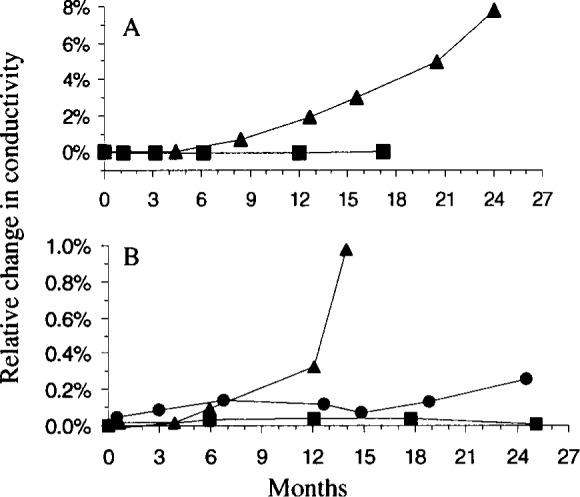
The stability of solutions having an electrolytic conductivity, κ , of 5 μS/cm to 100 000 μS/cm packaged in glass screw-cap bottles, glass serum bottles, and glass ampoules was monitored for 1 year to 2 years. The conductivity was determined by measuring the ac resistance of the solution. Mass loss was also monitored for solutions packaged in bottles. The solutions were prepared using KCl in water ( κ ≥100 μS/cm) or KCl in 30 % (by mass) n-propanol 70 % (by mass) water ( κ ≤ 15 μS/cm). The conductivity changes were compared by packaging type and by nominal κ . The main causes of the κ changes are evaporation (screw-cap bottles) and leaching (screw-cap bottles, serum bottles, and ampoules). Evaporation is determined from mass loss data; leaching occurs from the glass container with no change in mass. The choice of optimal packaging, which depends on the conductivity level, is the packaging in which κ changes the least with time. Ampoules are the most suitable packaging for standards having nominal κ values of 500 μS/cm to 100 000 μS/cm. Screw-cap bottles are most suitable for standards having a nominal κ of 5 μS/cm to 100 μS/cm.


 Zotero 插件