Möllerherm Helene, von Köckritz-Blickwede Maren, Branitzki-Heinemann Katja
Department of Physiological Chemistry, University for Veterinary Medicine Hannover , Hanover , Germany.
Department of Physiological Chemistry, University for Veterinary Medicine Hannover, Hanover, Germany; Research Center for Emerging Infections and Zoonoses (RIZ), University for Veterinary Medicine Hannover, Hanover, Germany.
Front Immunol. 2016 Jul 18;7:265. doi: 10.3389/fimmu.2016.00265. eCollection 2016.
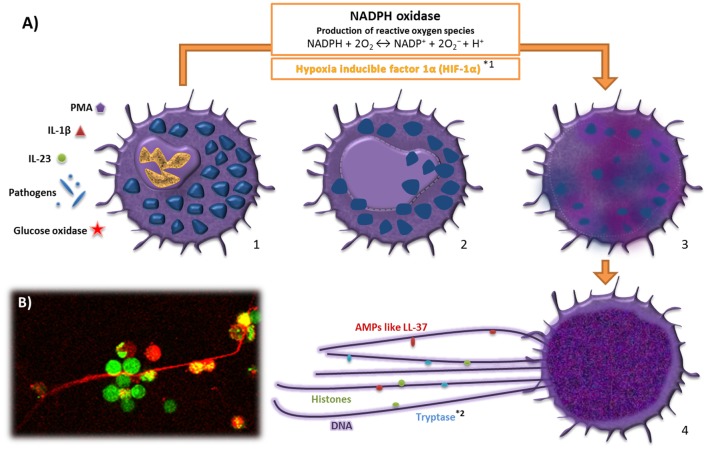
Mast cells (MCs) have been shown to release their nuclear DNA and subsequently form mast cell extracellular traps (MCETs) comparable to neutrophil extracellular traps, which are able to entrap and kill various microbes. The formation of extracellular traps is associated with the disruption of the nuclear membrane, which leads to mixing of nuclear compounds with granule components and causes the death of the cell, a process called ETosis. The question arises why do MCs release MCETs although they are very well known as multifunctional long-living sentinel cells? MCs are known to play a role during allergic reactions and certain parasitic infections. Nonetheless, they are also critical components of the early host innate immune response to bacterial and fungal pathogens: MCs contribute to the initiation of the early immune response by recruiting effector cells including neutrophils and macrophages by locally releasing inflammatory mediators, such as TNF-α. Moreover, various studies demonstrate that MCs are able to eliminate microbes through intracellular as well as extracellular antimicrobial mechanisms, including MCET formation similar to that of professional phagocytes. Recent literature leads to the suggestion that MCET formation is not the result of a passive release of DNA and granule proteins during cellular disintegration, but rather an active and controlled process in response to specific stimulation, which contributes to the innate host defense. This review will discuss the different known aspects of the antimicrobial activities of MCs with a special focus on MCETs, and their role and relevance during infection and inflammation.
肥大细胞(MCs)已被证明会释放其核DNA,随后形成与中性粒细胞胞外陷阱类似的肥大细胞胞外陷阱(MCETs),这些陷阱能够捕获并杀死各种微生物。胞外陷阱的形成与核膜的破坏有关,这会导致核化合物与颗粒成分混合,并导致细胞死亡,这一过程称为ETosis。问题在于,尽管肥大细胞作为多功能长寿哨兵细胞广为人知,但它们为什么会释放MCETs呢?已知肥大细胞在过敏反应和某些寄生虫感染中发挥作用。尽管如此,它们也是宿主对细菌和真菌病原体早期固有免疫反应的关键组成部分:肥大细胞通过局部释放炎症介质(如TNF-α)招募包括中性粒细胞和巨噬细胞在内的效应细胞,从而促进早期免疫反应的启动。此外,各种研究表明,肥大细胞能够通过细胞内和细胞外抗菌机制消除微生物,包括形成与专业吞噬细胞类似的MCETs。最近的文献表明,MCET的形成不是细胞解体过程中DNA和颗粒蛋白被动释放的结果,而是对特定刺激的一种主动且可控的过程,这有助于宿主的固有防御。本综述将讨论肥大细胞抗菌活性的不同已知方面,特别关注MCETs,以及它们在感染和炎症过程中的作用及相关性。