Sun Hongtao, Zheng Maohua, Wang Yanmin, Diao Yunfeng, Zhao Wanyong, Wei Zhengjun
Sixth Department of Neurosurgery, Affiliated Hospital of Logistics University of People's Armed Police Force, Tianjin.
Department of Neurosurgery, The First Hospital of Lanzhou University, Lanzhou, People's Republic of China.
Neuropsychiatr Dis Treat. 2016 Aug 24;12:2125-9. doi: 10.2147/NDT.S102929. eCollection 2016.
The aim of this study was to investigate the clinical significance and changes of brain tissue partial pressure of oxygen (PbtO2) in the course of mild hypothermia treatment (MHT) for treating severe traumatic brain injury (sTBI).
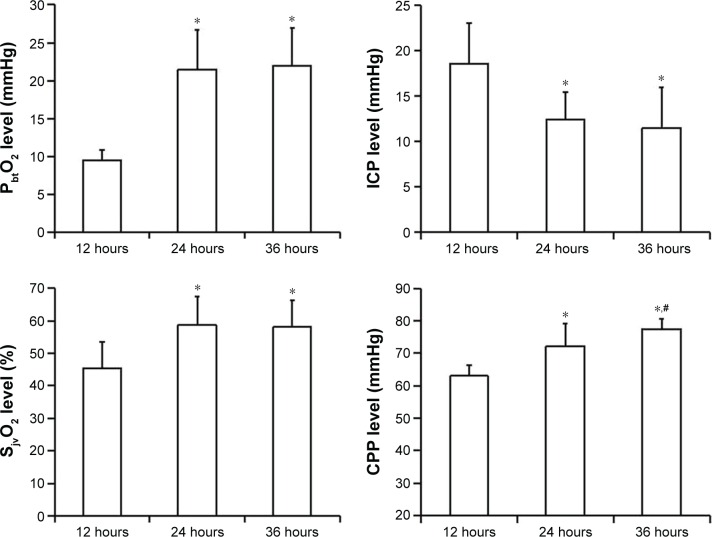
There were 68 cases with sTBI undergoing MHT. PbtO2, intracranial pressure (ICP), jugular venous oxygen saturation (SjvO2), and cerebral perfusion pressure (CPP) were continuously monitored, and clinical outcomes were evaluated using the Glasgow Outcome Scale score.
Of 68 patients with sTBI, PbtO2, SjvO2, and CPP were obviously increased, but decreased ICP level was observed throughout the MHT. PbtO2 and ICP were negatively linearly correlated, while there was a positive linear correlation between PbtO2 and SjvO2. Monitoring CPP and SjvO2 was performed under normal circumstances, and a large proportion of patients were detected with low PbtO2. Decreased PbtO2 was also found after MHT.
Continuous PbtO2 monitoring could be introduced to evaluate the condition of regional cerebral oxygen metabolism, thereby guiding the clinical treatment and predicting the outcome.
本研究旨在探讨在重度创伤性脑损伤(sTBI)亚低温治疗(MHT)过程中脑组织氧分压(PbtO2)的临床意义及变化。
68例sTBI患者接受MHT治疗。持续监测PbtO2、颅内压(ICP)、颈静脉血氧饱和度(SjvO2)和脑灌注压(CPP),并采用格拉斯哥预后量表评分评估临床结局。
68例sTBI患者中,PbtO2、SjvO2和CPP明显升高,但在整个MHT过程中ICP水平降低。PbtO2与ICP呈负线性相关,而PbtO2与SjvO2呈正线性相关。在正常情况下监测CPP和SjvO2,发现很大一部分患者PbtO2较低。MHT后也发现PbtO2降低。
可引入持续PbtO2监测以评估局部脑氧代谢状况,从而指导临床治疗并预测预后。