
基于PS技术的地基SAR大气相位屏校正
Atmospheric phase screen correction in ground-based SAR with PS technique.
作者信息
Qiu Zhiwei, Ma Yuxiao, Guo Xiantao
机构信息
Earth Science and Engineering, Hohai University, Xikang Road 1, Nanjing, 210098 China ; Henan University of Urban Construction, Longxiang Avenue, New Urban District, Pingdingshan, 467036 China.
Henan University of Urban Construction, Longxiang Avenue, New Urban District, Pingdingshan, 467036 China.
出版信息
Springerplus. 2016 Sep 17;5(1):1594. doi: 10.1186/s40064-016-3262-6. eCollection 2016.
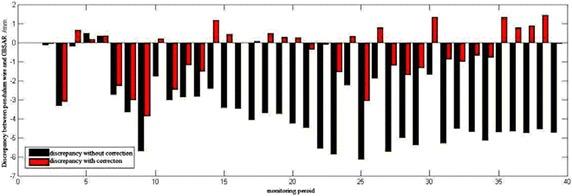
Ground-based synthetic aperture radar (GBSAR) is a powerful tool used in monitoring structures, such as bridges and dams. However, despite the extremely short range of GBSAR interferometry, the atmosphere effects cannot be neglected. The permanent scatterer technique is an effective operational tool that utilizes a long series of SAR data and detects information with high accuracy. An algorithm based on the permanent scatterer technique is developed in accordance with the phase model used in GBSAR interferometry. In this study, atmospheric correction is carried out on a real campaign (Geheyan Dam, China). The atmosphere effects created using this method, which utilizes SAR data, can be reduced effectively compared to when plumb line data are used.
地基合成孔径雷达(GBSAR)是用于监测桥梁和水坝等建筑物的强大工具。然而,尽管GBSAR干涉测量的范围极短,但大气影响仍不可忽视。永久散射体技术是一种有效的操作工具,它利用一系列SAR数据并高精度地检测信息。基于永久散射体技术的算法是根据GBSAR干涉测量中使用的相位模型开发的。在本研究中,对一次实际测量(中国隔河岩大坝)进行了大气校正。与使用铅垂线数据时相比,利用该方法(利用SAR数据)产生的大气影响可以有效降低。




 Zotero 插件