
八种栎属植物对模拟风荷载的形态学响应
Morphological Response of Eight Quercus Species to Simulated Wind Load.
作者信息
Wu Tonggui, Zhang Peng, Zhang Lei, Wang Geoff G, Yu Mukui
机构信息
East China Coastal Forest Ecosystem Long-term Research Station, Research Institute of Subtropical Forestry, Chinese Academy of Forestry, Hangzhou, Zhejiang 311400, PR China.
Department of Forestry and Environment Conservation, Clemson University, Clemson, SC29634-0317, United States of America.
出版信息
PLoS One. 2016 Sep 23;11(9):e0163613. doi: 10.1371/journal.pone.0163613. eCollection 2016.
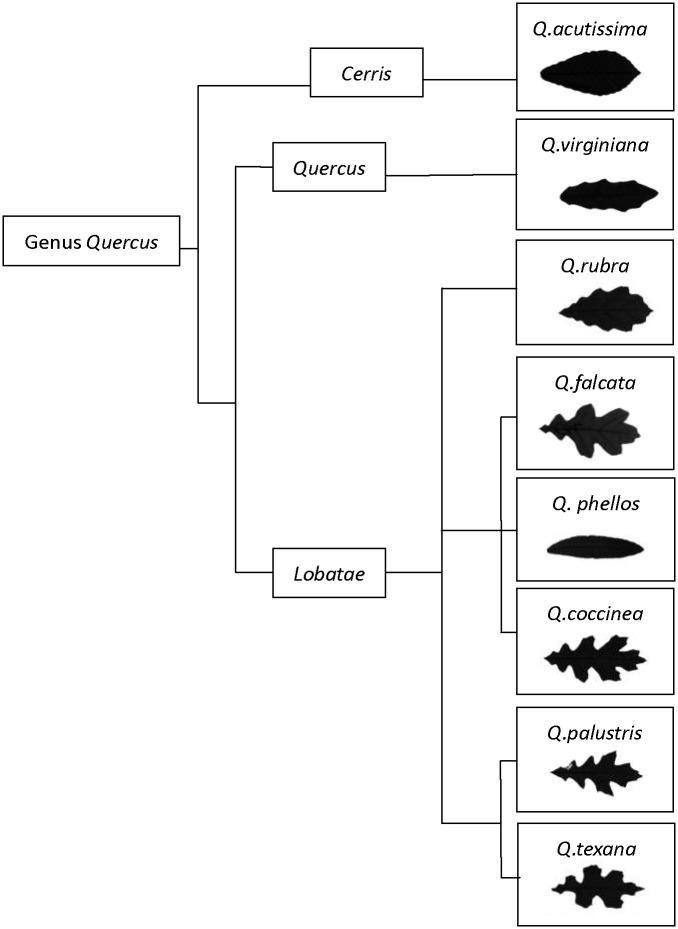
Leaf shape, including leaf size, leaf dissection index (LDI), and venation distribution, strongly impacts leaf physiology and the forces of momentum exerted on leaves or the canopy under windy conditions. Yet, little has been known about how leaf shape affects the morphological response of trees to wind load. We studied eight Quercus species, with different leaf shapes, to determine the morphological response to simulated wind load. Quercus trees with long elliptical leaves, were significantly affected by wind load (P< 0.05), as indicted by smaller specific leaf area (SLA), stem base diameter and stem height under windy conditions when compared to the control. The Quercus trees with leaves characterized by lanceolate or sinuous edges, showed positive morphological responses to wind load, such as bigger leaf thickness, larger stem diameter, allocation to root biomass, and smaller stem height (P< 0.05). These morphological responses to wind can reduce drag and increase the mechanical strength of the tree. Leaf dissection index (LDI), an important index of leaf shape, was correlated with morphological response to wind load (P< 0.05), including differences in SLA, in stem base diameter and in allocation to root biomass. These results suggest that trees with higher LDI, such as those with more and/or deeper lobes, are better adapted to wind load.
叶片形状,包括叶片大小、叶片解剖指数(LDI)和叶脉分布,对叶片生理以及在有风条件下作用于叶片或树冠的动量有很大影响。然而,关于叶片形状如何影响树木对风荷载的形态响应,人们所知甚少。我们研究了8种具有不同叶片形状的栎属物种,以确定它们对模拟风荷载的形态响应。与对照相比,具有长椭圆形叶片的栎属树木在有风条件下受到风荷载的显著影响(P<0.05),具体表现为比叶面积(SLA)、茎基部直径和茎高较小。具有披针形或边缘弯曲叶片的栎属树木对风荷载表现出积极的形态响应,如叶片厚度更大、茎直径更大、根系生物量分配增加以及茎高更小(P<0.05)。这些对风的形态响应可以减少阻力并增加树木的机械强度。叶片解剖指数(LDI)是叶片形状的一个重要指标,与对风荷载的形态响应相关(P<0.05),包括SLA、茎基部直径和根系生物量分配的差异。这些结果表明,具有较高LDI的树木,如那些有更多和/或更深裂片的树木,更能适应风荷载。



 Zotero 插件