
Notch1通过诱导上皮-间质转化信号通路促进肝细胞癌中的血管生成拟态。
Notch1 promotes vasculogenic mimicry in hepatocellular carcinoma by inducing EMT signaling.
作者信息
Jue Chen, Lin Cui, Zhisheng Zhang, Yayun Qian, Feng Jin, Min Zhao, Haibo Wang, Youyang Shi, Hisamitsu Tadashi, Shintaro Ishikawa, Shiyu Guo, Yanqing Liu
机构信息
Institution of Combining Chinese Traditional and Western Medicine, Medical College, Yangzhou University, Yangzhou, Jiangsu, China.
Department of Oncology, The Second Peoples Hospital of Taizhou Affiliated to Yangzhou University, Taizhou, Jiangsu, China.
出版信息
Oncotarget. 2017 Jan 10;8(2):2501-2513. doi: 10.18632/oncotarget.12388.
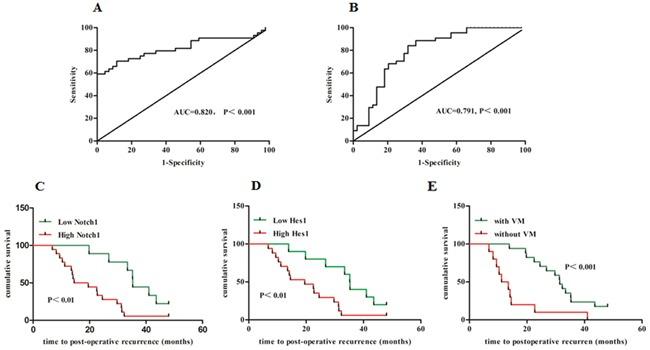
Hypervascularity is one of the main characteristics of hepatocellular carcinoma (HCC). However, the mechanisms of angiogenesis in HCC remain controversial. In this study, we investigate the role of Notch1 in angiogenesis of HCC. We found that Notch1 expression was correlated with formation of vasculogenic mimicry (VM) and expression of biomarkers of epithelial-to-mesenchymal transition (EMT) in the tumor specimens. Two HCC cell lines, HepG2 and MHCC97-H, with low and high Notch1 expression, respectively, were used to study the mechanism of VM formation both in vitro and in vivo. It was found that MHCC97-H cells, but not HepG2 cells form VM when they grow on matrigel in vitro. HepG2 cells gained the power of forming VM when they were overexpressed with Notch1, while knockdown Notch1 expression in MHCC97-H cells led to the loss of VM forming ability of the cells. Similar results were found in in vivo study. High expression of Notch1 in HepG2 promoted xenograft growth in nude mice, with abundant VM formation in the tumor samples. Moreover, we observed Notch1 was associated with the EMT and malignant behavior of hepatocellular carcinoma by analyzing clinical specimens, models for in vitro and in vivo experiments. HepG2 presented EMT phenomenon when induced by TGF-β1, accompanied by Notch1 activation while MHCC97-H with knockdown of Notch1 lost the responsiveness to TGF-β1 induction. Our results suggest that Notch1 promotes HCC progression through activating EMT pathway and forming VM. Our results will guide targeting Notch1 in new drug development.
血管生成增加是肝细胞癌(HCC)的主要特征之一。然而,HCC中血管生成的机制仍存在争议。在本研究中,我们探讨了Notch1在HCC血管生成中的作用。我们发现,肿瘤标本中Notch1的表达与血管生成拟态(VM)的形成以及上皮-间质转化(EMT)生物标志物的表达相关。分别使用Notch1表达低和高的两种HCC细胞系HepG2和MHCC97-H,在体外和体内研究VM形成的机制。结果发现,MHCC97-H细胞在体外Matrigel上生长时可形成VM,而HepG2细胞则不能。当HepG2细胞过表达Notch1时,其获得了形成VM的能力,而敲低MHCC97-H细胞中的Notch1表达则导致细胞失去形成VM的能力。在体内研究中也发现了类似的结果。HepG2中Notch1的高表达促进了裸鼠异种移植瘤的生长,肿瘤样本中有丰富的VM形成。此外,通过分析临床标本、体外和体内实验模型,我们观察到Notch1与肝细胞癌的EMT和恶性行为相关。HepG2在TGF-β1诱导下出现EMT现象,同时伴有Notch1激活,而敲低Notch1的MHCC97-H对TGF-β1诱导失去反应。我们的结果表明,Notch1通过激活EMT途径和形成VM促进HCC进展。我们的结果将为新药开发中靶向Notch1提供指导。




 Zotero 插件