Zhang Chen, Miller Cassandra L, Gorkhali Rakshya, Zou Juan, Huang Kenneth, Brown Edward M, Yang Jenny J
Department of Chemistry, Georgia State University Atlanta, GA, USA.
Center for Diagnostics and Therapeutics, Georgia State UniversityAtlanta, GA, USA; Division of Endocrinology, Diabetes and Hypertension, Department of Medicine, Brigham and Women's HospitalBoston, MA, USA.
Front Physiol. 2016 Sep 30;7:441. doi: 10.3389/fphys.2016.00441. eCollection 2016.
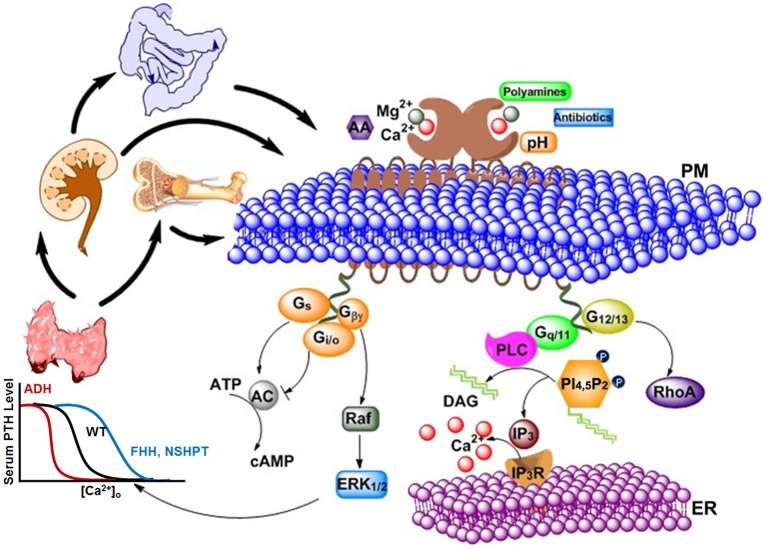
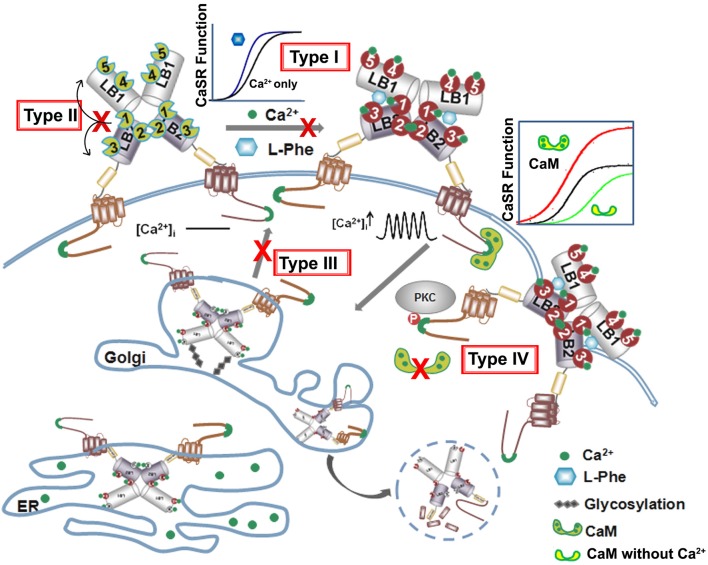
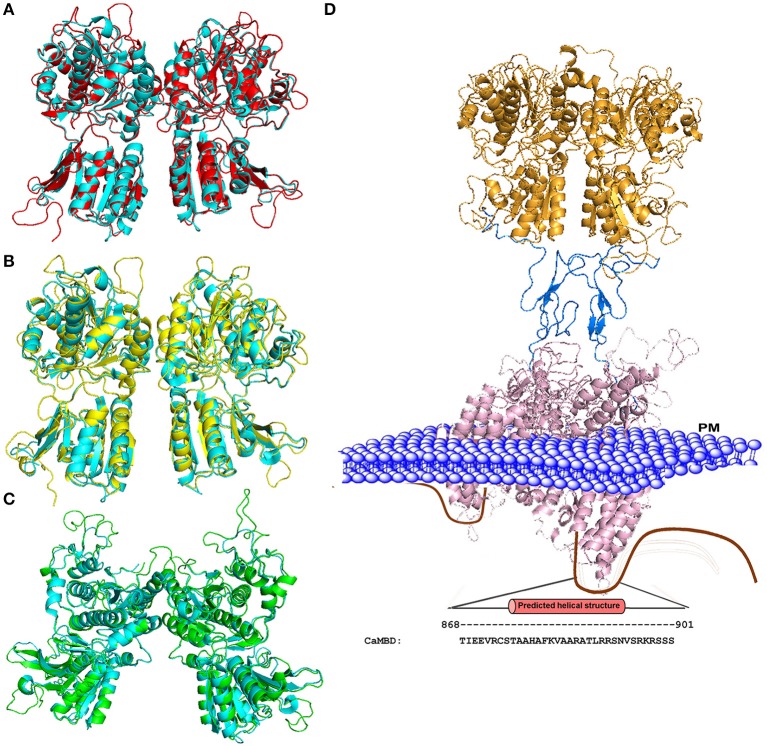
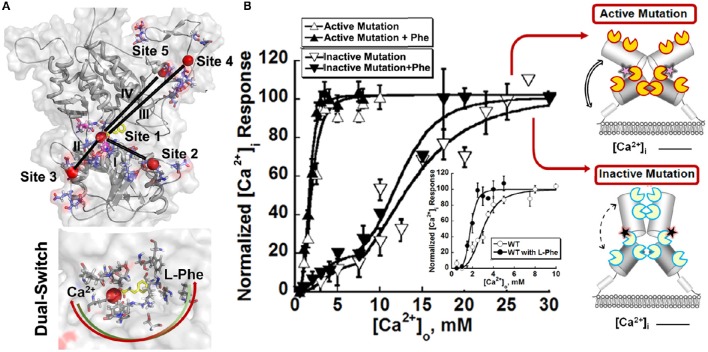
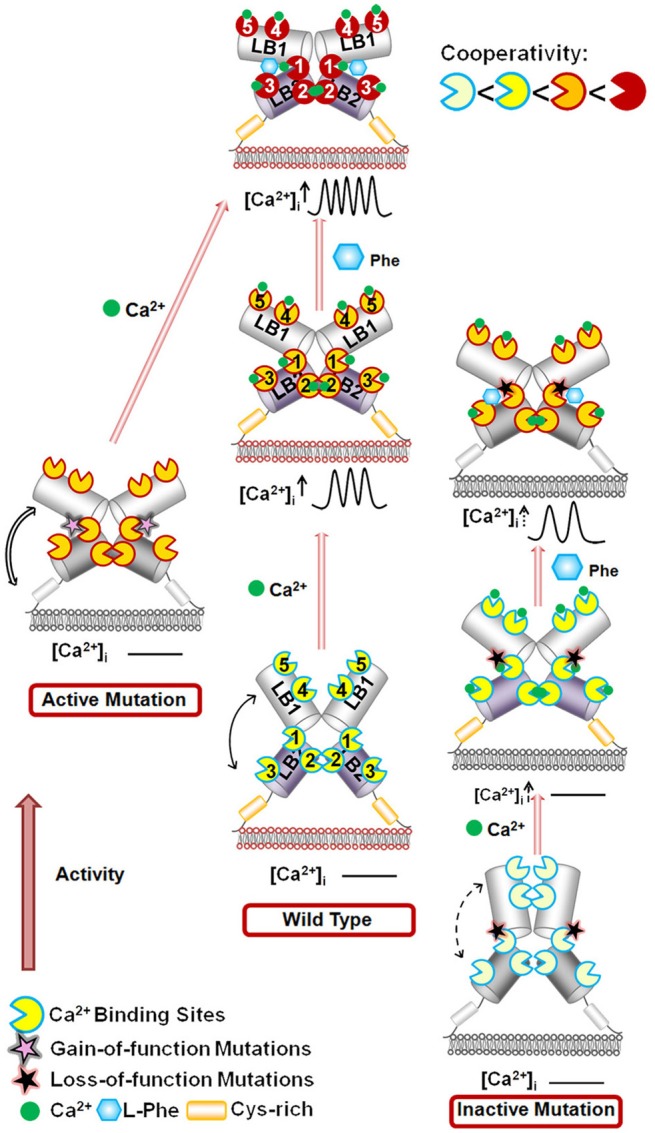
Ca-sensing receptors (CaSRs) play a central role in regulating extracellular calcium concentration ([Ca]) homeostasis and many (patho)physiological processes in multiple organs. This regulation is orchestrated by a cooperative response to extracellular stimuli such as small changes in Ca, Mg, amino acids, and other ligands. In addition, CaSR is a pleiotropic receptor regulating several intracellular signaling pathways, including calcium mobilization and intracellular calcium oscillation. Nearly 200 mutations and polymorphisms have been found in CaSR in relation to a variety of human disorders associated with abnormal Ca homeostasis. In this review, we summarize efforts directed at identifying binding sites for calcium and amino acids. Both homotropic cooperativity among multiple calcium binding sites and heterotropic cooperativity between calcium and amino acid were revealed using computational modeling, predictions, and site-directed mutagenesis coupled with functional assays. The hinge region of the bilobed Venus flytrap (VFT) domain of CaSR plays a pivotal role in coordinating multiple extracellular stimuli, leading to cooperative responses from the receptor. We further highlight the extensive number of disease-associated mutations that have also been shown to affect CaSR's cooperative action via several types of mechanisms. These results provide insights into the molecular bases of the structure and functional cooperativity of this receptor and other members of family C of the G protein-coupled receptors (cGPCRs) in health and disease states, and may assist in the prospective development of novel receptor-based therapeutics.
钙敏感受体(CaSRs)在调节细胞外钙浓度([Ca])稳态以及多个器官的许多(病理)生理过程中发挥着核心作用。这种调节是通过对细胞外刺激(如钙、镁、氨基酸和其他配体的微小变化)的协同反应来精心安排的。此外,CaSR是一种多效性受体,可调节多种细胞内信号通路,包括钙动员和细胞内钙振荡。在CaSR中已发现近200种突变和多态性,与多种与钙稳态异常相关的人类疾病有关。在这篇综述中,我们总结了旨在确定钙和氨基酸结合位点的研究工作。使用计算建模、预测、定点诱变结合功能测定,揭示了多个钙结合位点之间的同促协同作用以及钙和氨基酸之间的异促协同作用。CaSR的双叶捕蝇草(VFT)结构域的铰链区在协调多种细胞外刺激方面起着关键作用,从而导致受体的协同反应。我们进一步强调了大量与疾病相关的突变,这些突变也已被证明通过几种机制影响CaSR的协同作用。这些结果为该受体以及G蛋白偶联受体C家族(cGPCRs)其他成员在健康和疾病状态下的结构和功能协同性的分子基础提供了见解,并可能有助于基于受体的新型治疗方法的前瞻性开发。