
通过瞬态测量研究溶液处理的热激活延迟荧光(TADF)发射体4CzIPN掺杂有机发光二极管(OLED)的电致发光机制。
The Electroluminescence Mechanism of Solution-Processed TADF Emitter 4CzIPN Doped OLEDs Investigated by Transient Measurements.
作者信息
Wang Peng, Zhao Suling, Xu Zheng, Qiao Bo, Long Zhijuan, Huang Qingyu
机构信息
Institute of Optoelectronic Technology, Beijing Jiaotong University, Beijing 100044, China.
Key Laboratory of Luminescence and Optical Information, Ministry of Education, Beijing Jiaotong University, Beijing 100044, China.
出版信息
Molecules. 2016 Oct 14;21(10):1365. doi: 10.3390/molecules21101365.
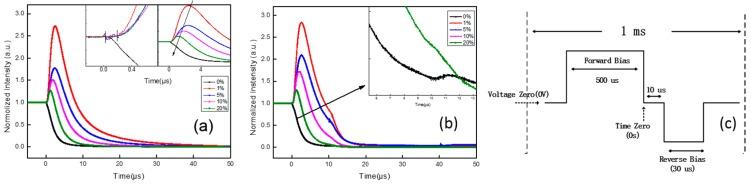
High efficiency, solution-processed, organic light emitting devices (OLEDs), using a thermally-activated delayed fluorescent (TADF) emitter, 1,2,3,5-tetrakis(carbazol-9-yl)-4,6-dicyanobenzene (4CzIPN), are fabricated, and the transient electroluminescence (EL) decay of the device with a structure of [ITO/PEDOT: PSS/4CzIPN 5 wt % doped 4,40-N,N0-dicarbazolylbiphenyl(CBP)/bis-4,6-(3,5-di-4-pyridylphenyl)-2-methylpyrimidine (B4PyMPM)/lithium fluoride (LiF)/Al], is systematically studied. The results shed light on the dominant operating mechanism in TADF-based OLEDs. Electroluminescence in the host-guest system is mainly produced from the 4CzIPN emitter, rather than the exciplex host materials.
采用热激活延迟荧光(TADF)发射体1,2,3,5-四(咔唑-9-基)-4,6-二氰基苯(4CzIPN)制备了高效、溶液法加工的有机发光器件(OLED),并对结构为[氧化铟锡/聚(3,4-乙撑二氧噻吩):聚苯乙烯磺酸盐/5 wt%掺杂4,4'-N,N'-二咔唑基联苯(CBP)的4CzIPN/双-4,6-(3,5-二-4-吡啶基苯基)-2-甲基嘧啶(B4PyMPM)/氟化锂(LiF)/铝]的器件的瞬态电致发光(EL)衰减进行了系统研究。结果揭示了基于TADF的OLED中的主要工作机制。主体-客体体系中的电致发光主要由4CzIPN发射体产生,而非激基复合物主体材料。


 Zotero 插件