
年龄和饮食会影响果蝇创伤性脑损伤后导致急性死亡的可基因分离的继发性损伤。
Age and Diet Affect Genetically Separable Secondary Injuries that Cause Acute Mortality Following Traumatic Brain Injury in Drosophila.
作者信息
Katzenberger Rebeccah J, Ganetzky Barry, Wassarman David A
机构信息
Department of Medical Genetics, School of Medicine and Public Health, University of Wisconsin-Madison, Wisconsin 53706.
Department of Genetics, College of Agriculture and Life Sciences, University of Wisconsin-Madison, Wisconsin 53706
出版信息
G3 (Bethesda). 2016 Dec 7;6(12):4151-4166. doi: 10.1534/g3.116.036194.
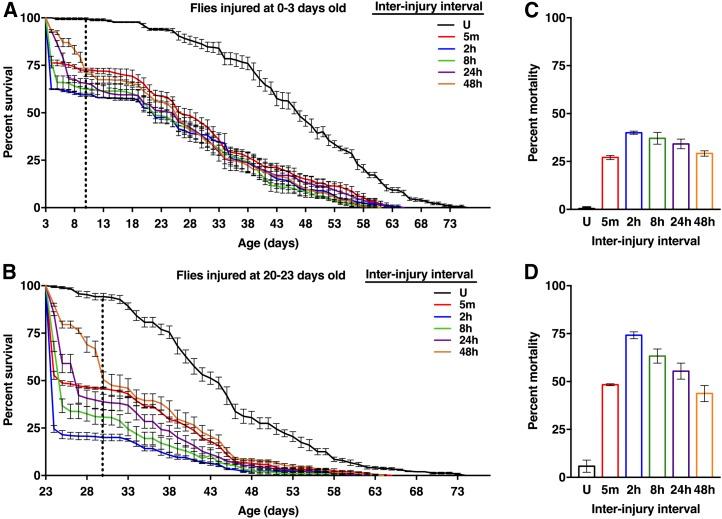
Outcomes of traumatic brain injury (TBI) vary because of differences in primary and secondary injuries. Primary injuries occur at the time of a traumatic event, whereas secondary injuries occur later as a result of cellular and molecular events activated in the brain and other tissues by primary injuries. We used a Drosophila melanogaster TBI model to investigate secondary injuries that cause acute mortality. By analyzing mortality percentage within 24 hr of primary injuries, we previously found that age at the time of primary injuries and diet afterward affect the severity of secondary injuries. Here, we show that secondary injuries peaked in activity 1-8 hr after primary injuries. Additionally, we demonstrate that age and diet activated distinct secondary injuries in a genotype-specific manner, and that concurrent activation of age- and diet-regulated secondary injuries synergistically increased mortality. To identify genes involved in secondary injuries that cause mortality, we compared genome-wide mRNA expression profiles of uninjured and injured flies under age and diet conditions that had different mortalities. During the peak period of secondary injuries, innate immune response genes were the predominant class of genes that changed expression. Furthermore, age and diet affected the magnitude of the change in expression of some innate immune response genes, suggesting roles for these genes in inhibiting secondary injuries that cause mortality. Our results indicate that the complexity of TBI outcomes is due in part to distinct, genetically controlled, age- and diet-regulated mechanisms that promote secondary injuries and that involve a subset of innate immune response genes.
创伤性脑损伤(TBI)的结果因原发性和继发性损伤的差异而有所不同。原发性损伤发生在创伤事件发生时,而继发性损伤则在原发性损伤激活大脑和其他组织中的细胞和分子事件后稍后发生。我们使用果蝇TBI模型来研究导致急性死亡的继发性损伤。通过分析原发性损伤后24小时内的死亡率,我们先前发现原发性损伤时的年龄和之后的饮食会影响继发性损伤的严重程度。在这里,我们表明继发性损伤在原发性损伤后1-8小时活动达到峰值。此外,我们证明年龄和饮食以基因型特异性方式激活不同的继发性损伤,并且年龄和饮食调节的继发性损伤的同时激活会协同增加死亡率。为了鉴定参与导致死亡的继发性损伤的基因,我们比较了在具有不同死亡率的年龄和饮食条件下未受伤和受伤果蝇的全基因组mRNA表达谱。在继发性损伤的高峰期,先天免疫反应基因是表达发生变化的主要基因类别。此外,年龄和饮食影响了一些先天免疫反应基因表达变化的幅度,表明这些基因在抑制导致死亡的继发性损伤中发挥作用。我们的结果表明,TBI结果的复杂性部分归因于促进继发性损伤且涉及先天免疫反应基因子集的独特、基因控制、年龄和饮食调节机制。



 Zotero 插件