
III期和高危II期结直肠癌患者序贯辅助化疗的可行性:采用3个月的奥沙利铂方案,随后3个月的卡培他滨:JSWOG-C2研究
Feasibility of sequential adjuvant chemotherapy with a 3-month oxaliplatin-based regimen followed by 3 months of capecitabine in patients with stage III and high-risk stage II colorectal cancer: JSWOG-C2 study.
作者信息
Tsuruta Atsushi, Yamashita Kazuki, Tanioka Hiroaki, Tsuji Akihito, Inukai Michio, Yamakawa Toshiki, Yamatsuji Tomoki, Yoshimitsu Masanori, Toyota Kazuhiro, Yamano Taketoshi, Nagasaka Takeshi, Okajima Masazumi
机构信息
Department of Digestive Surgery, Kawasaki Medical School Hospital.
Department of Surgery.
出版信息
Drug Des Devel Ther. 2016 Nov 23;10:3827-3835. doi: 10.2147/DDDT.S112322. eCollection 2016.
BACKGROUND
Six months of oxaliplatin-based chemotherapy is the standard adjuvant chemotherapy for completely resected stage III colorectal cancer (CRC). Also, patients with stage II CRC who are considered to be at high risk of disease recurrence often receive the same adjuvant chemotherapy treatment. We prospectively investigated the extent and degree of neuropathy suffered by stage III and high-risk stage II resectable CRC patients who underwent sequential approach involving 3 months of an oxaliplatin-based regimen followed by 3 months of capecitabine.
PATIENTS AND METHODS
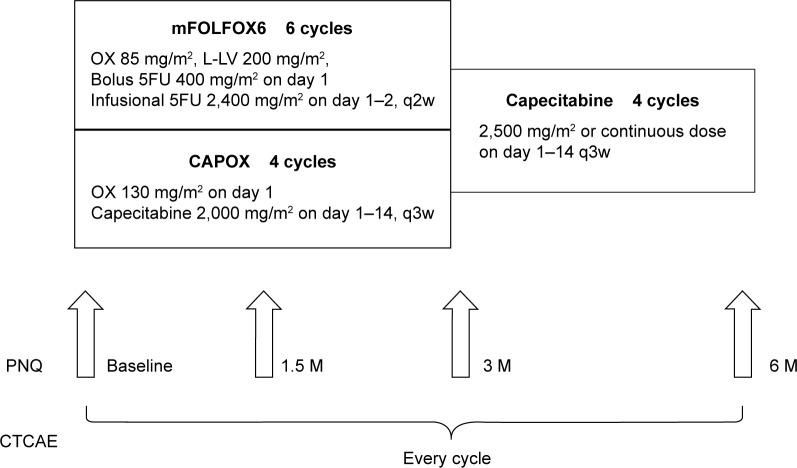
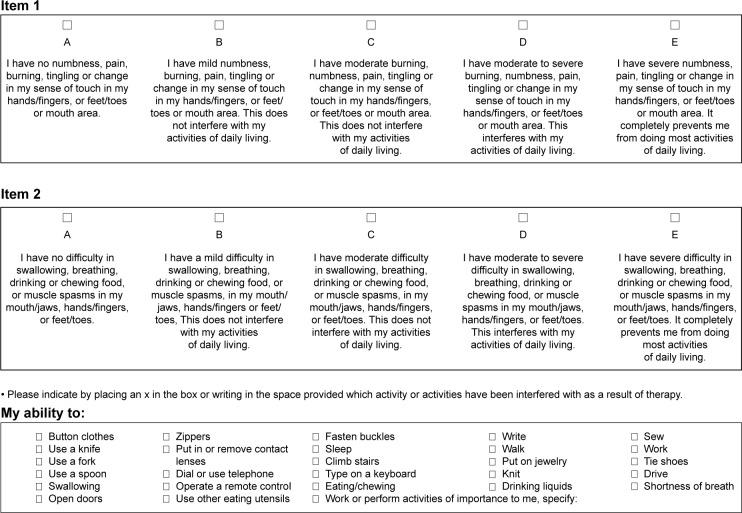
Patients with completely resected stage III and high-risk stage II CRC aged ≥20 years were eligible. Patients were treated with folinic acid, fluorouracil, and oxaliplatin (FOLFOX) or capecitabine and oxaliplatin (CAPOX) for 3 months followed by capecitabine (2,500 mg/m on days 1-14 every 3 weeks) for 3 months. Primary end points were frequency and the grade of oxaliplatin-induced neurotoxicity as evaluated using the physician-based Common Terminology Criteria for Adverse Events version 4.0 (CTCAE) grading and the patient-based scale, self-reported Patient Neurotoxicity Questionnaire.
RESULTS
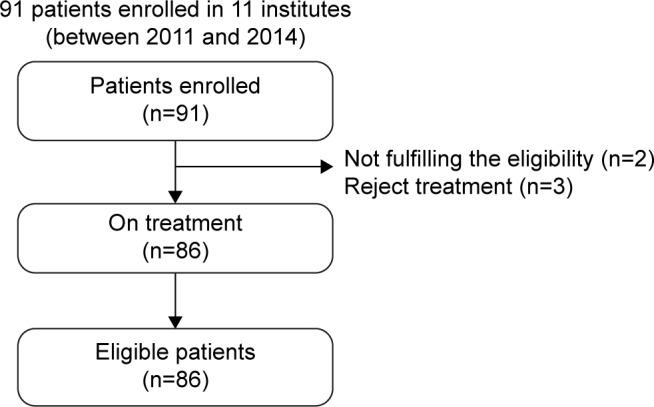
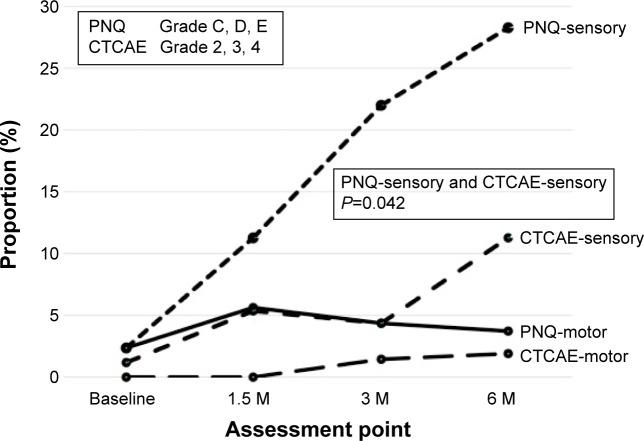
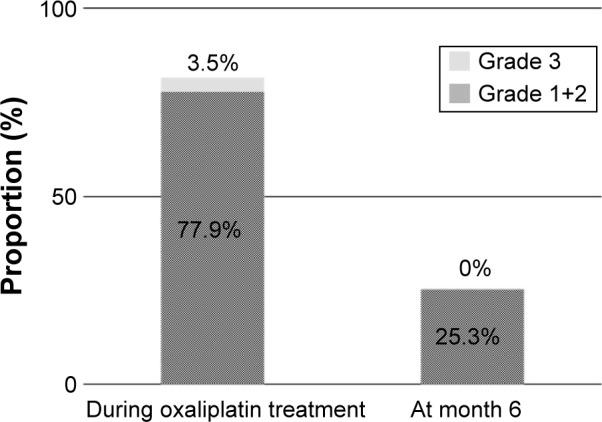
Ninety-one patients were enrolled and 86 patients assessed. Eighty-four percent of patients completed the planned oxaliplatin-based therapy for 3 months, and 63% of patients completed all treatments for the full 6 months. Overall incidences of grade 3 or 4 peripheral sensory or motor neuropathy according to the CTCAE were 3.5% and 1.2%, respectively. Regarding the peripheral sensory neuropathy, the proportion of Patient Neurotoxicity Questionnaire (grade C-E) and CTCAE (grade 2-4) at months 1.5/3/6 were 11.3/22.1/29.4% and 5.3/4.4/11.3%, respectively (Spearman correlation coefficient: 0.47).
CONCLUSION
A sequential approach to adjuvant chemotherapy with 3 months of an oxaliplatin-based regimen followed by 3 months of capecitabine was tolerated by patients and associated with a low incidence of neuropathy.
背景
对于完全切除的III期结直肠癌(CRC),基于奥沙利铂的化疗6个月是标准的辅助化疗方案。此外,被认为疾病复发风险高的II期CRC患者通常也接受相同的辅助化疗治疗。我们前瞻性地调查了接受序贯治疗(3个月基于奥沙利铂的方案,随后3个月卡培他滨)的III期和高危II期可切除CRC患者神经病变的范围和程度。
患者与方法
年龄≥20岁、完全切除的III期和高危II期CRC患者符合条件。患者接受亚叶酸、氟尿嘧啶和奥沙利铂(FOLFOX)或卡培他滨和奥沙利铂(CAPOX)治疗3个月,随后接受卡培他滨(每3周第1 - 14天2500 mg/m²)治疗3个月。主要终点是使用基于医生的《不良事件通用术语标准》第4.0版(CTCAE)分级和基于患者的量表(自我报告的患者神经毒性问卷)评估的奥沙利铂诱导的神经毒性的频率和等级。
结果
91例患者入组,86例患者接受评估。84%的患者完成了为期3个月的基于奥沙利铂的计划治疗,63%的患者完成了全部6个月的所有治疗。根据CTCAE,3级或4级周围感觉或运动神经病变的总体发生率分别为3.5%和1.2%。关于周围感觉神经病变,在第1.5/3/6个月时,患者神经毒性问卷(C - E级)和CTCAE(2 - 4级)的比例分别为11.3/22.1/29.4%和5.3/4.4/11.3%(斯皮尔曼相关系数:0.47)。
结论
患者能够耐受3个月基于奥沙利铂的方案随后3个月卡培他滨的序贯辅助化疗方法,且神经病变发生率较低。
 Zotero 插件