Juhl Alexander Andersen, Christiansen Peer, Damsgaard Tine Engberg
Plastic Surgery Research Unit, Department of Plastic and Breast Surgery, Aarhus University Hospital, Aarhus, Denmark.
Plastic Surgery Research Unit, Department of Plastic and Breast Surgery, Aarhus University Hospital, Aarhus, Denmark.; Department of Surgery, Randers Regional Hospital/Aarhus University Hospital, Aarhus, Denmark.; Danish Breast Cancer Cooperative Group, Denmark.
J Breast Cancer. 2016 Dec;19(4):447-454. doi: 10.4048/jbc.2016.19.4.447. Epub 2016 Dec 23.
Persistent pain is a common side effect of breast cancer treatment. The present study aimed to assess the prevalence, associated treatment-related factors, and the type of pain (neuropathic or nociceptive) in patients who had undergone a unilateral mastectomy.
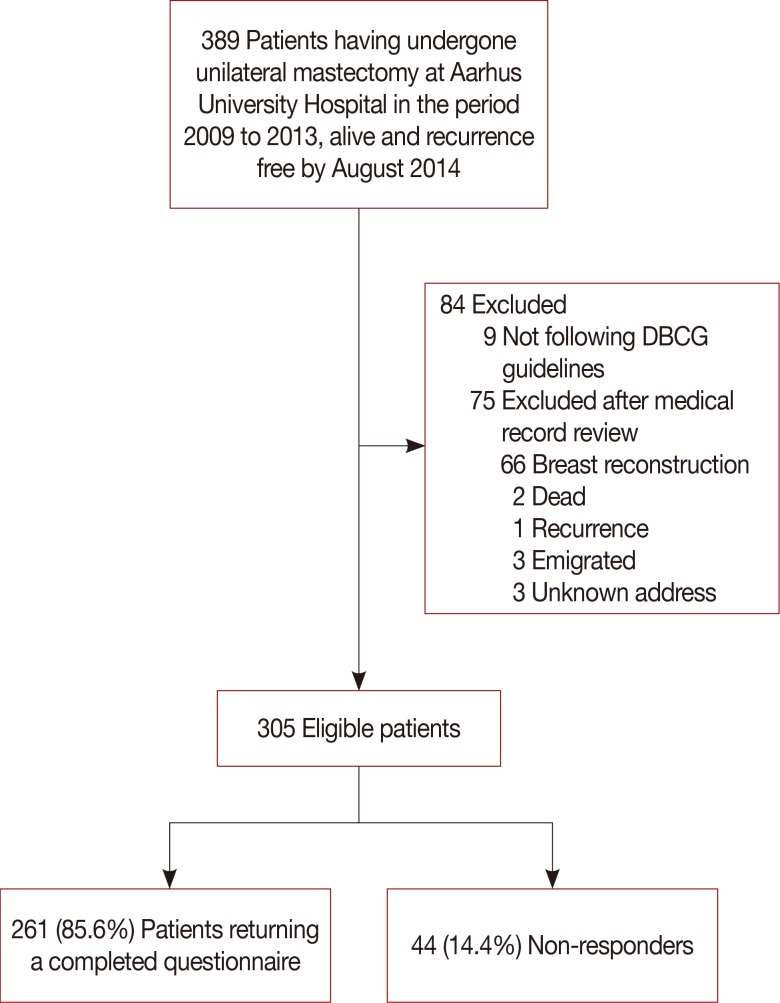
All women who underwent a unilateral mastectomy at a University Hospital between 2009 and 2013 were eligible for inclusion. Women with breast reconstruction or active cancer were excluded. Participants were mailed a questionnaire evaluating the prevalence, location, intensity, and frequency of surgical site pain. Additionally, the painDETECT®, a validated instrument to evaluate neuropathic pain, was mailed to all participants.
A total of 305 women were included, and of them, 261 (85.6%) completed the study questionnaire. After a median follow-up period of 3.0 years, 100 women (38.3%) reported experiencing pain at the surgical site. Body mass index ≥30 kg/m, radiation therapy, and axillary lymph node dissection were significantly associated with persistent pain in univariate models. However, only body mass index ≥30 kg/m was independently associated with persistent pain (odds ratio, 2.13; 95% confidence interval, 1.06-4.27; =0.034) in a multivariate analysis. Of the patients reporting pain, 71.0% were unlikely to have a neuropathic pain component. A moderate, but highly significant, positive correlation was observed between the pain intensity and the painDETECT® score (rs=0.47, <0.001).
Persistent pain after breast cancer treatment continues to have a high prevalence. Our results indicate that the largest proportion of patients experiencing persistent pain after breast cancer treatment do not have a clear neuropathic pain component.
持续性疼痛是乳腺癌治疗常见的副作用。本研究旨在评估接受单侧乳房切除术患者的疼痛患病率、相关治疗因素以及疼痛类型(神经性或伤害性)。
2009年至2013年间在某大学医院接受单侧乳房切除术的所有女性均符合纳入标准。接受乳房重建或患有活动性癌症的女性被排除在外。向参与者邮寄了一份问卷,评估手术部位疼痛的患病率、位置、强度和频率。此外,还向所有参与者邮寄了疼痛DETECT®,这是一种用于评估神经性疼痛的有效工具。
共纳入305名女性,其中261名(85.6%)完成了研究问卷。中位随访期为3.0年,100名女性(38.3%)报告手术部位疼痛。在单变量模型中,体重指数≥30kg/m²、放疗和腋窝淋巴结清扫与持续性疼痛显著相关。然而,在多变量分析中,只有体重指数≥30kg/m²与持续性疼痛独立相关(优势比,2.13;95%置信区间,1.06 - 4.27;P = 0.034)。在报告疼痛的患者中,71.0%不太可能有神经性疼痛成分。疼痛强度与疼痛DETECT®评分之间存在中度但高度显著的正相关(rs = 0.47,P < 0.001)。
乳腺癌治疗后的持续性疼痛患病率仍然很高。我们的结果表明,乳腺癌治疗后经历持续性疼痛的患者中,最大比例没有明确的神经性疼痛成分。