
微小RNA-141通过激活人视网膜色素上皮细胞和视网膜神经节细胞中的Keap1-Nrf2信号通路减轻紫外线诱导的氧化应激。
miRNA-141 attenuates UV-induced oxidative stress via activating Keap1-Nrf2 signaling in human retinal pigment epithelium cells and retinal ganglion cells.
作者信息
Cheng Li-Bo, Li Ke-Ran, Yi Nan, Li Xiu-Miao, Wang Feng, Xue Bo, Pan Ying-Shun, Yao Jin, Jiang Qin, Wu Zhi-Feng
机构信息
Department of Ophthalmology, Wuxi Second Hospital, Nanjing Medical University, Wu'xi, China.
The Affiliated Eye Hospital, Nanjing Medical University, Nanjing, China.
出版信息
Oncotarget. 2017 Feb 21;8(8):13186-13194. doi: 10.18632/oncotarget.14489.
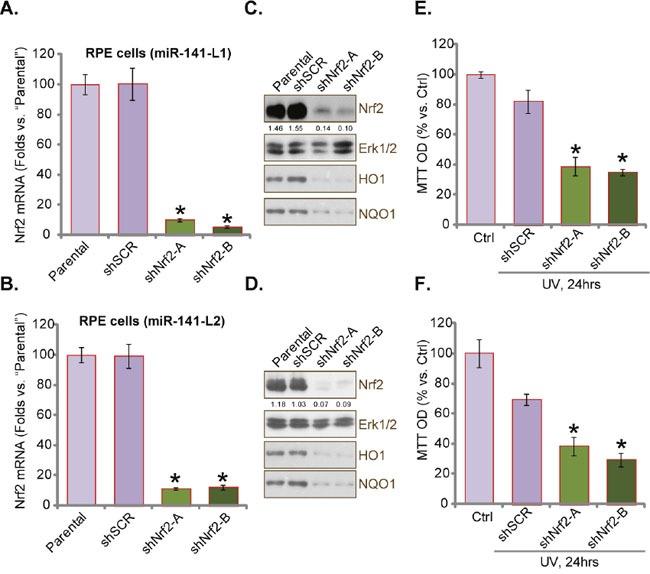
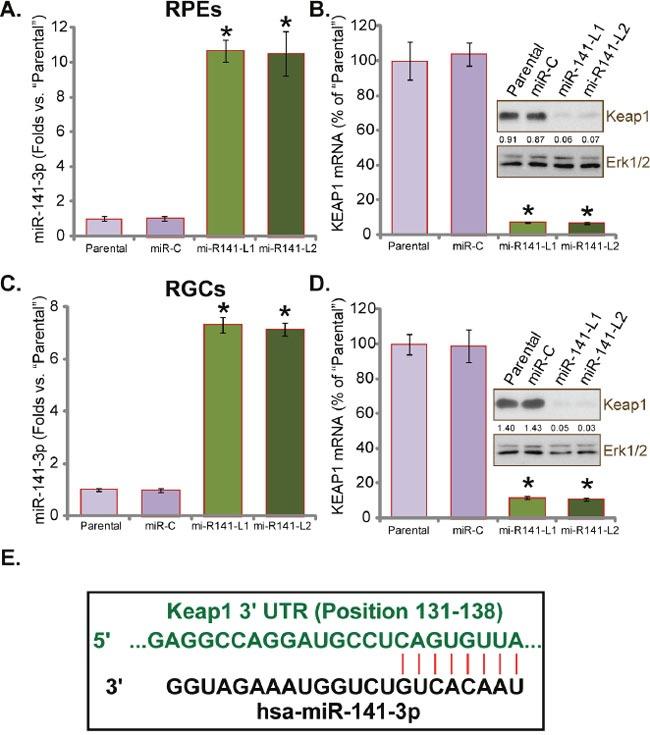
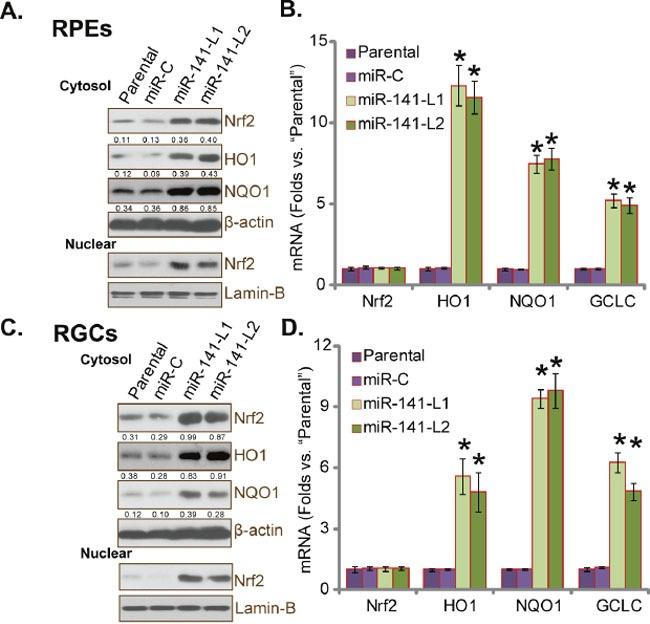
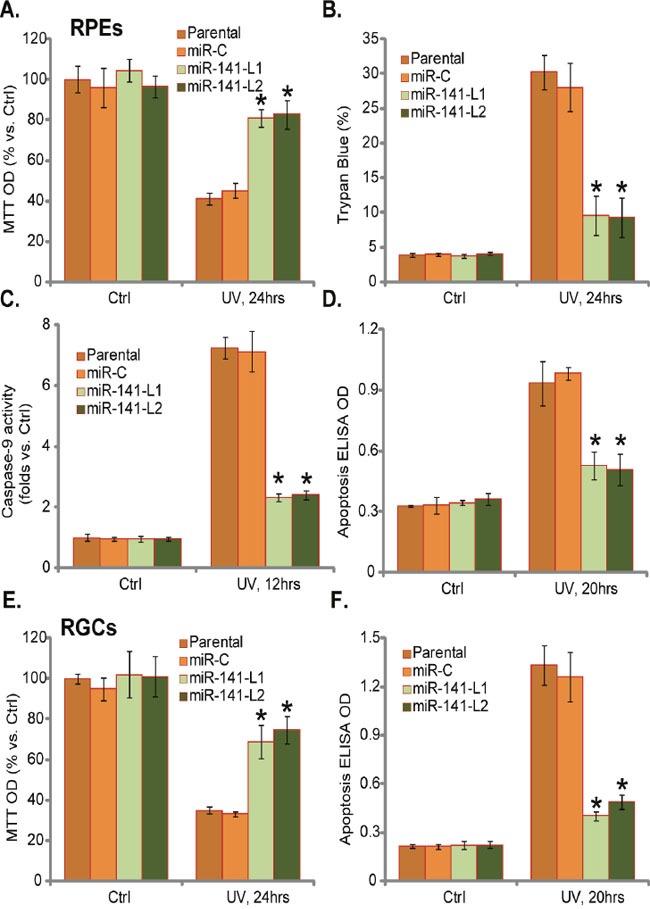
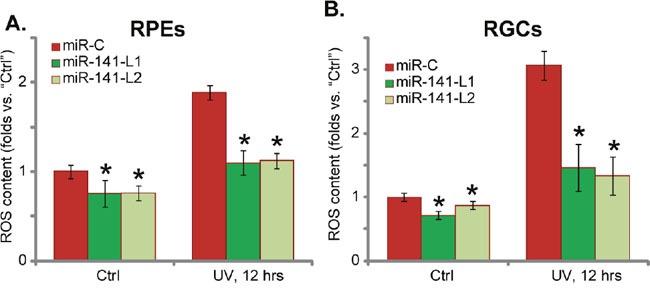
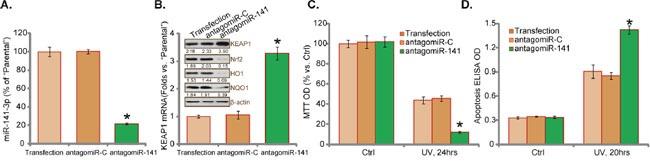
Activation of NF-E2-related factor 2 (Nrf2) signaling could protect cells from ultra violet (UV) radiation. We aim to provoke Nrf2 activation via downregulating its inhibitor Keap1 by microRNA-141 ("miR-141"). In both human retinal pigment epithelium cells (RPEs) and retinal ganglion cells (RGCs), forced-expression of miR-141 downregulated Keap1, causing Nrf2 stabilization, accumulation and nuclear translocation, which led to transcription of multiple antioxidant-responsive element (ARE) genes (HO1, NOQ1 and GCLC). Further, UV-induced reactive oxygen species (ROS) production and cell death were significantly attenuated in miR-141-expressing RPEs and RGCs. On the other hand, depletion of miR-141 via expressing its inhibitor antagomiR-141 led to Keap1 upregulation and Nrf2 degradation, which aggravated UV-induced death of RPEs and RGCs. Significantly, Nrf2 shRNA knockdown almost abolished miR-141-mediated cytoprotection against UV in RPEs. These results demonstrate that miR-141 targets Keap1 to activate Nrf2 signaling, which protects RPEs and RGCs from UV radiation.
激活核因子E2相关因子2(Nrf2)信号通路可保护细胞免受紫外线(UV)辐射。我们旨在通过微小RNA-141(“miR-141”)下调其抑制剂Keap1来激发Nrf2的激活。在人视网膜色素上皮细胞(RPEs)和视网膜神经节细胞(RGCs)中,miR-141的强制表达下调了Keap1,导致Nrf2稳定、积累并发生核转位,进而导致多个抗氧化反应元件(ARE)基因(HO1、NOQ1和GCLC)的转录。此外,在表达miR-141的RPEs和RGCs中,紫外线诱导的活性氧(ROS)产生和细胞死亡显著减轻。另一方面,通过表达其抑制剂抗miR-141来消耗miR-141导致Keap1上调和Nrf2降解,这加剧了紫外线诱导的RPEs和RGCs死亡。值得注意的是,Nrf2短发夹RNA(shRNA)敲低几乎消除了miR-141介导的RPEs对紫外线的细胞保护作用。这些结果表明,miR-141靶向Keap1以激活Nrf2信号通路,从而保护RPEs和RGCs免受紫外线辐射。
 Zotero 插件