García-Marchena Nuria, Araos Pedro Fernando, Barrios Vicente, Sánchez-Marín Laura, Chowen Julie A, Pedraz María, Castilla-Ortega Estela, Romero-Sanchiz Pablo, Ponce Guillermo, Gavito Ana L, Decara Juan, Silva Daniel, Torrens Marta, Argente Jesús, Rubio Gabriel, Serrano Antonia, de Fonseca Fernando Rodríguez, Pavón Francisco Javier
Unidad Gestión Clínica de Salud Mental, Instituto de Investigación Biomédica de Málaga (IBIMA), Hospital Regional Universitario de Málaga, Málaga, Spain; Facultad de Psicología, Universidad Complutense de Madrid, Madrid, Spain.
Unidad Gestión Clínica de Salud Mental, Instituto de Investigación Biomédica de Málaga (IBIMA), Hospital Regional Universitario de Málaga , Málaga , Spain.
Front Psychiatry. 2017 Jan 18;7:214. doi: 10.3389/fpsyt.2016.00214. eCollection 2016.
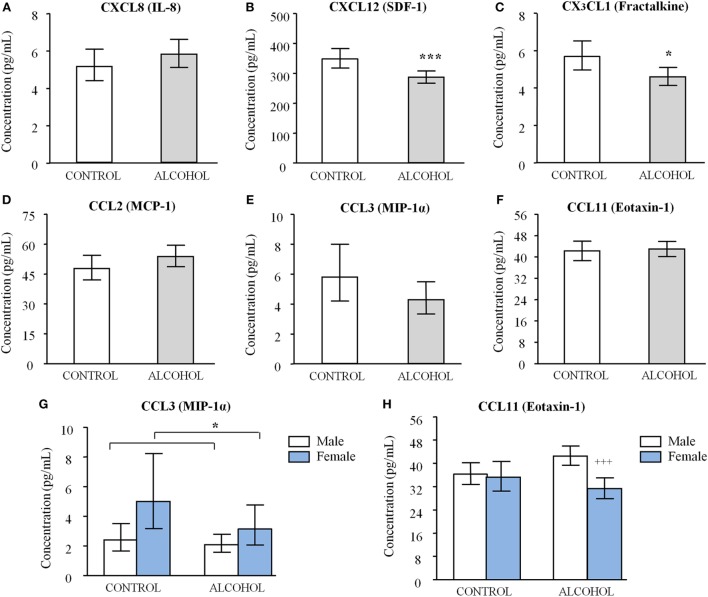
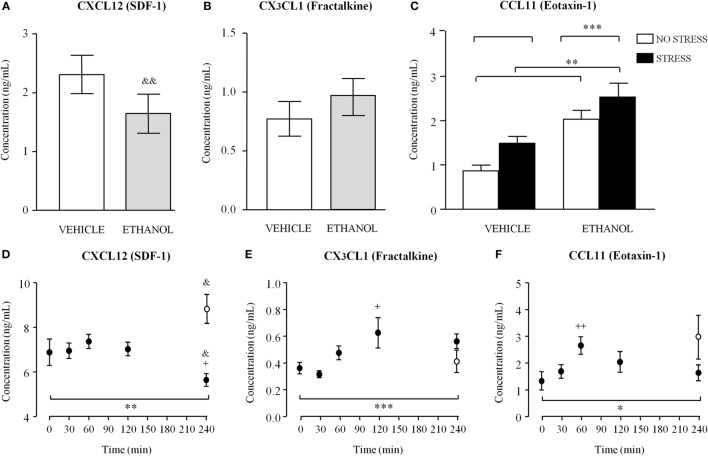
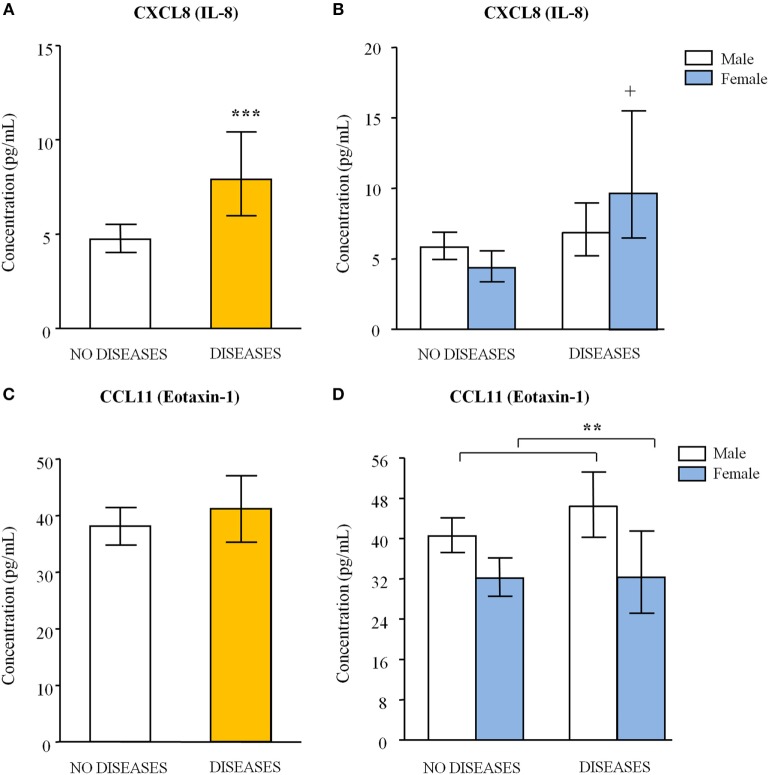
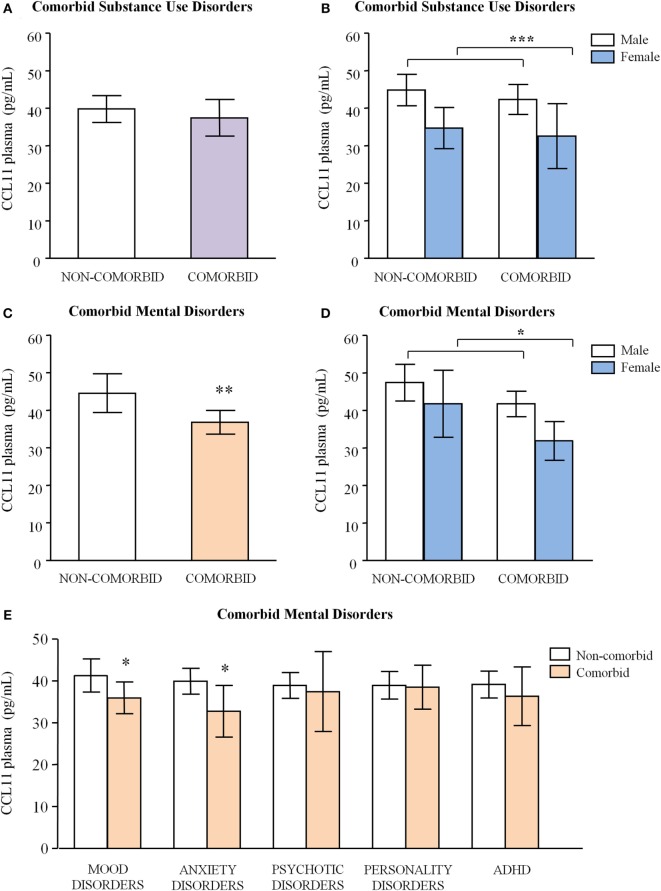
Recent studies have linked changes in peripheral chemokine concentrations to the presence of both addictive behaviors and psychiatric disorders. The present study further explore this link by analyzing the potential association of psychiatry comorbidity with alterations in the concentrations of circulating plasma chemokine in patients of both sexes diagnosed with alcohol use disorders (AUD). To this end, 85 abstinent subjects with AUD from an outpatient setting and 55 healthy subjects were evaluated for substance and mental disorders. Plasma samples were obtained to quantify chemokine concentrations [C-C motif (CC), C-X-C motif (CXC), and C-X-C motif (CXC) chemokines]. Abstinent AUD patients displayed a high prevalence of comorbid mental disorders (72%) and other substance use disorders (45%). Plasma concentrations of chemokines CXCL12/stromal cell-derived factor-1 ( < 0.001) and CXCL1/fractalkine ( < 0.05) were lower in AUD patients compared to controls, whereas CCL11/eotaxin-1 concentrations were strongly decreased in female AUD patients ( < 0.001). In the alcohol group, CXCL8 concentrations were increased in patients with liver and pancreas diseases and there was a significant correlation to aspartate transaminase ( = +0.456, < 0.001) and gamma-glutamyltransferase ( = +0.647, < 0.001). Focusing on comorbid psychiatric disorders, we distinguish between patients with additional mental disorders ( = 61) and other substance use disorders ( = 38). Only CCL11 concentrations were found to be altered in AUD patients diagnosed with mental disorders ( < 0.01) with a strong main effect of sex. Thus, patients with mood disorders ( = 42) and/or anxiety ( = 16) had lower CCL11 concentrations than non-comorbid patients being more evident in women. The alcohol-induced alterations in circulating chemokines were also explored in preclinical models of alcohol use with male Wistar rats. Rats exposed to repeated ethanol (3 g/kg, gavage) had lower CXCL12 ( < 0.01) concentrations and higher CCL11 concentrations ( < 0.001) relative to vehicle-treated rats. Additionally, the increased CCL11 concentrations in rats exposed to ethanol were enhanced by the prior exposure to restraint stress ( < 0.01). Concordantly, acute ethanol exposure induced changes in CXCL12, CXCL1, and CCL11 in the same direction to repeated exposure. These results clearly indicate a contribution of specific chemokines to the phenotype of AUD and a strong effect of sex, revealing a link of CCL11 to alcohol and anxiety/stress.
近期研究已将外周趋化因子浓度的变化与成瘾行为和精神疾病的存在联系起来。本研究通过分析诊断为酒精使用障碍(AUD)的男女患者中精神疾病共病与循环血浆趋化因子浓度改变之间的潜在关联,进一步探究了这种联系。为此,对85名来自门诊的戒酒AUD患者和55名健康受试者进行了物质和精神障碍评估。采集血浆样本以量化趋化因子浓度[C-C基序(CC)、C-X-C基序(CXC)和C-X-C基序(CXC)趋化因子]。戒酒的AUD患者共病精神障碍的患病率较高(72%),其他物质使用障碍的患病率也较高(45%)。与对照组相比,AUD患者血浆趋化因子CXCL12/基质细胞衍生因子-1(<0.001)和CXCL1/ fractalkine(<0.05)的浓度较低,而女性AUD患者CCL11/嗜酸性粒细胞趋化因子-1的浓度显著降低(<0.001)。在酒精组中,患有肝脏和胰腺疾病的患者CXCL8浓度升高,且与天冬氨酸转氨酶(=+0.456,<0.001)和γ-谷氨酰转移酶(=+0.647,<0.001)显著相关。聚焦于共病精神障碍,我们区分了患有其他精神障碍(=61)和其他物质使用障碍(=38)的患者。仅发现诊断为精神障碍的AUD患者中CCL11浓度发生改变(<0.01),且存在显著的性别主效应。因此,患有情绪障碍(=42)和/或焦虑症(=16)的患者CCL11浓度低于无共病的患者,在女性中更为明显。还在雄性Wistar大鼠酒精使用的临床前模型中探究了酒精诱导的循环趋化因子变化。与接受赋形剂处理的大鼠相比,反复暴露于乙醇(3 g/kg,灌胃)的大鼠CXCL12浓度较低(<0.01),CCL11浓度较高(<0.001)。此外,预先暴露于束缚应激可增强暴露于乙醇的大鼠中升高的CCL11浓度(<0.01)。同样,急性乙醇暴露诱导的CXCL12、CXCL1和CCL11变化方向与反复暴露相同。这些结果清楚地表明特定趋化因子对AUD表型有影响,且存在显著的性别效应,揭示了CCL11与酒精及焦虑/应激之间的联系。