
Polder 图:通过排除主体溶剂来改进 OMIT 图。
Polder maps: improving OMIT maps by excluding bulk solvent.
机构信息
Molecular Biophysics and Integrated Bioimaging Division, Lawrence Berkeley National Laboratory (LBNL), Berkeley, CA 94720, USA.
Bioscience Division, Los Alamos National Laboratory, Los Alamos, NM 87545, USA.
出版信息
Acta Crystallogr D Struct Biol. 2017 Feb 1;73(Pt 2):148-157. doi: 10.1107/S2059798316018210.
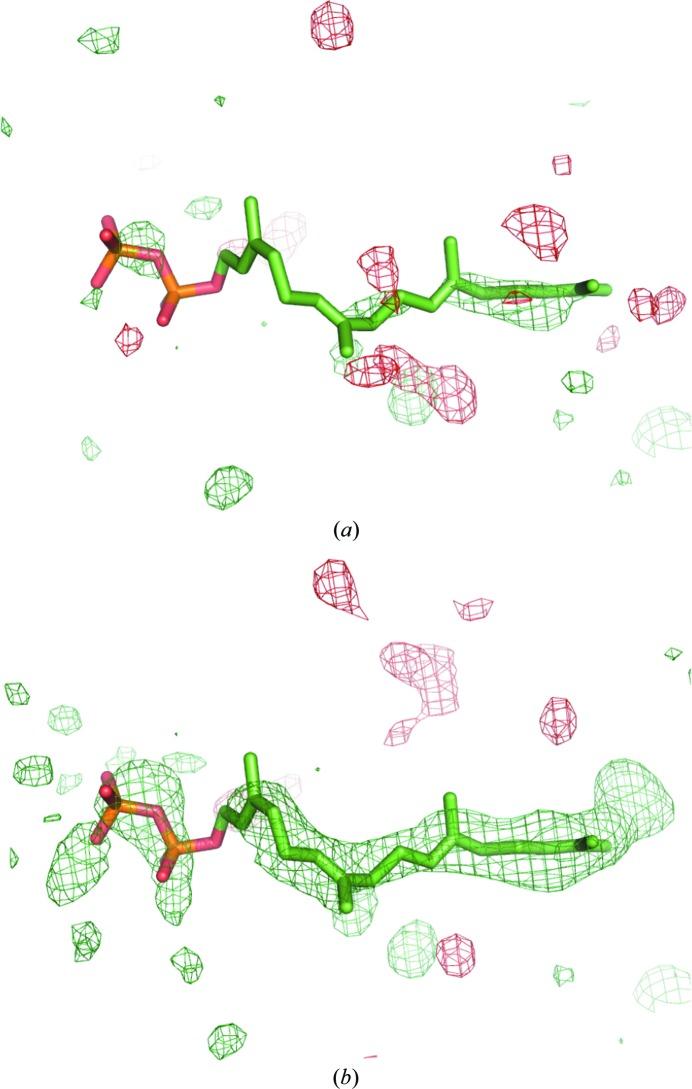
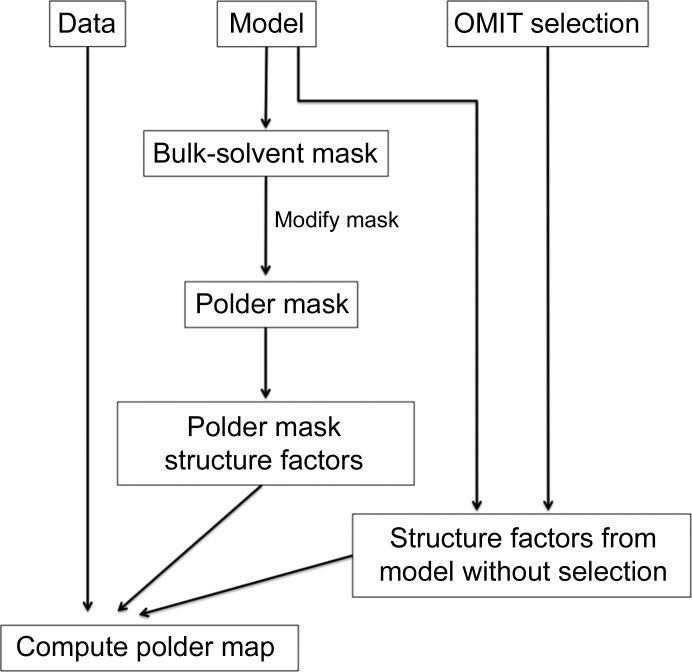
The crystallographic maps that are routinely used during the structure-solution workflow are almost always model-biased because model information is used for their calculation. As these maps are also used to validate the atomic models that result from model building and refinement, this constitutes an immediate problem: anything added to the model will manifest itself in the map and thus hinder the validation. OMIT maps are a common tool to verify the presence of atoms in the model. The simplest way to compute an OMIT map is to exclude the atoms in question from the structure, update the corresponding structure factors and compute a residual map. It is then expected that if these atoms are present in the crystal structure, the electron density for the omitted atoms will be seen as positive features in this map. This, however, is complicated by the flat bulk-solvent model which is almost universally used in modern crystallographic refinement programs. This model postulates constant electron density at any voxel of the unit-cell volume that is not occupied by the atomic model. Consequently, if the density arising from the omitted atoms is weak then the bulk-solvent model may obscure it further. A possible solution to this problem is to prevent bulk solvent from entering the selected OMIT regions, which may improve the interpretative power of residual maps. This approach is called a polder (OMIT) map. Polder OMIT maps can be particularly useful for displaying weak densities of ligands, solvent molecules, side chains, alternative conformations and residues both in terminal regions and in loops. The tools described in this manuscript have been implemented and are available in PHENIX.
在结构解析工作流程中经常使用的晶体学映射图几乎总是基于模型的,因为模型信息用于其计算。由于这些映射图也用于验证通过建模和精修得到的原子模型,这就构成了一个直接的问题:添加到模型中的任何内容都会在映射图中显现出来,从而阻碍验证。排除映射图(OMIT map)是验证模型中原子存在的常用工具。计算 OMIT 映射图的最简单方法是从结构中排除有问题的原子,更新相应的结构因子并计算残差映射图。然后,如果这些原子存在于晶体结构中,则在该映射图中会看到被省略原子的电子密度呈现为正特征。然而,这被现代晶体学精修程序中几乎普遍使用的平坦溶剂模型复杂化了。该模型假设在不被原子模型占据的晶胞体积的任何体素中都存在恒定的电子密度。因此,如果由于省略的原子而产生的密度较弱,则溶剂模型可能会进一步掩盖它。解决此问题的一种可能方法是防止溶剂进入所选的排除区域,这可能会提高残差映射图的解释能力。这种方法称为屏蔽(OMIT)图。屏蔽 OMIT 映射图对于显示配体、溶剂分子、侧链、替代构象和末端区域和环中的残基的弱密度特别有用。本文档中描述的工具已实现并可在 PHENIX 中使用。




 Zotero 插件