Hodes Aaron, Lodish Maya B, Tirosh Amit, Meyer Jerrold, Belyavskaya Elena, Lyssikatos Charalampos, Rosenberg Kendra, Demidowich Andrew, Swan Jeremy, Jonas Nichole, Stratakis Constantine A, Zilbermint Mihail
Section on Endocrinology and Genetics, Eunice Kennedy Shriver National Institute of Child Health and Human Development, National Institutes of Health, Bethesda, MD, 20892, USA.
Albert Einstein College of Medicine, Department of Radiology, Jacobi Medical Center, Bronx, NY, 10461, USA.
Endocrine. 2017 Apr;56(1):164-174. doi: 10.1007/s12020-017-1231-7. Epub 2017 Feb 13.
Hair cortisol evaluation has been used to help detect patients with suspected Cushing syndrome. Our goal was to correlate segmental hair cortisol with biochemical testing in patients with Cushing syndrome and controls. This study was a prospective analysis of hair cortisol in confirmed Cushing syndrome cases over 16 months.
Thirty-six subjects (26.5 ± 18.9 years, 75% female, and 75% Caucasian) were analyzed by diurnal serum cortisol, 24 h urinary free cortisol corrected for body surface area (UFC/BSA), and 24 h urinary 17-hydroxysteroids corrected for creatinine (17OHS/Cr). Thirty patients were diagnosed with Cushing syndrome, and six were defined as controls. 3-cm hair samples nearest to the scalp, cut into 1-cm segments (proximal, medial, and distal), were analyzed for cortisol by enzyme immunoassay and measured as pmol cortisol/g dry hair. Hair cortisol levels were compared with laboratory testing done within previous 2 months of the evaluation.
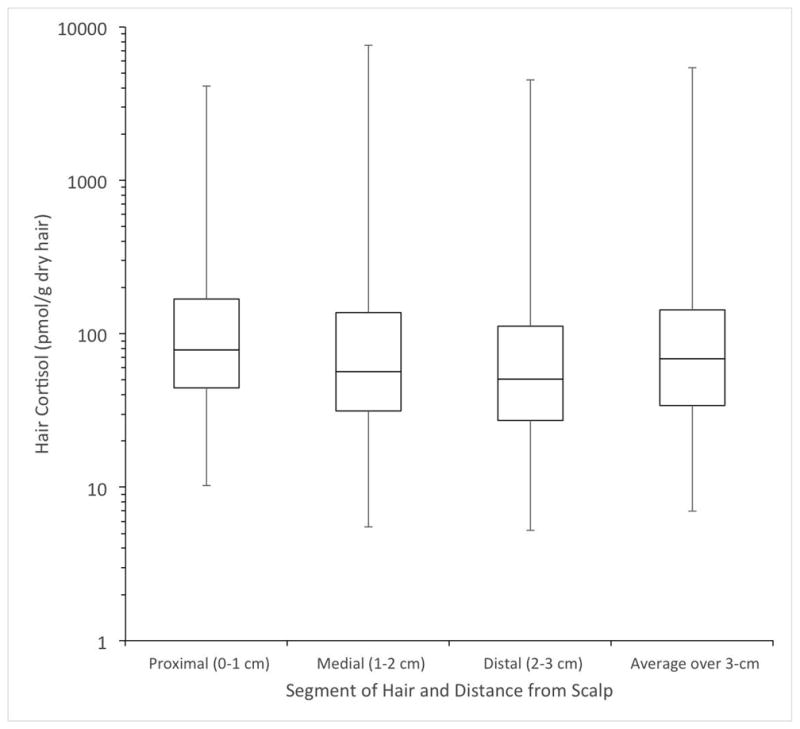
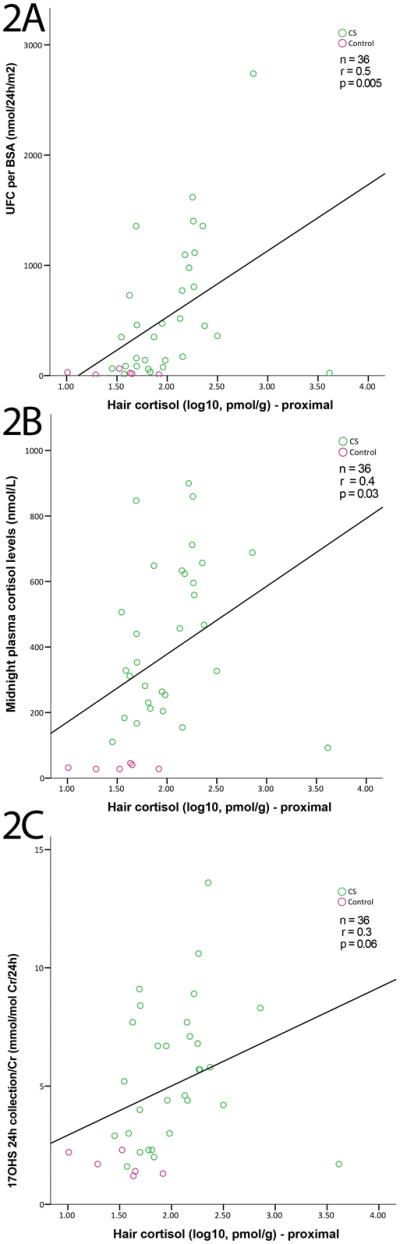
Proximal hair cortisol was higher in Cushing syndrome patients (266.6 ± 738.4 pmol/g) than control patients (38.9 ± 25.3 pmol/g) (p = 0.003). Proximal hair cortisol was highest of all segments in 25/36 (69%) patients. Among all subjects, proximal hair cortisol was strongly correlated with UFC/BSA (r = 0.5, p = 0.005), midnight serum cortisol (r = 0.4, p = 0.03), and 17OHS/Cr, which trended towards significance (r = 0.3, p = 0.06).
Among the three examined hair segments, proximal hair contained the highest cortisol levels and correlated the most with the initial biochemical tests for Cushing syndrome in our study. Further studies are needed to validate proximal hair cortisol in the diagnostic workup for Cushing syndrome.
毛发皮质醇评估已被用于帮助检测疑似库欣综合征的患者。我们的目标是将库欣综合征患者和对照组的节段性毛发皮质醇与生化检测结果进行关联。本研究是对确诊的库欣综合征病例进行为期16个月的前瞻性毛发皮质醇分析。
对36名受试者(年龄26.5±18.9岁,75%为女性,75%为白种人)进行了日间血清皮质醇、校正体表面积后的24小时尿游离皮质醇(UFC/BSA)以及校正肌酐后的24小时尿17-羟类固醇(17OHS/Cr)分析。30例患者被诊断为库欣综合征,6例被定义为对照组。采集距头皮最近的3厘米头发样本,切成1厘米的节段(近端、中间和远端),通过酶免疫测定法分析皮质醇,以皮摩尔皮质醇/克干发为单位进行测量。将毛发皮质醇水平与评估前2个月内进行的实验室检测结果进行比较。
库欣综合征患者近端毛发皮质醇水平(266.6±738.4皮摩尔/克)高于对照组患者(38.9±25.3皮摩尔/克)(p=0.003)。在25/36(69%)的患者中,近端毛发皮质醇在所有节段中最高。在所有受试者中,近端毛发皮质醇与UFC/BSA(r=0.5,p=0.005)、午夜血清皮质醇(r=0.4,p=0.03)以及17OHS/Cr(r=0.3,p=0.06,有显著趋势)密切相关。
在本研究中,在所检测的三个毛发节段中,近端毛发的皮质醇水平最高,且与库欣综合征的初始生化检测相关性最强。需要进一步研究以验证近端毛发皮质醇在库欣综合征诊断检查中的作用。