
CCR7-CCL19/CCL21轴对于后肢缺血小鼠模型中的有效动脉生成至关重要。
CCR7-CCL19/CCL21 Axis is Essential for Effective Arteriogenesis in a Murine Model of Hindlimb Ischemia.
作者信息
Nossent A Yaël, Bastiaansen Antonius J N M, Peters Erna A B, de Vries Margreet R, Aref Zeen, Welten Sabine M J, de Jager Saskia C A, van der Pouw Kraan Tineke C T M, Quax Paul H A
机构信息
Department of Surgery, Leiden University Medical Center, Leiden, the Netherlands
Einthoven Laboratory for Experimental Vascular Medicine, Leiden University Medical Center, Leiden, the Netherlands.
出版信息
J Am Heart Assoc. 2017 Mar 8;6(3):e005281. doi: 10.1161/JAHA.116.005281.
BACKGROUND
In order to identify factors that stimulate arteriogenesis after ischemia, we followed gene expression profiles in two extreme models for collateral artery formation over 28 days after hindlimb ischemia, namely "good-responding" C57BL/6 mice and "poor-responding" BALB/c mice.
METHODS AND RESULTS
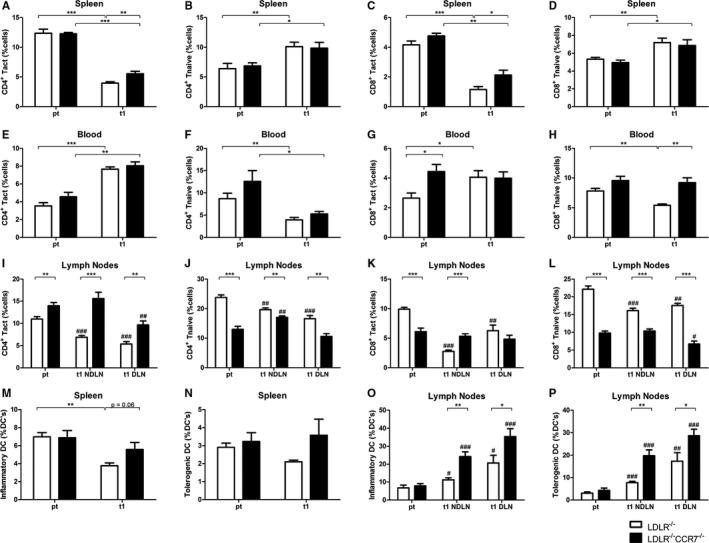
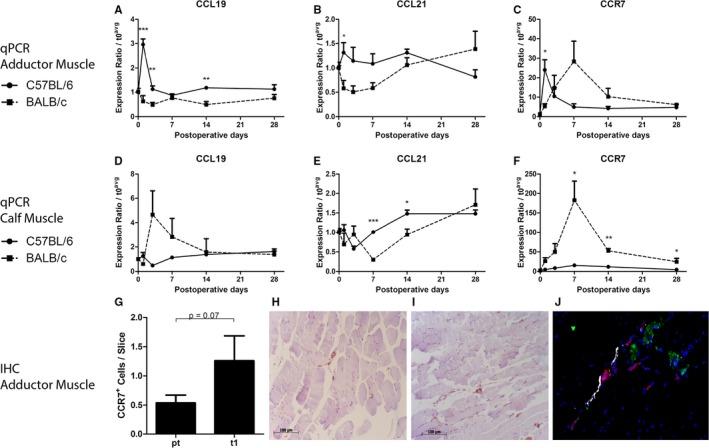
Although BALB/c mice show very poor blood flow recovery after ischemia, most known proarteriogenic genes were upregulated more excessively and for a longer period than in C57BL/6 mice. In clear contrast, chemokine genes , , and and the chemokine receptor were upregulated in C57BL/6 mice 1 day after hindlimb ischemia, but not in BALB/C mice. CCL19 and CCL21 regulate migration and homing of T lymphocytes via CCR7. When subjecting CCR7/LDLR mice to hindlimb ischemia, we observed a 20% reduction in blood flow recovery compared with that in LDLR mice. Equal numbers of α-smooth muscle actin-positive collateral arteries were found in the adductor muscles of both mouse strains, but collateral diameters were smaller in the CCR7/LDLR. Fluorescence-activated cell sorter analyses showed that numbers of CCR7 T lymphocytes (both CD4 and CD8) were decreased in the spleen and increased in the blood at day 1 after hindlimb ischemia in LDLR mice. At day 1 after hindlimb ischemia, however, numbers of activated CD4 T lymphocytes were decreased in the draining lymph nodes of LDLR mice compared with CCR7/LDLR mice.
CONCLUSIONS
These data show that CCR7-CCL19/CCL21 axis facilitates retention CD4 T lymphocytes at the site of collateral artery remodeling, which is essential for effective arteriogenesis.
背景
为了确定缺血后刺激动脉生成的因素,我们在两种极端的后肢缺血后28天侧支动脉形成模型中追踪基因表达谱,即“反应良好”的C57BL/6小鼠和“反应不佳”的BALB/c小鼠。
方法与结果
尽管BALB/c小鼠缺血后血流恢复很差,但大多数已知的促动脉生成基因比C57BL/6小鼠上调得更过度且持续时间更长。与之形成鲜明对比的是,趋化因子基因CCL19、CCL21和CCL25以及趋化因子受体CCR7在C57BL/6小鼠后肢缺血1天后上调,而在BALB/C小鼠中未上调。CCL19和CCL21通过CCR7调节T淋巴细胞的迁移和归巢。当使CCR7/LDLR小鼠后肢缺血时,我们观察到与LDLR小鼠相比,血流恢复降低了20%。在两种小鼠品系的内收肌中发现了数量相等的α平滑肌肌动蛋白阳性侧支动脉,但CCR7/LDLR小鼠的侧支直径较小。荧光激活细胞分选分析显示,LDLR小鼠后肢缺血1天后,脾脏中CCR7 T淋巴细胞(CD4和CD8)数量减少,血液中数量增加。然而,在后肢缺血1天时,与CCR7/LDLR小鼠相比,LDLR小鼠引流淋巴结中活化的CD4 T淋巴细胞数量减少。
结论
这些数据表明,CCR7-CCL19/CCL21轴促进CD4 T淋巴细胞在侧支动脉重塑部位的滞留,这对有效的动脉生成至关重要。




 Zotero 插件