
使用三脚架式微型钛板的骨整合手指假体
Osseointegrated Finger Prostheses Using a Tripod Titanium Mini-Plate.
作者信息
Manrique Oscar J, Ciudad Pedro, Doscher Matthew, Lo Torto Federico, Liebling Ralph, Galan Ricardo
机构信息
Department of Plastic and Reconstructive Surgery, China Medical University Hospital, Taichung, Taiwan.
Division of Plastic and Reconstructive Surgery, Albert Einstein College of Medicine, New York, NY, USA.
出版信息
Arch Plast Surg. 2017 Mar;44(2):150-156. doi: 10.5999/aps.2017.44.2.150. Epub 2017 Mar 15.
BACKGROUND
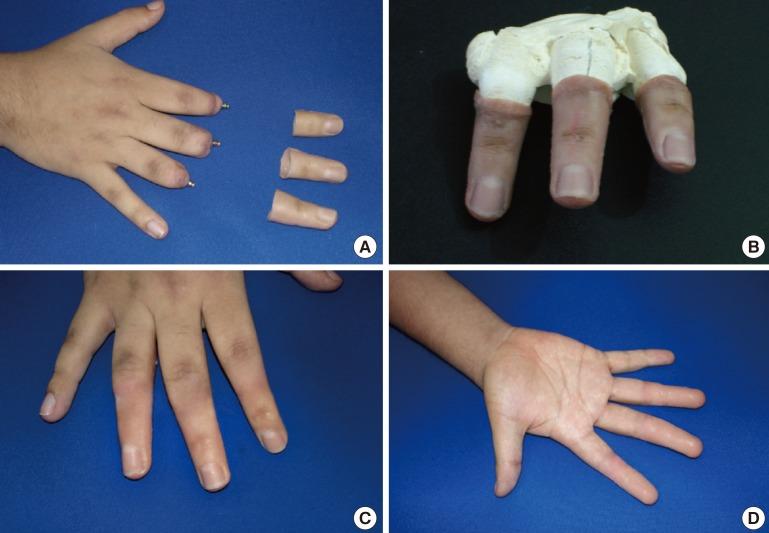
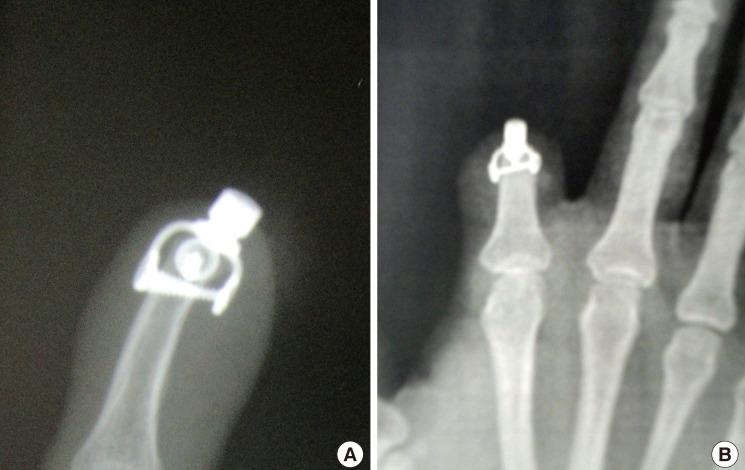
Digital amputation is a common upper extremity injury and can cause significant impairment in hand function, as well as psychosocial stigma. Currently, the gold standard for the reconstruction of such injuries involves autologous reconstruction. However, when this or other autologous options are not available, prosthetic reconstruction can provide a functionally and aesthetically viable alternative. This study describes a novel technique, known as a tripod titanium mini-plate, for osseointegrated digit prostheses, and reviews the outcomes in a set of consecutive patients.
METHODS
A retrospective review of patients who underwent 2-stage prosthetic reconstruction of digit amputations was performed. Demographic information, occupation, mechanism of injury, number of amputated fingers, and level of amputation were reviewed. Functional and aesthetic outcomes were assessed using the quick disabilities of the arm, shoulder, and hand (Q-DASH) scale and a visual analog scale (VAS) score, respectively. In addition, complications during the postoperative period were recorded.
RESULTS
Seven patients were included in this study. Their average age was 29 years. Five patients had single-digit amputations and 2 patients had multiple-digit amputations. Functional and aesthetic outcomes were assessed using the Q-DASH score (average, 10.4) and VAS score (average, 9.1), respectively. One episode of mild cellulitis was seen at 24 months of follow-up. However, it was treated successfully with oral antibiotics. No other complications were reported.
CONCLUSIONS
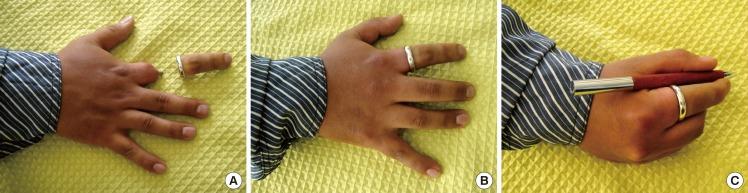
When autologous reconstruction is not suitable for digit reconstruction, prosthetic osseointegrated reconstruction can provide good aesthetic and functional results. However, larger series with longer-term follow-up are required in order to rule out the possibility of other complications.
背景
手指离断是一种常见的上肢损伤,可导致手部功能严重受损以及心理社会层面的耻辱感。目前,此类损伤重建的金标准是自体组织重建。然而,当无法采用这种或其他自体组织方案时,假体重建可提供功能和美观上可行的替代方案。本研究描述了一种用于骨整合式手指假体的新技术,即三脚架钛微型钢板,并回顾了一组连续患者的治疗结果。
方法
对接受两阶段手指离断假体重建的患者进行回顾性研究。回顾了人口统计学信息、职业、损伤机制、离断手指数量和离断水平。分别使用手臂、肩部和手部快速功能障碍量表(Q-DASH)和视觉模拟量表(VAS)评分评估功能和美观结果。此外,记录术后并发症。
结果
本研究纳入7例患者。他们的平均年龄为29岁。5例患者为单指离断,2例患者为多指离断。分别使用Q-DASH评分(平均10.4)和VAS评分(平均9.1)评估功能和美观结果。随访24个月时出现1例轻度蜂窝织炎。然而,通过口服抗生素成功治愈。未报告其他并发症。
结论
当自体组织重建不适合手指重建时,骨整合式假体重建可提供良好的美观和功能效果。然而,需要更大规模的系列研究和更长时间的随访以排除其他并发症的可能性。


 Zotero 插件