Sakka Laurent, Delétage Nathalie, Chalus Maryse, Aissouni Youssef, Sylvain-Vidal Valérie, Gobron Stéphane, Coll Guillaume
Laboratoire d'Anatomie et d'Organogenèse, Laboratoire de Biophysique Sensorielle, NeuroDol, Faculté de Médecine, Université Clermont Auvergne, F-63000 Clermont-Ferrand, France.
Service de Neurochirurgie, Pole RMND, CHU de Clermont-Ferrand, Hôpital Gabriel-Montpied, 63003 Clermont-Ferrand Cedex, France.
Oncotarget. 2017 Jun 27;8(26):42789-42807. doi: 10.18632/oncotarget.17050.
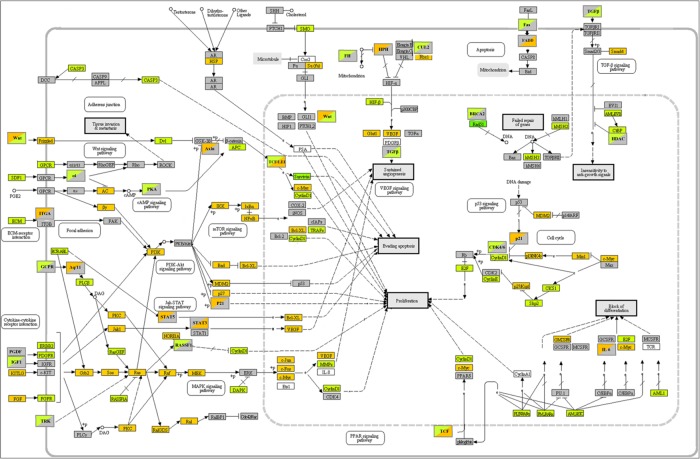
Selective serotonin reuptake inhibitors (SSRI) are common antidepressants which cytotoxicity has been assessed in cancers notably colorectal carcinomas and glioma cell lines. We assessed and compared the cytotoxicity of 2 SSRI, citalopram and escitalopram, on neuroblastoma cell lines. The study was performed on 2 non-MYCN amplified cell lines (rat B104 and human SH-SY5Y) and 2 human MYCN amplified cell lines (IMR32 and Kelly). Citalopram and escitalopram showed concentration-dependent cytotoxicity on all cell lines. Citalopram was more cytotoxic than escitalopram. IMR32 was the most sensitive cell line. The absence of toxicity on human primary Schwann cells demonstrated the safety of both molecules for myelin. The mechanisms of cytotoxicity were explored using gene-expression profiles and quantitative real-time PCR (qPCR). Citalopram modulated 1 502 genes and escitalopram 1 164 genes with a fold change ≥ 2. 1 021 genes were modulated by both citalopram and escitalopram; 481 genes were regulated only by citalopram while 143 genes were regulated only by escitalopram. Citalopram modulated 69 pathways (KEGG) and escitalopram 42. Ten pathways were differently modulated by citalopram and escitalopram. Citalopram drastically decreased the expression of MYBL2, BIRC5 and BARD1 poor prognosis factors of neuroblastoma with fold-changes of -107 (p<2.26 10-7), -24.1 (p<5.6 10-9) and -17.7 (p<1.2 10-7). CCNE1, AURKA, IGF2, MYCN and ERBB2 were more moderately down-regulated by both molecules. Glioma markers E2F1, DAPK1 and CCND1 were down-regulated. Citalopram displayed more powerful action with broader and distinct spectrum of action than escitalopram.
选择性5-羟色胺再摄取抑制剂(SSRI)是常见的抗抑郁药,其细胞毒性已在癌症尤其是结肠直肠癌和胶质瘤细胞系中得到评估。我们评估并比较了两种SSRI(西酞普兰和艾司西酞普兰)对神经母细胞瘤细胞系的细胞毒性。该研究在2种非MYCN扩增细胞系(大鼠B104和人SH-SY5Y)以及2种人MYCN扩增细胞系(IMR32和凯利)上进行。西酞普兰和艾司西酞普兰在所有细胞系上均表现出浓度依赖性细胞毒性。西酞普兰的细胞毒性比艾司西酞普兰更强。IMR32是最敏感的细胞系。对人原代雪旺细胞无毒性证明了这两种分子对髓磷脂的安全性。使用基因表达谱和定量实时PCR(qPCR)探索细胞毒性机制。西酞普兰调节了1502个基因,艾司西酞普兰调节了1164个基因,倍数变化≥2。1021个基因同时被西酞普兰和艾司西酞普兰调节;481个基因仅被西酞普兰调节,而143个基因仅被艾司西酞普兰调节。西酞普兰调节了69条通路(KEGG),艾司西酞普兰调节了42条。10条通路被西酞普兰和艾司西酞普兰不同地调节。西酞普兰显著降低了神经母细胞瘤预后不良因素MYBL2、BIRC5和BARD1的表达,倍数变化分别为-107(p<2.26×10⁻⁷)、-24.1(p<5.6×10-9)和-17.7(p<1.2×10-7)。CCNE1、AURKA、IGF2、MYCN和ERBB2被这两种分子更适度地下调。胶质瘤标志物E2F1、DAPK1和CCND1被下调。与艾司西酞普兰相比,西酞普兰表现出更强有力的作用,且作用谱更广泛、更独特。