
微波合成法制备的介孔二氧化硅材料对重金属的吸附研究
Investigating the Heavy Metal Adsorption of Mesoporous Silica Materials Prepared by Microwave Synthesis.
作者信息
Zhu Wenjie, Wang Jingxuan, Wu Di, Li Xitong, Luo Yongming, Han Caiyun, Ma Wenhui, He Sufang
机构信息
Faculty of Environmental Science and Engineering, Kunming University of Science and Technology, Kunming, 650500, China.
Faculty of Metallurgical and Energy Engineering, Kunming University of Science and Technology, Kunming, 650093, China.
出版信息
Nanoscale Res Lett. 2017 Dec;12(1):323. doi: 10.1186/s11671-017-2070-4. Epub 2017 May 4.
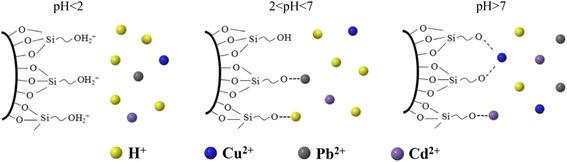
Mesoporous silica materials (MSMs) of the MCM-41 type were rapidly synthesized by microwave heating using silica fume as silica source and evaluated as adsorbents for the removal of Cu, Pb, and Cd from aqueous solutions. The effects of microwave heating times on the pore structure of the resulting MSMs were investigated as well as the effects of different acids which were employed to adjust the solution pH during the synthesis. The obtained MCM-41 samples were characterized by nitrogen adsorption-desorption analyses, X-ray powder diffraction, and transmission electron microscopy. The results indicated that microwave heating method can significantly reduce the synthesis time of MCM-41 to 40 min. The MCM-41 prepared using citric acid (c-MCM-41(40)) possessed more ordered hexagonal mesostructure, higher pore volume, and pore diameter. We also explored the ability of c-MCM-41(40) for removing heavy metal ions (Cu, Pb, and Cd) from aqueous solution and evaluated the influence of pH on its adsorption capacity. In addition, the adsorption isotherms were fitted by Langmuir and Freundlich models, and the adsorption kinetics were assessed using pseudo-first-order and pseudo-second-order models. The intraparticle diffusion model was studied to understand the adsorption process and mechanism. The results confirmed that the as-synthesized adsorbent could efficiently remove the heavy metal ions from aqueous solution at pH range of 5-7. The adsorption isotherms obeyed the Langmuir model, and the maximum adsorption capacities of the adsorbent for Cu, Pb, and Cd were 36.3, 58.5, and 32.3 mg/g, respectively. The kinetic data were well fitted to the pseudo-second-order model, and the results of intraparticle diffusion model showed complex chemical reaction might be involved during adsorption process.
以硅灰为硅源,通过微波加热快速合成了MCM - 41型介孔二氧化硅材料(MSMs),并将其作为吸附剂用于去除水溶液中的铜、铅和镉。研究了微波加热时间对所得MSMs孔结构的影响,以及合成过程中用于调节溶液pH值的不同酸的影响。通过氮气吸附 - 脱附分析、X射线粉末衍射和透射电子显微镜对所得MCM - 41样品进行了表征。结果表明,微波加热法可将MCM - 4l的合成时间显著缩短至40分钟。用柠檬酸制备的MCM - 41(c - MCM - 41(40))具有更有序的六方介孔结构、更高的孔体积和孔径。我们还研究了c - MCM - 41(40)从水溶液中去除重金属离子(铜、铅和镉)的能力,并评估了pH值对其吸附容量的影响。此外,用Langmuir和Freundlich模型拟合吸附等温线,并用准一级和准二级模型评估吸附动力学。研究了颗粒内扩散模型以了解吸附过程和机理。结果证实,合成的吸附剂在pH值为5 - 7的范围内能有效地从水溶液中去除重金属离子。吸附等温线符合Langmuir模型,吸附剂对铜、铅和镉的最大吸附容量分别为36.3、58.5和32.3 mg/g。动力学数据与准二级模型拟合良好,颗粒内扩散模型的结果表明吸附过程可能涉及复杂的化学反应。



 Zotero 插件