Coutinho Teresa A, Wingfield Michael J
Department of Microbiology and Plant Pathology, Forestry and Agricultural Biotechnology Institute, University of PretoriaPretoria, South Africa.
Front Plant Sci. 2017 May 11;8:761. doi: 10.3389/fpls.2017.00761. eCollection 2017.
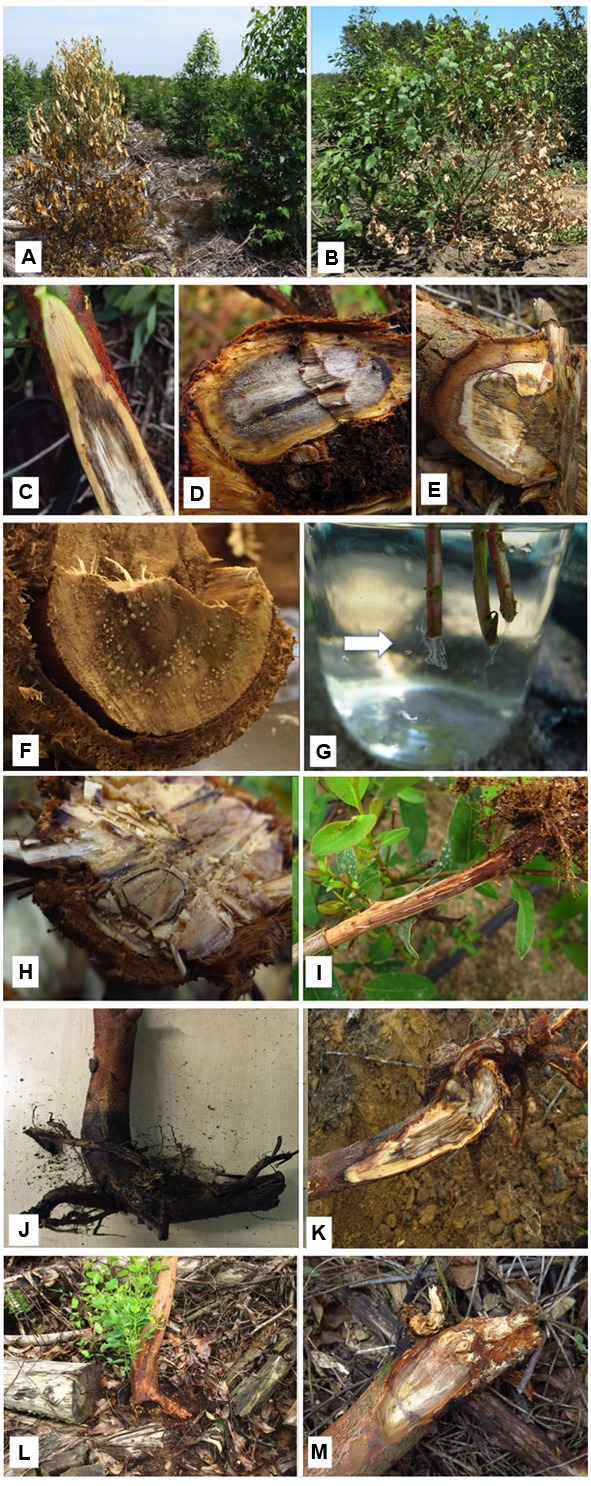
and are well known primary pathogens of herbaceous crops. Reports of wilt caused by these pathogens in tree species are limited other than on species. Despite the widespread occurrence of so-called bacterial wilt on eucalypts in tropical and sub-tropical parts of Africa, Asia, and the Americas, there remain many contradictions relating to the disease. Our field observations over many years in most regions where the disease occurs on show that it is always associated with trees that have been subjected to severe stress. The disease is typically diagnosed by immersing cut stems in water and observing bacterial streaming, but the identity of the bacteria within this suspension is seldom considered. To add to the confusion, pathogenicity tests on susceptible species or clones are rarely successful. When they do work, they are on small plants in greenhouse trials. It has become all to easy to attribute death exclusively to infection. Our data strongly suggest that species and probably other bacteria are latent colonists commonly occurring in healthy and particularly clonally propagated eucalypts. The onset of stress factors provide the bacteria with an opportunity to develop. We believe that the resulting stress weakens the defense systems of the trees allowing and bacterial endophytes to proliferate. Overall our research suggests that and are not primary pathogens of . Short of clear evidence that they are primary pathogens of it is inappropriate to attribute this disease solely to infection by species.
[具体病原菌名称1]和[具体病原菌名称2]是草本作物中广为人知的主要病原菌。除了[具体树种名称]外,关于这些病原菌在其他树种上引起枯萎病的报道有限。尽管在非洲、亚洲和美洲的热带和亚热带地区,桉树所谓的细菌性枯萎病普遍发生,但关于这种病害仍存在许多矛盾之处。我们在该病发生的大多数地区进行了多年的实地观察,发现它总是与遭受严重胁迫的树木有关。该病通常通过将切割的茎浸入水中并观察细菌溢出来诊断,但很少考虑该悬浮液中细菌的身份。更令人困惑的是,对易感物种或无性系进行的致病性测试很少成功。即便成功,也只是在温室试验中的小植株上。人们很容易将[具体树种名称]的死亡完全归因于[具体病原菌名称1]感染。我们的数据强烈表明,[具体病原菌名称1]以及可能的其他细菌是健康的尤其是无性繁殖的桉树上常见的潜伏性定殖菌。胁迫因素的出现为这些细菌提供了发展的机会。我们认为,由此产生的胁迫削弱了树木的防御系统,使[具体病原菌名称1]和细菌内生菌得以增殖。总体而言,我们的研究表明,[具体病原菌名称1]和[具体病原菌名称2]不是[具体树种名称]的主要病原菌。在没有明确证据表明它们是[具体树种名称]的主要病原菌的情况下,仅将这种病害归因于[具体病原菌名称1]物种的感染是不合适的。