Seo Yunhee, Kim Young Ho
Department of Agricultural Biotechnology and Research Institute of Agriculture and Life Sciences, Seoul National University, Seoul 08826, Korea.
Plant Pathol J. 2017 Jun;33(3):249-263. doi: 10.5423/PPJ.OA.02.2017.0026. Epub 2017 Jun 1.
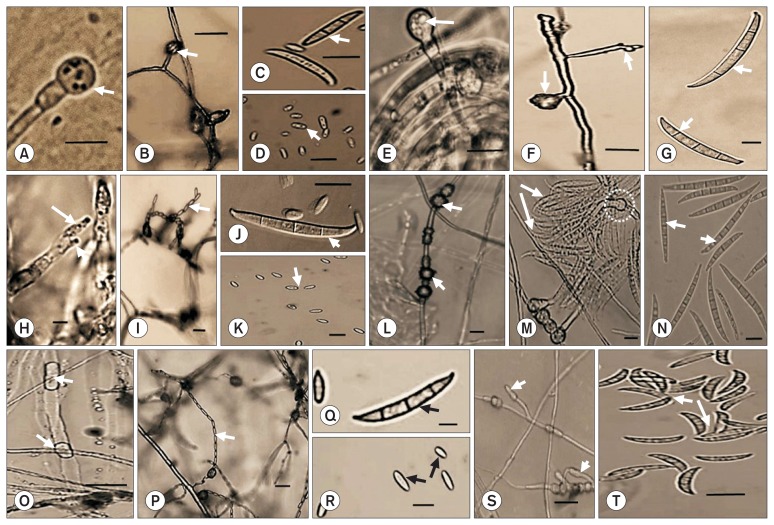
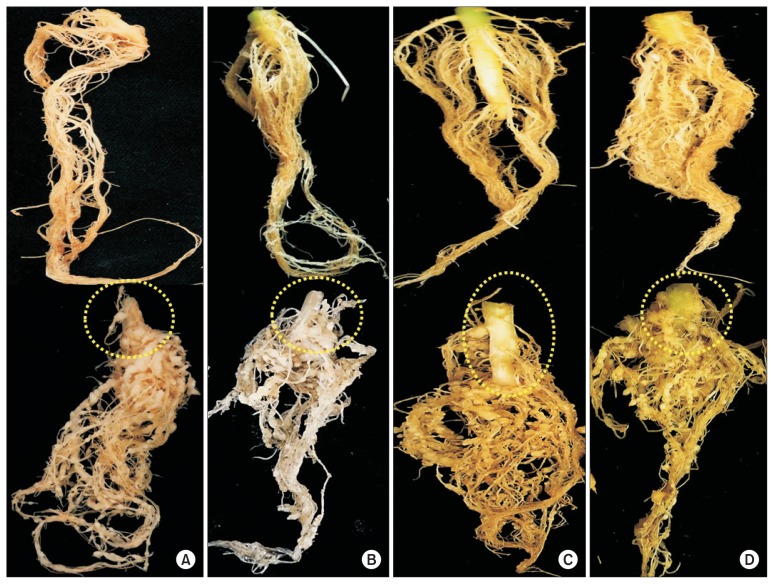
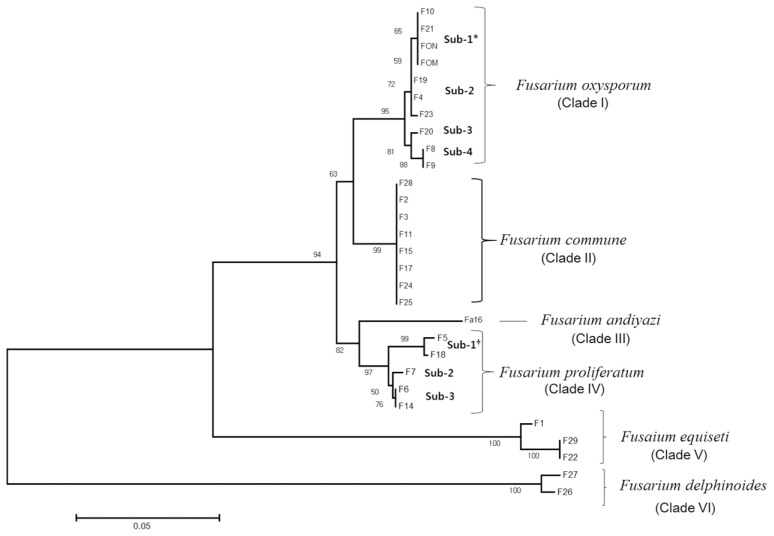
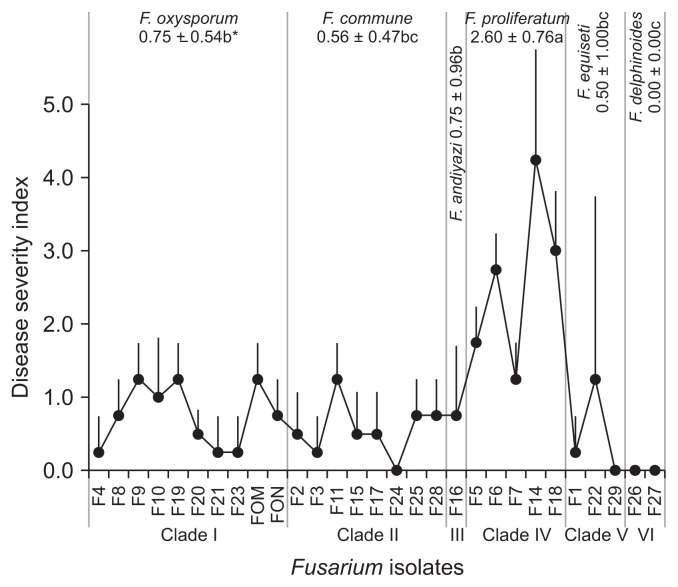
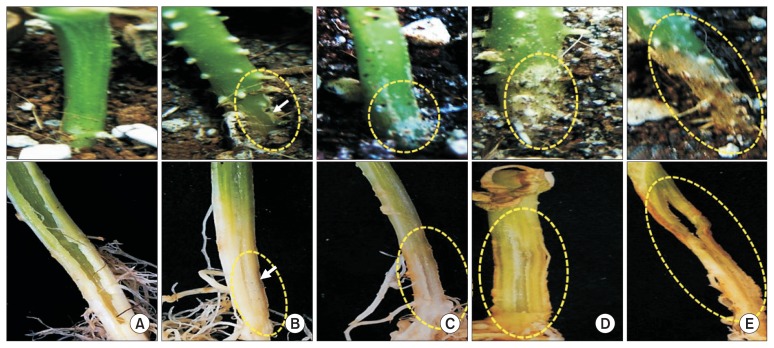
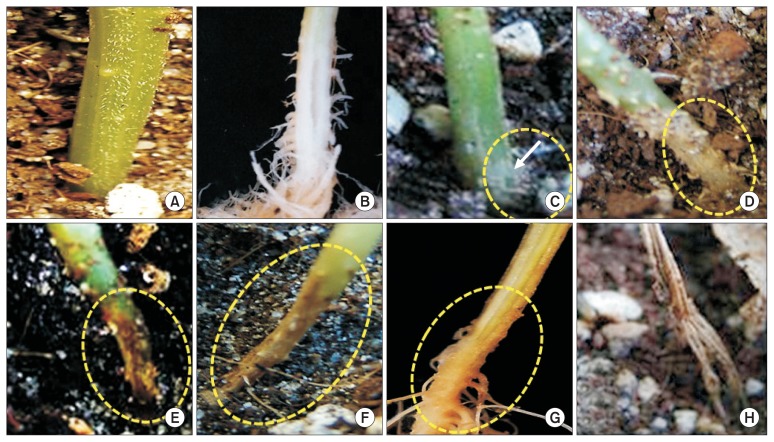
This study aims to examine the potential reasons for the current prevalence of the fusarium wilt in the oriental melon. Twenty-seven isolates obtained from oriental melon greenhouses in 2010-2011 were identified morphologically and by analysis of gene () and internal transcribed spacer (ITS) rDNA sequences as 6 species (8 isolates of , 8 , 5 , 3 , 2 , and 1 ), which were classified as same into 6 sequence-based phylogenetic clades. Pathogenicity of the isolates on the oriental melon was highest in , next in and , and lowest in the other species tested, suggesting and were major pathogens of the oriental melon, inducing stem rots and vascular wilts, respectively. Oriental melon and watermelon were more susceptible to than shintosa and cucumber; and cucumber was most, oriental melon and watermelon, medially, and shintosa was least susceptible to , whose virulence varied among and within their phylogenetic subclades. Severe root-knot galls were formed on all the crops infected with ; however, little indication of vascular wilts or stem and/or root rots was shown by the nematode infection. These results suggest the current fungal disease in the oriental melon may be rarely due to virulence changes of the fusarium wilt pathogen and the direct cause of the severe root-knot nematode infection, but may be potentially from other pathogen infection that produces seemingly wilting caused by severe stem rotting.
本研究旨在探究当前东方甜瓜枯萎病流行的潜在原因。对2010 - 2011年从东方甜瓜温室中分离得到的27个菌株进行了形态学鉴定,并通过基因()和内转录间隔区(ITS)核糖体DNA序列分析,确定为6个种(尖孢镰刀菌8株、层出镰刀菌8株、木贼镰刀菌5株、茄病镰刀菌3株、串珠镰刀菌2株和半裸镰刀菌1株),它们被归为基于序列的6个系统发育分支。这些菌株对东方甜瓜的致病性在尖孢镰刀菌中最高,层出镰刀菌和木贼镰刀菌次之,在所测试的其他菌种中最低,表明尖孢镰刀菌和层出镰刀菌分别是导致东方甜瓜茎腐病和维管束枯萎病的主要病原菌。东方甜瓜和西瓜比新土佐番茄和黄瓜更易感染尖孢镰刀菌;黄瓜最易感,东方甜瓜和西瓜次之,新土佐番茄最不易感,其毒力在系统发育亚分支之间和内部存在差异。所有感染南方根结线虫的作物上都形成了严重的根结瘤;然而,线虫感染几乎没有显示出维管束枯萎病或茎腐病和/或根腐病的迹象。这些结果表明,当前东方甜瓜的真菌病害可能很少是由于枯萎病病原菌的毒力变化以及严重根结线虫感染的直接原因,而可能潜在地源于其他病原菌感染,这些病原菌通过严重的茎腐病导致看似枯萎的症状。